
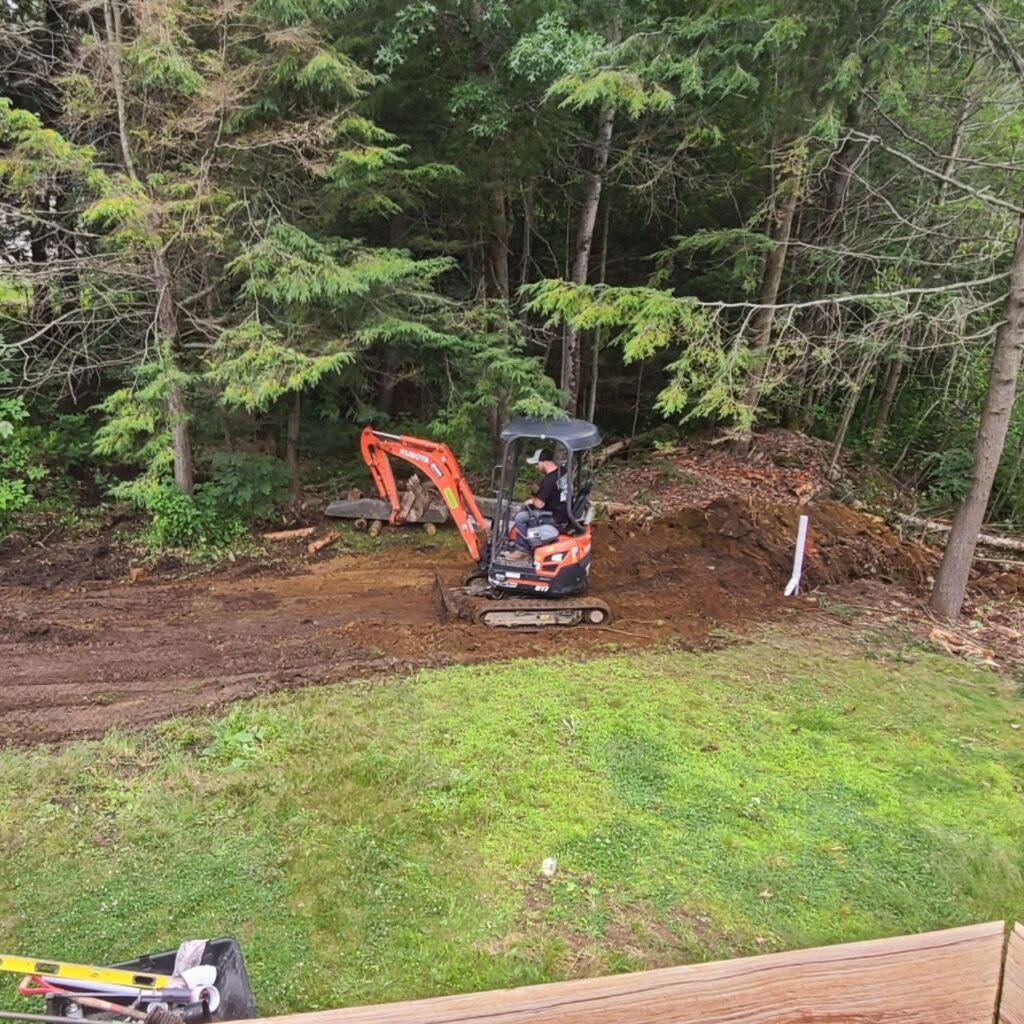
Grading and backfilling is the work of shaping the ground into the slopes water should follow, and putting excavated soil back in a way that holds those slopes instead of sinking out from under them. Grading decides the route. Backfilling decides whether the route survives the first few winters. It is the same work we do every week through our drainage and grading services across Central Massachusetts.
Most properties end up with a water problem because the grading and backfilling was treated as cleanup rather than as construction. Someone shaped a nice lawn over ground that was never compacted, or someone refilled a trench in one dump of loose soil and raked the top flat. Both look finished on the day. Both turn into a low spot that collects water within a year or two.
What Is Grading and Backfilling, Exactly?
Grading and backfilling is a single operation with two halves. Grading is cutting and filling the surface of a property so that every part of it drains somewhere on purpose. Backfilling is returning soil to an opening that was dug, whether that is a foundation wall, a utility trench, a drain line, or a stump hole, and doing it in a way that ends up as solid as the ground around it.
The two halves are inseparable because the finished grade sits on top of the backfill. If the fill under a lawn settles four inches over two winters, the slope you built into that lawn settles with it. That is why grading and backfilling gets treated as one job rather than two, and why the compaction step in the middle matters more than the raking step at the end.
The scale of grading and backfilling ranges from small to large. A single downspout area that needs eight inches of fill and a reshaped slope is grading and backfilling. So is a whole back yard reshaped after a foundation goes in. The principles do not change with the size of the machine.
Why Grading and Backfilling Decides Where Water Goes
Water on a property has no opinion. It moves down the steepest available path, and it stops wherever there is no path. Every puddle, every wet basement corner, and every soft rutted patch of lawn is the ground telling you what its current shape is. Grading and backfilling is how that shape gets changed on purpose instead of by accident.
Small numbers do the work in grading and backfilling. A lawn only needs a fall of about two percent, roughly a quarter inch of drop per foot, to move surface water reliably. Ground right against a house wants more, closer to six inches of drop across the first ten feet. Those are not dramatic slopes. Standing in the yard you would not see them. Water finds them immediately.
This is also why the fix for a wet yard is so often earthwork rather than pipe. Before anyone prices a drainage system, the honest first question is whether the ground was ever shaped correctly. Our guide to yard drainage covers the diagnosis side, and a fair share of those calls end with grading and backfilling rather than anything buried.
Rough Grading and Finish Grading Are Different Steps
Grading and backfilling begins with rough grading, which establishes the shape. The machine cuts the high ground, moves it to the low ground, and builds the general contours the property will have when it is done. At this stage the surface is bare subsoil, tracked and uneven, and it looks nothing like a finished yard. What matters is that the elevations and the falls are correct, because everything after this only follows what rough grading set.
Finish grading is the last few inches. Topsoil goes back over the shaped subsoil, gets spread to an even depth, and gets worked until the surface is smooth enough to mow and consistent enough to seed. Finish grading does not rescue a bad rough grade. Spreading loam over a low spot buries the low spot, it does not remove it, and the low spot reappears the first time the loam settles.
Between the two steps sits the part homeowners never see, which is the fill placement and compaction. That middle stage is where grading and backfilling either succeeds quietly for twenty years or fails visibly in eighteen months.
Reading the Ground Before Grading and Backfilling Starts
Good grading and backfilling starts with watching, not digging. Where does water arrive on this property, where does it currently leave, and what is in the way in between? Roof runoff, the neighbor uphill, the road, and the driveway are the four usual sources. A walk during a hard rain answers more questions in ten minutes than an hour of guessing on a dry day.
The other half of reading the ground is finding the fixed points that cannot move. The bottom of the siding, the top of the foundation, a patio, a septic system, the base of a mature tree, and the property line all set limits on how much you can raise or lower a surface. Grading is the art of getting the falls you need without violating any of those.
On some properties the answer is a full slope rebuild rather than surface work, which is its own subject covered in our guide to regrading and slope correction. On others the water simply needs a shaped channel, which is where swales and runoff management come in. Grading and backfilling is the base layer under both.
Positive Drainage Away From the Foundation
The single most valuable outcome of grading and backfilling on a house lot is positive drainage at the foundation, meaning the ground falls away from the walls on every side. Almost every wet basement complaint in New England traces back to ground that is flat or pitched inward within a few feet of the house, plus roof water landing on that same ground.
Backfill against a foundation settles, and settled backfill is what creates a reverse pitch. The soil was dropped in loose when the house was built, and it consolidated over the years into a shallow trough that now rings the building. Rain runs into that trough, sits against the wall, and finds the joint between the slab and the footing. The fix is soil, not sealant.
Rebuilding that pitch is careful grading and backfilling. Fill goes in, gets compacted, and gets shaped to fall away, while keeping enough clearance below the siding and the sill so nothing traps moisture against wood. Raising grade too high against a house causes a different and more expensive problem than the one it solved, so the target is a proper fall within the clearance available.
Foundation Backfill and the Ground Right Against a House
Backfilling against a new or exposed foundation has rules of its own. The wall is designed to be braced by the floor system, so backfilling too early, or too aggressively on one side, can push a wall out of plumb or crack it. Contractors sequence this deliberately, which is part of why foundation excavation and the backfill that follows get planned as one operation rather than two unrelated visits.
Material selection matters here more than anywhere else on the property. Clean granular fill drains and compacts predictably. Heavy clay and organic soil hold water against the wall, freeze, and expand. Rocks and construction debris leave voids that turn into sinkholes later. The soil that came out of the hole is not automatically the soil that should go back in.
Getting this right at the start is far cheaper than correcting it. Once a house is finished and landscaped, redoing foundation backfill means removing everything that was installed on top of it. Grading and backfilling done properly during construction is invisible. Done poorly, it becomes a project for a future owner.
Backfilling a Drainage Trench Without Undoing the Work
A drainage trench is the place where careless backfilling destroys the thing that was just installed. Pipe laid at a precise pitch can be knocked out of line by a bucket of fill dropped straight down on it. The correct sequence is bedding material around and over the pipe first, hand or light machine work at that level, and only then normal fill above it. Our guide to french drain installation walks through the layering in detail.
The second trap is the trench itself becoming a drain. A loosely backfilled trench is more permeable than the ground around it, so water follows it, and where that trench runs toward a foundation the water arrives at the wall. Compacting the backfill in the trench to roughly the density of the surrounding soil is what stops that path from forming.
The third is settlement across the trench line. Loose fill in a trench will consolidate and leave a visible depression tracking across the lawn, which then holds water in a perfect straight line. Anyone who has seen a lawn with a long narrow puddle across it has seen grading and backfilling that skipped its lifts.
Placing Fill in Lifts Is the Core of Grading and Backfilling
Lifts are the core discipline of grading and backfilling. Fill goes in a layer at a time, usually somewhere between six and twelve inches depending on the soil and the equipment, and each layer gets compacted before the next one is placed. A compactor working on the top of a four foot pile of loose soil densifies the top few inches and leaves everything underneath exactly as loose as it was.
Moisture is the other half of compaction. Soil that is bone dry will not knit together, and soil that is saturated pumps and shoves rather than compacting. There is a workable middle, and experienced operators judge it by how the material behaves under the machine. This is a real reason work gets postponed after a wet week rather than pushed through.
Compaction is a large enough subject on its own that it has a dedicated guide, our post on backfilling and compaction from the excavation side of the work. On a drainage job the goal is slightly different: enough density that the finished grade holds its shape, without turning the whole yard into a surface that sheds water like pavement.
Choosing What Fill Belongs Where in Grading and Backfilling
Not all fill is interchangeable, and matching material to location is a quiet part of grading and backfilling that never shows in a photo. Granular material, meaning sand and gravel mixes, compacts well and drains, which makes it the right choice against foundations, under slabs and pads, and in the lower portion of deep backfill.
Native subsoil is usually fine for general yard fill where it is not holding a structure, provided it is free of organic matter, stumps, and debris. Topsoil belongs only in the top few inches, because it is full of organic material that decomposes and settles, and it is the layer grass actually needs. Using topsoil as structural fill guarantees a low spot later.
Clay deserves specific caution on Central Massachusetts lots. It holds water, swells and shrinks with moisture, and heaves with frost. It has legitimate uses where an impermeable layer is wanted, but as general backfill against a house it creates exactly the pressure and moisture conditions a foundation does not want.
Grading and Backfilling Around Driveways, Walks, and Patios
Hard surfaces concentrate water. A driveway is a wide impermeable sheet that collects everything falling on it and delivers it to whatever is at the low end, which is often a garage door or a lawn edge that cannot absorb it. Grading and backfilling around those surfaces is what decides whether that volume disperses or arrives all in one place.
The shoulders matter as much as the surface. A gravel drive that sheds water sideways to soft shoulders stays intact. A drive with shoulders built up higher than the surface becomes a channel, and the water runs its full length and cuts. That failure mode is covered further in our guide to erosion control, and the fix is almost always earthwork rather than more stone.
Around patios and walks, the same rule applies at smaller scale. A quarter inch per foot of fall away from the house across a patio is invisible to the eye and decisive in a storm. Settled backfill under an edge is what tips those surfaces back toward the building over time.
Settlement, and Why It Shows Up Months Later
Settlement is the delayed bill for grading and backfilling that skipped its compaction. Loose soil holds air voids, and water, gravity, and freeze cycles gradually collapse them. The ground goes down, the finished grade goes with it, and a property that drained correctly in October is holding water in April. Nothing changed above ground, which is why homeowners so often assume the problem is new.
The pattern of the settlement usually names the cause. A depression tracking in a straight line is a trench. A trough running along the house is foundation backfill. A round dip in the middle of a lawn is a filled stump hole or an old excavation. Reading those shapes tells you what was done and how deep the correction needs to go.
Some settlement is normal even with correct work, which is why a fresh grade is often left slightly high in fill areas so it settles to the intended elevation. What is not normal is several inches of drop, or a hole that keeps reopening. That is a void, and adding topsoil to the surface will not fix it.
Frost, Ledge, and Central Massachusetts Ground
Local conditions set the difficulty of grading and backfilling more than anything else. Central Massachusetts ground is glacial till, which means dense mixed soil with stone and boulders through it, ledge that can appear a foot down or not at all, and pockets of clay that hold water long after the surrounding soil has drained.
Ledge changes the plan rather than the goal. Where rock sits close to the surface, cutting down is off the table and the answer becomes building up, routing around, or accepting a shallower fall and compensating elsewhere. Discovering ledge halfway through is one of the more common reasons a grading and backfilling plan gets revised in the field.
Frost is the other constant. The state builds to a 48 inch frost depth, and the freeze and thaw cycle works on soil every winter, lifting stone, loosening fill, and finding any layer that was not compacted. Work done in the fall gets tested immediately, which is a fair argument for doing it properly rather than quickly.
How Grading and Backfilling Fits With Pipe and Stone
Buried drainage is not a substitute for grade. A pipe can only carry water that reaches it, so the surface still has to be shaped to deliver flow to the inlet. Systems that fail on paper usually fail because the ground around the catch basin is flat, or because the outlet is buried in a low corner with nowhere to daylight.
The productive sequence is to shape first, then decide what needs to be buried. Once the grading and backfilling is right, many properties turn out to need much less pipe than expected, and the pipe that remains handles a specific concentrated problem such as roof water or a persistent wet corner. Our drainage and grading overview lays out how the pieces relate.
The reverse order is what produces expensive disappointments. Installing a system into ground whose shape has not been corrected means the system fights the property for its whole life, and every clogged inlet becomes an emergency because there is no surface path as a backup.
Topsoil, Seed, and Finishing the Surface
Bare graded soil is vulnerable soil. Until something is growing in it, every rain moves a little of it, and the shape that was just built starts eroding immediately. Finishing the surface promptly is part of grading and backfilling, not an optional landscaping upgrade that can wait for spring.
That usually means four to six inches of screened topsoil spread over the shaped subgrade, raked to a consistent surface, then seeded and mulched with straw or covered with an erosion blanket on anything steep. On slopes the covering is what holds the seed in place long enough for roots to take.
Timing helps. Late summer into early fall is the strongest seeding window in New England, with spring a workable second. Grading and backfilling completed just before winter with nothing growing on it is the version most likely to need touching up in the spring.
Signs the Grading and Backfilling Was Done Wrong
Properties tell on their earthwork. Water standing against a foundation after a normal rain, a lawn that stays soft for days, a straight line depression across a yard, mulch and stone regularly washed out of one bed, or a driveway edge that keeps rutting are all grading and backfilling symptoms rather than landscaping ones.
Inside the house the tells are a damp basement corner after storms, efflorescence on the foundation wall, or a musty smell that follows the weather. Those point outward. Interior waterproofing manages symptoms, while grading and backfilling addresses whether the water arrives at the wall in the first place.
The useful diagnostic is timing. Problems that appear in the same spot after every significant rain are drainage and grade problems. Problems that appear randomly are usually plumbing or a specific failure somewhere. It is a crude test and it is right most of the time.
When Grading and Backfilling Is Not the Answer
There are properties where earthwork alone will not solve it. Ground with a genuinely high water table can be shaped perfectly and still be wet, because the water is coming up rather than running across. Sites at the bottom of a large watershed receive more volume than any residential grade can move, and that becomes a question of conveyance and capacity.
There are also legal limits. You cannot simply grade a problem onto a neighbor, and moving concentrated flow onto an abutting property is a reliable way to turn a drainage issue into a dispute. Solutions have to end somewhere legitimate on the property or at a lawful discharge point.
And on the tightest lots there is not enough room to build the falls that are needed, which pushes the answer toward pipe, retaining structures, or storage. An honest assessment says so up front rather than selling grading and backfilling that cannot deliver.
In Massachusetts, Watch Out for These
Call before any of it starts. State law defines excavation broadly at Massachusetts General Laws Chapter 82, Section 40, and that definition names grading and backfilling explicitly alongside digging, trenching, and drilling. Shaping a lawn is legally excavation. Notice goes through Dig Safe at 811 or the state Dig Safe page, and the official guidance requires at least 72 business hours of notice, excluding weekends and holidays, with the resulting ticket valid for 30 days.
Wetlands reach further than most homeowners expect. Under the Wetlands Protection Act at Chapter 131, Section 40, no person may remove, fill, dredge or alter a wetland, bank, or land subject to flooding without filing written notice and receiving an order of conditions from the local conservation commission. The state explains the process in its guidance on protecting wetlands in Massachusetts, and the protected area runs 100 feet from a wetland edge and 200 feet along most perennial streams.
That reach matters here specifically, because filling is one of the listed activities. Bringing in material to raise a low corner is exactly the kind of work that triggers a filing if the low corner happens to be a resource area. Ask the commission first. They answer questions readily, and they are far less accommodating about work discovered afterward.
Permits are local. Every city and town employs a building commissioner or inspector of buildings who administers and enforces the state building code, under Chapter 143, Section 3, and many towns add their own earth removal or fill bylaws on top. Grafton, Worcester, Shrewsbury, and Northborough do not handle this identically, so the answer comes from the town the property sits in.
Then there is frost, which enforces its own rules. The 48 inch frost depth the state builds to is a reminder that anything shallow and loose gets rearranged every winter. Backfill placed in proper lifts and compacted holds through the freeze and thaw. Backfill dumped and raked does not, and mud season is when the property reports back.
Frequently Asked Questions
What is the difference between grading and backfilling?
Grading shapes the surface of the ground into the slopes that carry water where it should go. Backfilling puts excavated soil back into an opening such as a trench or a foundation excavation, in compacted layers, so the ground ends up as solid as what surrounds it. Most jobs involve both, because the finished grade sits on top of the backfill.
How much slope does my yard need to drain properly?
About two percent across open lawn, which is roughly a quarter inch of fall per foot, is enough to move surface water reliably. Ground next to a house wants more, closer to six inches of drop across the first ten feet. Those falls are small enough that you will not notice them standing in the yard, and decisive during a storm.
Why does my lawn have a low spot where a trench was dug in Central Massachusetts?
The trench was almost certainly backfilled in one pass instead of in compacted lifts. Loose soil holds air voids that collapse over a few freeze and thaw cycles, so the fill consolidates and the surface drops. Adding topsoil to the dip is a temporary cover. The lasting fix is excavating the loose material and replacing it in layers.
Do I need a permit for grading and backfilling in Massachusetts?
It depends where the work sits and how much material moves. Ordinary reshaping on high ground away from wet areas usually needs no filing, while work within 100 feet of a wetland or 200 feet of most perennial streams requires an order of conditions from the local conservation commission. Many towns also have their own fill bylaws, and any earth movement triggers Dig Safe notice through 811.
When is the best time of year for grading and backfilling in Central Massachusetts?
Late spring through early fall, when the ground is dry enough to compact properly and seed will establish before winter. Saturated soil will not compact, it pumps under equipment and ruts badly, so mud season is the window to avoid. Late summer into early fall tends to be the strongest combination of workable ground and good seeding conditions.
Grading and backfilling is one of those subjects where standing on the property during a rain answers questions that photographs cannot. We look at where the water arrives, where it leaves, and what shape the ground is currently telling it to follow, and a surprising share of wet yard calls end with earthwork rather than anything buried.
D and M Good Construction handles this work for homeowners in Grafton, Worcester, Shrewsbury, Northborough, and the surrounding Central Massachusetts towns as part of our drainage and grading services. If water is sitting against the house, a lawn has gone soft, or a filled area keeps dropping, tell us what you are seeing and we will come look at it. Our estimates are always free.