
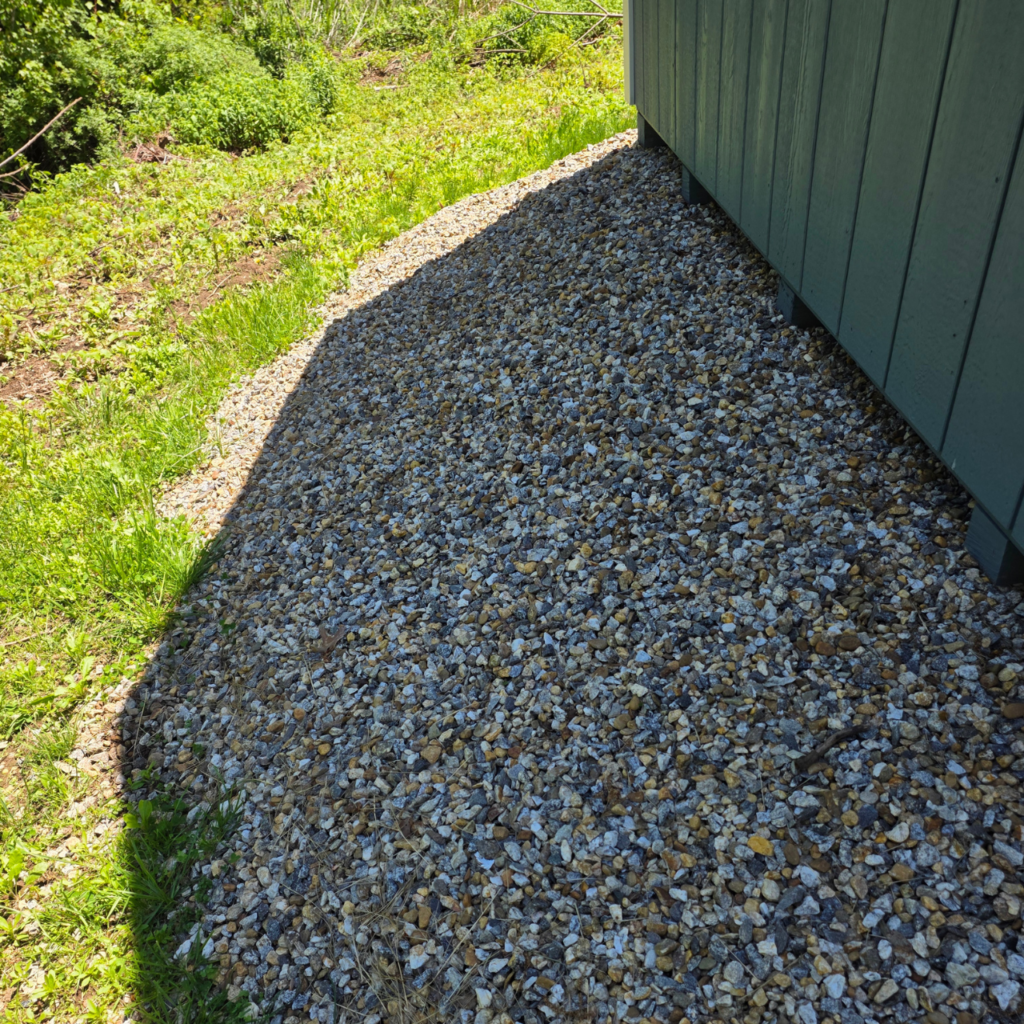
French drain installation is the work of burying a perforated pipe in a stone filled trench so groundwater has an easier path to travel than the one it is taking now. It is the same work we handle every week through our Central Massachusetts drainage and grading service, and it is often what a damp basement, a lawn that stays spongy for days, or a hillside that never dries out actually needs. This guide explains what french drain installation involves, how drain piping fits alongside it, and the rules Massachusetts adds once the water being moved gets anywhere near a wetland.
What Is French Drain Installation, Exactly?
A french drain is a trench filled with washed stone that holds a perforated pipe near the bottom. Water that is sitting in the surrounding soil seeps into the stone, drops into the pipe through the holes, and runs downhill to an outlet. French drain installation is the process of building that system correctly: cutting the trench on a consistent pitch, wrapping the stone in filter fabric, setting the pipe, and finishing the surface so the drain disappears into the yard.
The idea is old and simple. Water follows the easiest path available to it, so a french drain installation gives it one that is far easier than squeezing between grains of clay and silt. Nothing pumps, nothing powers it, and nothing about it is clever. It works because stone has large voids and dense New England soil does not. It is one focused piece of the broader water control covered in our guide to drainage and grading.
The name has nothing to do with France. It traces back to Henry French, a nineteenth century American writer whose 1859 book on farm drainage popularized the buried stone and tile method. The approach has been used on New England ground for well over a century, and the reason french drain installation is still standard practice is that the physics behind it never changed.
How a French Drain Moves Water Underground
Soil holds water the way a sponge does. After a long rain or a spring thaw, the spaces between soil particles fill and the water table rises toward the surface. When that saturated zone reaches your basement wall, your crawl space, or the root zone of your lawn, you see the symptom: seepage, soft ground, standing puddles that outlast the storm by days.
A french drain installation intercepts that saturated zone before it gets where it is going. The stone column in the trench is essentially an open void running through dense soil, so water under pressure moves sideways into it rather than continuing toward the house. Once inside, gravity takes over and the pipe carries it away. Everything the system does depends on that one relationship between void space and gravity.
This is why a french drain solves a different problem than a surface fix. Regrading sheds water that is still on top of the ground. A french drain installation handles water that is already in the ground and moving through it. Most wet properties have both problems at once, which is why the two are usually planned together rather than treated as competing options.
The Parts of a French Drain Installation
Every french drain installation is built from the same short list of components, and the quality of the result comes down to how carefully each one is handled. The trench sets the depth and the pitch. Filter fabric separates the stone from the surrounding soil. Washed stone fills the trench and creates the void space. Perforated pipe sits low in that stone and carries the collected water to the outlet.
The outlet is the part homeowners think about last and the part that decides whether the system works at all. A drain that collects water beautifully and has nowhere to release it is just an underground reservoir. Before any french drain installation begins, we walk the property and confirm where the water can legally and physically go, because that endpoint dictates the depth and route of everything upstream of it.
Curtain Drains, Footing Drains, and Yard Drains
A curtain drain runs across a slope above the area you want to protect, cutting off groundwater that is traveling downhill toward the house. On sloped Central Massachusetts lots, this is the most common form of french drain installation we do, because so many homes here sit at the bottom of ground that sheds water toward them.
A footing drain sits alongside the foundation footing and relieves pressure against the basement wall, and it is the deepest form of french drain installation we build. On an existing home this means excavating along the foundation, which is a larger project than a yard drain and needs care around the structure. A yard drain, by contrast, is a shallower run placed under a chronically wet lawn area to dry out the root zone and make the space usable again.
The three are not interchangeable. Putting a shallow yard drain where a curtain drain belongs will move some water and leave the real source untouched. Matching the type to the water source is the first judgment call in any french drain installation, and it is worth getting right before a shovel moves.
Trench Depth and Pitch in Central Massachusetts Soil
Depth in a french drain installation is determined by the water you are trying to catch, not by a standard number. A yard drain may only need to sit a foot or two down. A curtain drain protecting a basement generally has to run deeper than the water path it is intercepting, and a footing drain sits at the base of the foundation. Deeper trenches in wet ground also need shoring or benching, which is part of why this is not a weekend project.
Pitch matters as much as depth. The trench bottom needs a steady fall toward the outlet, commonly around one percent, which is roughly an inch of drop for every eight feet of run. A pipe laid flat holds water and silts up. A pipe with dips and humps traps sediment at every low point. Setting a consistent grade with instruments rather than by eye is a large part of what separates a french drain installation that lasts from one that clogs in three seasons.
Frost is the other local factor. The Massachusetts frost line is 48 inches, and while a properly built drain full of stone and moving water is far less vulnerable than a still pipe, shallow outlet ends and rigid connections near the surface are where frost damage shows up. We plan those details for a climate that freezes hard and thaws repeatedly.
Washed Stone, Filter Fabric, and Perforated Pipe
The stone has to be washed and uniformly sized, with no sand or dust in it. Those fines are what fill the voids between the stones and choke the drain over time. Processed gravel and bank run are the wrong materials here even though they are cheaper and easier to get. In a french drain installation, the empty space between the stones is the working part of the system.
Filter fabric wraps the stone in a french drain installation and keeps surrounding soil from migrating into it while still letting water pass. Skipping it buys a few years before silt slowly turns the stone bed into dirt. There are situations where a fabric sock on the pipe is used instead of a full trench wrap, and situations where a sock is a bad idea because it blinds off in silty soil, so the choice depends on what the ground is made of.
The pipe itself is usually rigid perforated PVC or corrugated pipe. Rigid pipe holds its grade, resists crushing, and can be cleaned out later with a snake or a jetter. Flexible corrugated pipe is faster to lay and forgiving around curves, but it sags between supports and its ridges collect sediment. For a french drain installation meant to last decades, we lean toward rigid pipe on a well prepared trench bottom.
Where the Water Goes: Outlets, Daylight, and Dry Wells
The cleanest outlet for a french drain installation is daylight, meaning the pipe ends at an exposed spot lower on the property where water can run out on its own. It needs a rodent grate, a stable stone apron so the discharge does not carve a gully, and enough fall to keep the line self cleaning. When the grade allows it, this is the outlet that gives the least trouble over time.
When there is no low point to reach, the water goes to a dry well: a buried chamber or stone pit sized to hold the flow and let it soak into the ground. Dry wells depend entirely on soil that actually percolates, so on heavy clay they need to be larger or replaced with a different strategy. Sizing one honestly matters more than building it neatly.
Occasionally the only workable answer is a sump pit and pump that lifts water up to a discharge point. That is a mechanical solution with a lifespan and a power requirement, so we use it when gravity truly has no route left. Wherever the water ends up, it cannot simply be pushed onto a neighbor’s land, which is both a practical and a legal constraint on any french drain installation.
Drain Piping That Is Not a French Drain
Not every buried pipe on a wet property is part of a french drain installation. Solid drain piping carries water that has already been collected somewhere else: roof runoff from downspouts, discharge from a sump, or flow from a catch basin set in a low spot. Solid pipe is sealed on purpose, because the entire point is to move that water past the wet area rather than let it soak back in.
Mixing the two up is a common and expensive mistake. Tying downspouts into a perforated french drain line dumps hundreds of gallons of roof water directly into the ground you are trying to dry out. On most properties we run the two systems separately and let them meet only near the outlet, and the same logic shows up in our guide to standing water solutions.
Catch basins and area drains handle the surface side of the problem. They collect water that is pooling on top of the ground and feed it into solid pipe. A complete plan for a wet property often uses all three: surface collection for what is running off, french drain installation for what is soaking through, and solid piping to carry both to a safe outlet.
Why French Drain Installation Fails
The french drain installation failures we get called to fix are predictable. Someone used unwashed stone or ordinary gravel, and the voids filled with fines. Someone skipped the filter fabric, and silt worked its way in from the sides. Someone laid the pipe flat or let it dip, so sediment settled in the low spots until the line closed itself off. None of these show up in year one, which is exactly why they keep happening.
The other big one is an outlet that was never real. A trench that ends in the middle of a lawn, or discharges to a spot that is wetter than the source, cannot work no matter how well the trench itself was built. When a homeowner tells us their drain worked for one season and quit, the outlet is the first place we look.
Undersized systems fail more quietly. A single shallow line on a property that is collecting groundwater from several acres uphill will move water without ever keeping up. Sizing the system to the water it will actually see is the difference between a real fix and a slow disappointment, and it is why a french drain installation starts with watching where the water comes from.
What French Drain Installation Looks Like on Site
A french drain installation starts before the machine does. We walk the property during or right after a wet stretch when the problem is visible, find the high point the water is coming from and the low point it can be sent to, and mark the route. Underground utilities get located and marked at this stage, which is a legal requirement rather than a courtesy.
Then the trench gets cut with a compact excavator, and spoil is stockpiled on tarps or hauled off depending on how much room the site has. The bottom is graded to the planned pitch and checked, fabric is laid in, a base layer of washed stone goes down, the perforated pipe is set and connected, and more stone is placed over it.
Finishing is where a french drain installation either blends into the property or announces itself forever. The fabric is folded over the stone, and the top is capped with either more stone at the surface for a visible drain or with soil and seed where you want lawn back. Access points for future cleanouts get set where they will actually be findable, and the surface is graded so it sheds instead of ponding.
When a French Drain Is Not the Right Fix
Plenty of wet yards do not need a french drain installation at all. If the ground slopes toward the house, or a patio was built above the door threshold, or a berm is holding water in place, the honest answer is to fix the shape of the ground first. That is the work covered in our guide to regrading and slope correction, and it often does more than a buried pipe would.
Roof water is another one. A house with no gutters, or with downspouts dumping at the foundation, can produce a wet basement all by itself. Extending those discharges away from the house is a small job that sometimes ends the problem completely. Our guide to yard drainage corrections covers the surface side of these calls in more detail.
And some ground is simply wet because it is wetland or has a high seasonal water table across the whole site. Draining that is not a landscaping decision, it is a regulated activity, and sometimes the right answer is to work around the wet area rather than fight it. We would rather tell a homeowner that before a french drain installation than after.
In Massachusetts, Watch Out for These
Anything that digs has to be marked out first. Massachusetts law requires a call to Dig Safe at 811 before excavation, with at least 72 business hours of notice, not counting weekends or legal holidays, and the resulting ticket is valid for 30 days. Trench work for drainage runs long and shallow, exactly the depth where buried services live, so this step is not optional on any french drain installation.
Wetlands rules matter more here than on most site work, because a drain by definition moves water. Under the Wetlands Protection Act, work within 100 feet of a wetland resource area, or within 200 feet of a perennial stream, falls under your local Conservation Commission. The state’s overview of wetlands protection explains the filings involved, which typically means a Request for Determination or a Notice of Intent and an Order of Conditions before work starts.
Where the water lands is a real constraint too. Discharging collected water onto an abutting property, into a road drainage system, or into a wetland without approval can create a dispute or a violation even when the drain itself was built well. Towns differ on what is allowed, so the outlet plan gets confirmed locally rather than assumed.
Septic systems deserve their own caution. Trenching near a leach field can damage it, and routing extra water toward one can shorten its life, so any drain that runs near a septic component gets planned around it and checked against local Board of Health requirements. Seasonal timing rounds out the list: frozen ground and mud season both make trenching harder, and late spring through fall is when this work goes best in Central Massachusetts. The Dig Safe guide is worth reading before any excavation season starts.
Frequently Asked Questions
Do I need a permit for french drain installation in Central Massachusetts?
It depends on where the trench runs. A drain well away from wetlands and inside your own property usually does not need a building permit, but any excavation within 100 feet of a wetland resource area requires review by your local Conservation Commission first, and Dig Safe markout is required by state law before any digging anywhere. Towns such as Grafton, Worcester, Shrewsbury, and Northborough each handle drainage discharge rules a little differently, so we confirm the local requirements for your address before the work is scheduled.
How long does a french drain last?
A properly built one can work for decades, and a poorly built one can stop working in three or four seasons. The difference is almost entirely materials and pitch: washed stone with no fines in it, filter fabric between the stone and the soil, rigid pipe set on a steady fall, and an outlet that actually releases the water. Adding cleanout access during the french drain installation also means the line can be flushed years later instead of dug up.
Can a french drain fix a wet basement on its own?
Sometimes, and sometimes it is only part of the answer. If groundwater is pushing against the foundation from uphill, an exterior curtain or footing drain intercepting that water usually makes a dramatic difference. If the real source is roof runoff dumping at the foundation, a negative grade against the house, or a crack in the wall, then a french drain installation alone will not solve it. We look for all of those before recommending a trench.
Does a french drain work in the heavy clay soil common in Central Massachusetts?
Yes, and clay is one of the main reasons drains are needed here. Clay holds water rather than letting it pass, so the stone trench gives that trapped water a route it does not otherwise have. What clay does change is the outlet strategy, because a dry well relies on soil that percolates and clay often will not. On those properties we look harder for a daylight outlet or a different discharge point.
What is the difference between a french drain and a curtain drain?
A curtain drain is a type of french drain, named for where it sits rather than how it is built. It runs across a slope above the area being protected so it catches groundwater on the way downhill, like a curtain drawn across the flow. Other placements have their own names: a footing drain runs alongside the foundation, and a yard drain sits under a chronically wet lawn area. The construction is the same in each case.
D&M Good Construction handles french drain installation and drain piping for homeowners across Grafton, Worcester, Shrewsbury, Northborough, and the rest of Central Massachusetts. If your basement seeps, your lawn stays wet long after the rain stops, or water keeps arriving from uphill, the first step is figuring out where it is coming from and where it can go. Our estimates are always free, so it costs nothing to find out whether a drain is the right answer for your property.