
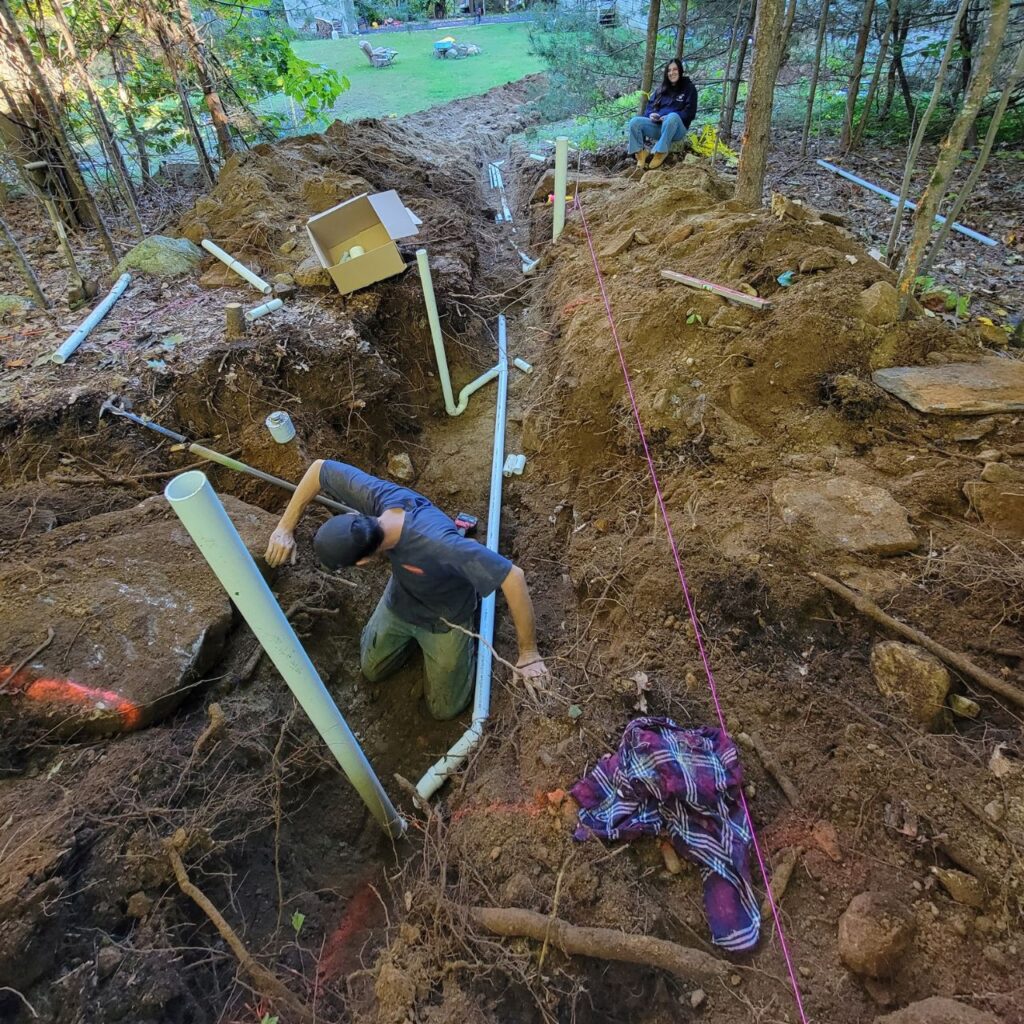
Drainage and grading is the work of shaping ground and managing water so rain and snowmelt flow away from your home instead of into it. Grading sets the slopes that decide where water goes; drainage gives it a safe path to follow. Together they are the quiet system that keeps basements dry, lawns usable, and driveways solid.
Most homeowners never think about drainage and grading until something goes wrong: a puddle that will not leave, a musty basement, a corner of the yard that stays swamp until June. This guide walks through every major type of drainage and grading work, what each one does, and when it is the right tool. It is the same toolbox we use every week in our Central Massachusetts drainage and grading services, explained in plain language.
What Is Drainage and Grading, Exactly?
Think of drainage and grading as two halves of one job. Grading is the shape of the land: the ground next to your foundation should fall away from the house, and the rest of the yard should carry water toward safe, planned exits. Drainage is the set of paths that water follows once the slopes send it moving: surface routes like swales, subsurface collectors like french drains, and buried piping that moves roof runoff away from the foundation. Neither half works alone. Perfect pipes cannot rescue a yard that slopes toward the house, and perfect slopes still need somewhere to send the water. Every drainage and grading fix below is some combination of the two.
Yard Drainage Corrections
Yard drainage corrections are the general fix for a lawn that will not dry out: puddles that linger for days, ground that squishes underfoot, grass that thins in the same soggy spots every season. The cause is usually a yard that settled over time or was never graded correctly, so water arrives faster than it can leave. Correcting it starts with a diagnosis of where the water comes from and where it gets stuck, then reshaping or opening a path so the lawn sheds instead of stores. It is the bread and butter of drainage and grading work, and often simpler than homeowners expect. For a deeper look at this side of the work, see our full guide to yard drainage.
Standing Water Solutions
Standing water is the clearest distress signal a property sends. Beyond being ugly, it drowns grass roots, breeds mosquitoes, rots posts and sills, and slowly loads the soil around foundations and driveways. Solving it is core drainage and grading work: giving the water somewhere better to be: regrading so the spot drains naturally, cutting a channel so it can escape, or collecting it and piping it to a safe outlet. The one thing that never works is ignoring the source; a drain with no outlet or a soak pit in soil that cannot absorb just moves the puddle underground. For a deeper look at this side of the work, see our full guide to standing water solutions in Central Massachusetts.
Regrading & Slope Correction
Regrading is the deepest fix in drainage and grading, because slopes are the root cause most other symptoms grow from. Ground around a house should drop away from the foundation, roughly six inches over the first ten feet, and the yard beyond should keep water moving to planned exits. Regrading rebuilds those angles: raising settled ground near foundations, softening slopes that erode, leveling ponding areas, and feathering everything together so the property drains as one system. Done once and done right, it quietly fixes wet basements, standing water, and ice sheets all at the same time. For a deeper look at this side of the work, see our full guide to regrading and slope correction.
French Drains & Drain Piping
Some water never shows itself on the surface. It moves through the soil, finds basement walls, and keeps ground spongy weeks after the last storm. A french drain intercepts it: a gravel-filled trench with perforated pipe, wrapped in filter fabric, that collects subsurface water and carries it by gravity to a safe outlet. As with all drainage and grading, the details decide whether it lasts decades or clogs in two seasons, which is why washed stone, real fabric, correct pitch, and an actual destination matter more than the product name. Solid drain piping plays the partner role, moving collected water where it needs to go. For a deeper look at this side of the work, see our full guide to french drain installation.
Swales & Runoff Management
When large volumes of water move across a property, the smart play is steering rather than fighting. A swale is a shallow, gently pitched channel, usually grassed, that intercepts runoff and carries it around whatever needs protecting. Swales swallow the big storms that overwhelm pipes, have nothing to clog, and disappear into the landscape once the grass establishes. Runoff management is the broader drainage and grading planning around them: reading how water from hills, roads, and neighboring lots crosses your land, and giving it a route that does no harm on the way through. For a deeper look at this side of the work, see our full guide to runoff management.
Erosion Control
Erosion is what happens when water moves too fast over ground that cannot hold on. Slopes carve into gullies, topsoil ends up in the street, and beds lose their mulch every storm. New England accelerates all of it with hard downpours and freeze-thaw winters that loosen soil annually. Control comes from slowing water down and anchoring soil: spreading flow instead of concentrating it, redirecting volume with swales, armoring the paths water insists on with stone, and stabilizing disturbed ground with seed before the next storm. On any drainage and grading project that exposes soil, erosion control is the step that protects the investment. For a deeper look at this side of the work, see our full guide to erosion control.
Grading & Backfilling
Grading and backfilling is how ground gets built to carry weight and shed water from day one. Foundations, trenches, and retaining walls get backfilled in controlled, compacted layers so nothing settles later. Those openings start as excavation and trenching work, and the backfill is what closes it out. New construction gets final grades that move water away before the first storm tests them. Pads for sheds and outbuildings get shaped, compacted, and pitched. The invisible part of this drainage and grading work is the part that matters: fill placed in compacted lifts stays where it was put, while fill that was dumped and smoothed becomes next year’s low spot and the drainage problem after that. For a deeper look at this side of the work, see our full guide to grading and backfilling.
Driveway Drainage & Grading
Driveways fail from water first and traffic second. Potholes, washboard, soft spots, and edge washouts all trace back to water sitting on the surface or running along it. The cure is shape: a crown along the centerline so rain sheds sideways, edges kept lower than the surface so it can escape, and ditches and culverts kept open so it has somewhere to go. Where a driveway crosses a natural water path, proper drainage and grading carries the flow underneath instead of letting it cut across. A correctly graded driveway is the difference between firm gravel and soup when mud season arrives. How that stone is built in the first place is covered in our guide to gravel installation.
Downspout & Roof Runoff Routing
A roof collects an enormous amount of water and concentrates all of it at a few downspouts, usually right beside the foundation. That makes roof runoff routing one of the highest-value moves in all of drainage and grading: connect the downspouts to buried solid pipe and carry the water to daylight or a dry well well away from the house. Combined with correct grading at the foundation, it removes the leading cause of chronic wet basements, and it is often the first thing worth checking before any bigger solution is discussed.
Wet Area Reclamation
Almost every property has a zone that has been surrendered to the water: the low corner, the back stretch that never dries, the ground nobody mows without leaving ruts. Reclamation figures out why the area holds water, then corrects it: restoring flow with grading, intercepting the water that feeds it, raising the grade with proper compacted fill where needed, and finishing with loam and seed so the space rejoins the yard. One Massachusetts note: if the wet area sits near a wetland, stream, or pond, state rules may apply, which is worth confirming before any drainage and grading work is scheduled.
In Massachusetts, Watch Out for These
New England makes drainage and grading its own discipline. Freeze-thaw cycles shift ground a little every winter, so grades that were right a decade ago may be wrong today. Mud season exposes marginal drainage every March and April. Many Central Massachusetts lots sit on dense soils or shallow ledge that absorb water slowly, which rules out some solutions and favors others. Machine digging legally requires a Dig Safe notice at 811 at least 72 business hours ahead. And work within 100 feet of a wetland, pond, or stream may need Conservation Commission review under the Wetlands Protection Act. A contractor who works here full time plans around all five from the first walkthrough, which is exactly how our drainage and grading services are run.
Frequently Asked Questions
What is the difference between drainage and grading?
Grading is shaping the ground so water flows in the right direction. Drainage is the system of channels, drains, and pipes that carries that water away. Grading decides where water goes; drainage handles the volume. Most real fixes involve both.
How do I know if my property needs drainage and grading work?
Watch one hard rain. Water flowing toward the house, pooling within ten feet of the foundation, or sitting on the lawn for more than a day are the classic signs, along with a damp basement, eroding slopes, or a driveway that keeps failing in the same spot.
Does drainage and grading work require permits in Massachusetts?
Often no, but there are two big exceptions: machine digging requires a Dig Safe notice by law, and work within 100 feet of a wetland, pond, or stream may need Conservation Commission review under the Wetlands Protection Act. A local contractor flags both before scheduling.
What time of year is best for drainage and grading work?
Late spring through fall is ideal, when the ground is workable and new grades can be seeded right away. Diagnosis, however, is best during wet weather, when the problem shows itself. Plan in the wet months, build in the dry ones.
Which drainage solution is right for my property?
Every drainage and grading fix depends on which water you are fighting: surface runoff calls for grading and swales, subsurface water calls for french drains, and roof water calls for downspout routing. A site visit during or after rain answers it fastest, and the fix is often simpler than expected.
If water is winning somewhere on your property, our Central Massachusetts drainage and grading team will trace it to the source and fix it for good. Request a free estimate to get started.