
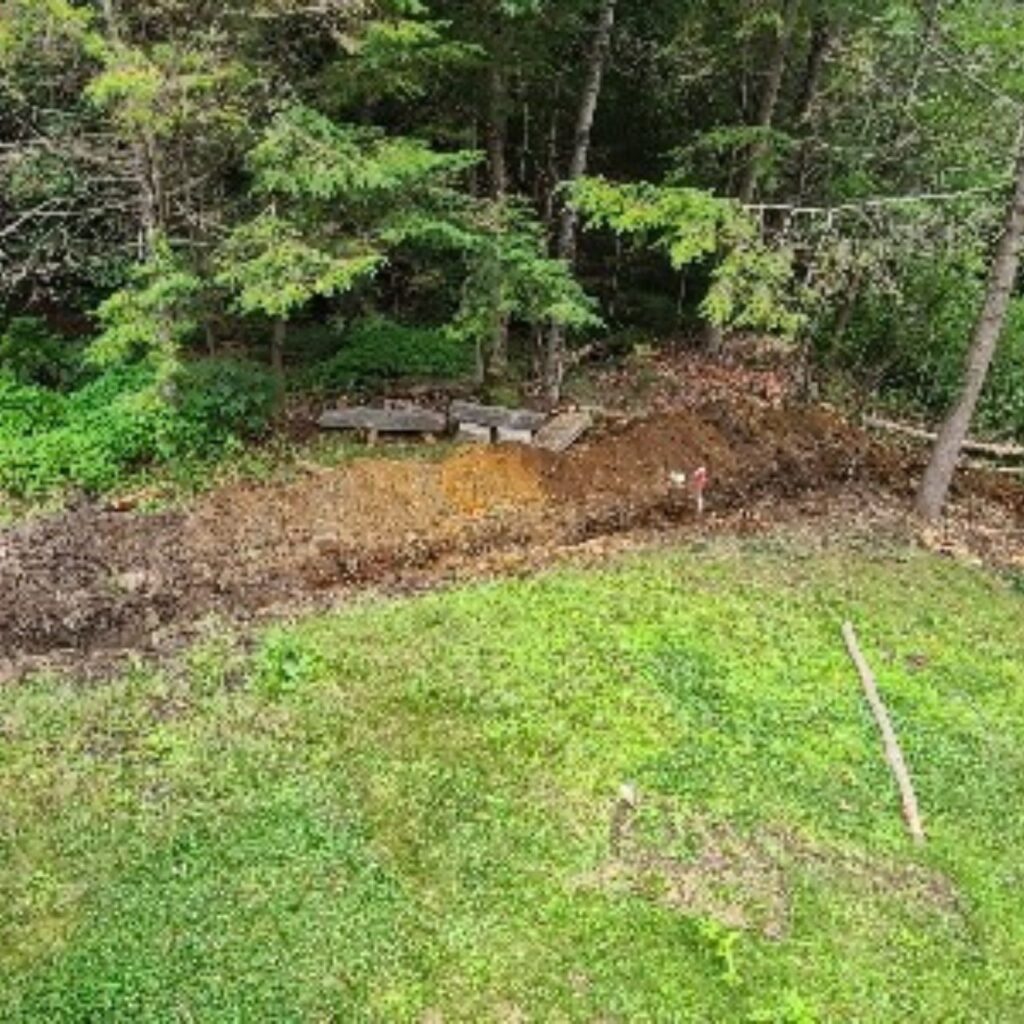
Erosion control is the work of keeping soil where it belongs when water and gravity are trying to carry it somewhere else. On a residential property that means shaping the ground so runoff never picks up enough speed to cut into it, armoring the few places where fast water is unavoidable, and covering bare soil before the next storm finds it. It is the same work we do every week through our drainage and grading services across Central Massachusetts.
Most homeowners meet the subject backward. They notice a gully across the lawn, a driveway that keeps washing into the street, or a bank behind the house that drops a little more soil every spring, and only then start asking what can be done. The honest answer is that the fix is usually simple once someone reads the water correctly, and expensive once the soil has been leaving for years.
What Is Erosion Control, Exactly?
Erosion control is the set of measures that stop moving water from detaching soil and carrying it off a property. It covers permanent construction such as regrading a slope, lining a channel with stone, or piping water to a stable outlet. It also covers temporary measures used while ground is open, such as silt fence, straw, and seeding. Both belong under the same heading because they answer the same question: where is the water going, and what is it taking with it?
The word control matters. Nobody stops water from crossing a property in New England. What erosion control does is decide the route, slow the water down along it, and make sure the surfaces it touches can take the contact. Water that moves slowly across grass carries almost nothing. The same volume concentrated into a narrow path on bare soil will dig a trench in a single afternoon.
Good erosion control is mostly invisible when it works. A shaped swale reads as a gentle dip in the lawn. A stone apron at a pipe outlet looks like landscaping. A driveway that sheds water to a vegetated shoulder looks like an ordinary driveway. The failures are the visible ones: the rill down the middle of the yard, the exposed tree roots, the fan of sand and gravel in the road after every heavy rain.
Why Soil Moves in the First Place
Three things decide whether soil stays put: how fast the water is moving, how long it stays concentrated, and whether anything is holding the surface together. Change any one of them and the outcome changes. A slope covered in established turf can shrug off a downpour. The same slope stripped bare for a project loses measurable material in the first storm.
Speed comes from grade and from concentration. Water spread thin across a broad lawn moves slowly and soaks in as it goes. The moment that same water is funneled into a narrow line by a wheel rut, a roof valley, a driveway edge, or a neighbor’s grading, it accelerates, and the energy it gains is what lifts soil particles and carries them.
Soil type decides how much abuse the ground will absorb before it gives. Much of Central Massachusetts sits on glacial till, a dense mix of sand, silt, clay, and stone that sheds water rather than absorbing it quickly. Pockets of sandier outwash soil drain beautifully but scour easily once water gets moving. Reading which one you are standing on changes the whole approach.
Where Erosion Shows Up on a Central Massachusetts Property
The first sign is almost never dramatic. It is a thin fan of sand at the bottom of the driveway, a strip of bare soil where grass will not hold, or mulch that keeps ending up on the walkway. Those are the early warnings that water has found a concentrated path, and they are the cheapest moment to intervene.
Slopes behind houses are the classic problem, especially where woods were cleared and the ground below never got a stable cover. Driveway edges are next, particularly gravel surfaces on any grade. After that come roof discharge points, where a downspout dumps a roof’s worth of water onto one square foot of lawn, and any place where a pipe or swale ends without something solid to land on.
Spring is when it all becomes obvious here. Frozen ground cannot absorb anything, so meltwater runs across the surface exactly like storm runoff, and it runs for weeks. That is why erosion control on a New England property has to work in March, not just in July. A design that only handles summer thunderstorms will lose ground every mud season.
Erosion Control Starts With Grade, Not Products
The first move in any erosion control plan is to change the shape of the ground, not to buy something. If water is concentrating where it should not, the answer is usually a small amount of earthwork that spreads it back out or redirects it to a place that can take it. Fabric, blankets, and stone all work better on ground that has already been shaped correctly, and none of them rescue a slope that is simply too steep for its cover.
That is why erosion control and regrading and slope correction are the same conversation. Laying a bank back to a gentler angle, breaking one long uninterrupted slope into shorter runs, or building a slight reverse pitch at the top of a hill to keep upslope water off it entirely will each do more than any product applied afterward.
Shaping also decides where water leaves. Every property has somewhere the water is going to end up, whether that is a wooded low spot, a roadside ditch, or a wetland edge. Erosion control work aims the flow at the route you have chosen and prepared, rather than letting each storm choose its own path across whatever is softest that week.
Swales and Shaped Channels
A swale is a shallow, wide, gently pitched channel that moves water across a property at low speed. It is the workhorse of residential erosion control because it handles volume without concentrating it into anything destructive. Grass-lined swales in particular slow water, filter sediment out of it, and let some of it soak in on the way through.
The geometry is what does the work. Wide and shallow beats narrow and deep every time, because the same flow spread across more width has less depth, less velocity, and less cutting power. A swale that is too steep will scour its own bottom out and become the gully it was meant to prevent, which is when stone lining or check structures come into the design.
We cover the full approach in our guide to swales and runoff management. For erosion control purposes the short version is that if a channel is holding its shape after a few seasons and the grass in it is healthy, the design was right. If its bottom is bare and cut, the water is moving faster than the surface can take.
Stone, Riprap, and Armored Outlets
Some places on a property will always see fast water, and those get armored rather than shaped. A pipe outlet, the toe of a steep bank, the bottom of a driveway culvert, or the point where a swale meets a ditch all take concentrated flow that grass cannot survive. The answer is stone sized to the flow, set on filter fabric, extending far enough that the water is spread and slowed before it touches soil again.
Stone size is a real decision, not a matter of taste. Undersized stone gets rolled downstream in the first serious storm and leaves the outlet worse off than it started. Angular stone locks together and stays put where rounded stone shifts. The apron also has to be wide enough at the far end that flow exits as a sheet rather than as a jet.
Armoring is a small part of most of these jobs and an essential one. It buys durability exactly at the points where the design cannot avoid speed, which then lets everything upstream and downstream stay soft, green, and easy to mow.
Seeding, Mulch, and Ground Cover
Bare soil is the raw material erosion needs. Cover it and the problem shrinks dramatically, which is why establishing vegetation is the cheapest and most durable erosion control measure available on most residential ground. Roots hold particles in place, leaves break the impact of raindrops, and a thatch layer slows the sheet flow moving through it.
Timing decides whether seeding takes. Late summer into early fall is the strongest window across Central Massachusetts, with spring a solid second. Seed laid down in midsummer heat or in late fall when the soil is cooling will often germinate poorly, which is why straw mulch, hydroseed tack, or erosion control blankets are used to hold the surface while the stand establishes.
On steeper faces, seed alone is not enough at the start. Erosion control blankets, biodegradable netting, and heavy straw crimping keep the seed and the soil together long enough for roots to take over. On the steepest ground the honest answer is sometimes that vegetation will never hold, and the slope needs to be laid back or terraced instead.
Silt Fence and Temporary Sediment Control
Sediment control is the other half of the job. Erosion control keeps soil from leaving the ground it belongs to. Sediment control catches whatever leaves anyway before it reaches a road, a neighbor, a stream, or a wetland. On any active site both are running at once, and inspectors look for both.
Silt fence is the familiar measure: fabric trenched into the ground on the downhill side of disturbed area, supported by stakes, working as a filter that ponds water briefly so particles drop out. It fails constantly on real sites for boring reasons. It gets laid on the surface instead of keyed into a trench, it gets run straight up and down a slope instead of along the contour, or it never gets cleaned out after it fills.
Straw wattles, compost socks, stone check dams, and a stabilized stone entrance where equipment leaves the site all do related work. These measures are temporary by design. Once the ground is stabilized and covered they come out, because permanent erosion control on a finished property should be grading and vegetation, not fabric.
How Drainage Work and Erosion Control Fit Together
Drainage moves water. Erosion control governs what that water does to the ground along the way. The two get designed together because a drainage fix that dumps concentrated flow onto an unprotected slope has simply moved the damage, and a beautifully stabilized slope that still has a downspout firing across it will fail anyway.
A buried solution such as french drain installation takes subsurface and low-lying water out of the equation entirely and carries it to a controlled outlet. That takes pressure off the surface, but it makes the outlet itself the critical point, and the outlet is always an erosion control detail.
The same logic runs through ordinary yard drainage corrections. Roof leaders, sump discharges, and driveway runoff all get collected and routed deliberately instead of being allowed to sheet across whatever is in front of them. Once the water has a plan, the erosion control work needed on the rest of the property usually gets much smaller.
This is why the whole subject sits inside drainage and grading rather than off on its own. The grade sets the routes, the drainage carries the concentrated flows, and erosion control protects every surface those two decisions put water onto.
Erosion Control on Driveways and Gravel Surfaces
Gravel driveways on a grade are the most common erosion control problem we get called about. Water runs down the wheel tracks, gains speed the whole way, and takes surface material with it. The result is washboarding, exposed base stone, a channel down one side, and a pile of your driveway in the road.
The fix is rarely more gravel. It is crowning the surface so water sheds sideways within a few feet instead of running the length of the drive, cutting shallow relief points that release water to a vegetated shoulder at intervals, and making sure the shoulder itself can take the discharge. Where the grade is severe, a properly set culvert or a stone-lined edge channel carries the load.
Those details are part of any competent gravel driveway installation, and retrofitting them into an existing drive is straightforward. A driveway that sheds water properly stops needing annual repair, which is the practical payoff of getting the details right on a surface you use every day.
Erosion Control Around Foundations and Structures
Close to a house, erosion control and water management become the same problem. Soil pulling away from a foundation wall opens a path for surface water to run straight down alongside the footing. Undermined slabs, settled walkways, and washed-out backfill next to a bulkhead all start the same way, with concentrated flow landing where nothing is holding the soil.
Positive grade away from the building is the requirement, and it has to be maintained over time because backfill settles for years after construction. A downspout that used to discharge onto a pitched lawn can end up discharging into a low spot against the wall after two or three seasons of settlement. Extending the leader and rebuilding the grade solves it.
Retaining walls, stone edges, and armored aprons handle the spots where grade alone cannot get it done, such as a walkout basement cut into a bank. The erosion control detail there is not the wall itself but what happens to the water above it, because a wall with no drainage behind it and no control over what reaches the top of it is a wall waiting to lean.
Erosion Control During Construction
Open ground is vulnerable ground. During excavation, land clearing, or any project that strips cover, a property can lose more soil in one storm than it did in the previous decade. That is why erosion control measures go in before the first machine works, not after the first washout.
The sequence that works is simple. Install perimeter controls and a stabilized entrance first, disturb only the area actually being worked, keep stockpiles away from flow paths and covered or ringed, and stabilize each finished area as soon as it reaches final grade instead of waiting for the whole job to finish. Phasing the work so bare ground never sits open through a wet stretch is worth more than any single measure.
Perimeter measures also protect the neighbors and the road. Sediment tracked onto pavement or washed into a catch basin becomes somebody else’s problem quickly, and it is the fastest way for a residential project to attract official attention it did not need.
Repairing a Washout After It Happens
When a channel has already cut, the repair has to address the cause and the damage in that order. Filling a gully with loam and seeding it is a way to do the same work again next spring. The water that cut it is still arriving at the same place with the same speed, and it will find the soft fill immediately.
A real repair starts upslope: intercept or spread the flow that is feeding the cut, then rebuild the damaged ground in compacted lifts of suitable material, then armor or vegetate the surface according to how much water it will still see. Sometimes the channel is telling you where the water genuinely wants to go, and the right answer is to build a proper stone-lined route on that line rather than to fight it.
Washouts under driveways and around culverts get treated the same way. Undermined pipe gets reset with proper bedding and compacted backfill, headwalls and aprons get rebuilt at both ends, and the approach grade gets corrected so the water enters the pipe instead of running past the inlet and around it.
What Happens When Erosion Control Waits
Erosion is patient and cumulative. A property loses a quarter inch of surface across a slope and nobody notices, then the same storm pattern repeats for six years and suddenly tree roots are exposed, the lawn has a permanent scar, and the low corner of the yard has a foot of silt in it. Nothing dramatic happened on any single day.
The problems that follow are the expensive ones. Soil lost from around a foundation, a driveway that needs rebuilding rather than resurfacing, a septic area with its cover stripped, sediment deposited in a wetland where regulators take an interest, or a neighbor downhill with a complaint that is entirely fair. Each of those is a much larger job than the grading and seeding that would have prevented it.
Maintaining Erosion Control Over the Years
Finished erosion control work is durable, not permanent. Swales silt in gradually and lose their shape. Stone aprons collect leaves and sediment. Culvert inlets plug with debris. Vegetation thins out in shade or under heavy foot traffic. None of that is failure, it is maintenance, and a walk around the property after the first heavy rain each spring catches nearly all of it.
Three habits keep the work performing. Keep outlets and inlets clear so water can actually leave the way the design intended. Repair bare patches on slopes and in channels while they are still small enough to fix with seed and mulch. Do not fill in or mow flat the shallow dips that are doing the drainage work, which happens more often than you would expect when a property changes hands.
When Erosion Control Is Not the Right Fix
Not every soil problem is an erosion problem. Standing water that never moves is a drainage and grading question, not an erosion one, because water that sits still is not carrying anything away. If the complaint is a wet spot that lingers for days, the answer is a route out, not a stabilized surface.
Slopes that are actively slumping rather than washing are a different matter as well. Deep-seated movement, saturated fill, or a failing retaining structure are engineering problems, and the right call is to bring in a qualified engineer rather than to treat the symptom with surface work. Honest erosion control includes recognizing the point where surface measures stop being the answer.
Work close to a wetland, a stream bank, or a pond edge also changes the conversation. The technical fix might be simple, but the permitting comes first, and doing the work before the filing is the one mistake that turns a small job into a long problem.
In Massachusetts, Watch Out for These
Wetlands rules reach further than most homeowners expect. Under the Wetlands Protection Act, codified at Massachusetts General Laws Chapter 131, Section 40, no person may remove, fill, dredge or alter a wetland, bank, or land subject to flooding without filing written notice and receiving an order of conditions from the local conservation commission. The state describes how the process runs in its guidance on protecting wetlands in Massachusetts, and the protected area extends 100 feet from a wetland edge and 200 feet along most perennial streams.
Erosion control work is often precisely the work that lands inside those zones, since the wet, low, and flowing parts of a property are where water problems concentrate. File first. A conservation commission that is asked in advance is generally helpful, and the same commission finding unpermitted work after the fact is not.
Call before any digging. State law defines excavation broadly at Chapter 82, Section 40, and the definition names grading, trenching, augering, and backfilling explicitly, so shaping a swale counts as much as digging a trench does. Notice goes through Dig Safe at 811 or through the state Dig Safe page, and the official guidance requires at least 72 business hours of notice, excluding weekends and holidays, with the resulting ticket valid for 30 days.
Larger projects pick up federal obligations. The EPA requires a Clean Water Act permit for stormwater discharges from construction activity disturbing one acre or more, or less than one acre when the work is part of a common plan of development that will ultimately disturb an acre or more. Most single-home projects fall under that threshold, but a full lot clearing or a multi-lot development does not.
Then there is frost. Massachusetts builds to a 48 inch frost depth, and the freeze and thaw cycle heaves stone, lifts shallow pipe, and loosens soil that was tight in October. Erosion control details set at proper depth and compacted properly survive the winter. Shallow, loose work does not, and mud season is when the property finds out.
Frequently Asked Questions
What is the difference between erosion control and drainage?
Drainage is about moving water off a property. Erosion control is about what that water does to the ground on its way. The two get designed together, because a drainage pipe discharging onto an unprotected slope just relocates the damage, and a stabilized slope with a downspout firing across it still fails.
How do I stop my gravel driveway from washing out in Central Massachusetts?
Stop the water from running the length of it. Crowning the surface so it sheds sideways, cutting relief points that release flow to a vegetated shoulder, and armoring the discharge points does far more than adding gravel. Where the grade is steep, a culvert or a stone-lined edge channel carries the volume.
Do I need a permit for erosion control work in Massachusetts?
It depends on where the work sits. Ordinary regrading and seeding on high ground away from wet areas usually needs no filing. Work within 100 feet of a wetland or 200 feet of most perennial streams requires written notice and an order of conditions from your local conservation commission, and any earth movement triggers Dig Safe notice through 811.
When is the best time of year to do erosion control in New England?
Late summer into early fall is the strongest window, because seed establishes well and the ground is dry enough to work cleanly. Spring is a workable second choice. The season to avoid starting is mud season, when saturated ground rutted by equipment stays rutted and new seed washes off before it takes.
Will grass alone hold a steep slope?
Sometimes, but not on its own at the start and not on the steepest ground. Seed needs straw mulch, tackifier, or an erosion control blanket to stay in place until roots establish. On very steep faces the honest answer is that vegetation will never hold, and the slope needs to be laid back, terraced, or armored instead.
Erosion control is one of those subjects where a walk around the property after a hard rain tells you more than any amount of guessing from photos. We look at where the water arrives, where it leaves, and what it is doing to the ground in between, and most of the time the fix is grading and cover rather than anything elaborate.
D and M Good Construction handles this work for homeowners in Grafton, Worcester, Shrewsbury, Northborough, and the surrounding Central Massachusetts towns as part of our drainage and grading services. If a slope is losing ground, a driveway keeps washing, or a low corner of the yard is filling with everything that used to be uphill, tell us what you are seeing and we will come look at it. Our estimates are always free.