
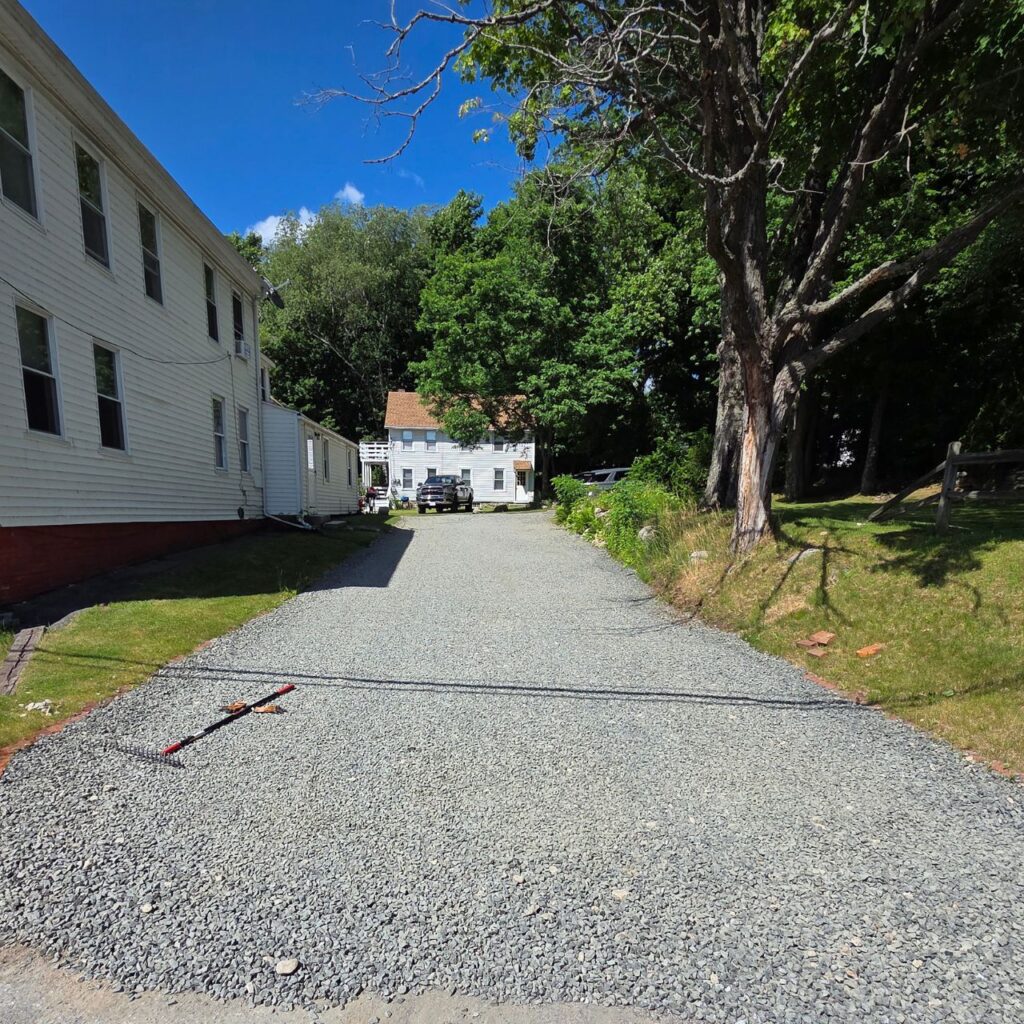
Gravel driveway installation is the construction of a stone driveway from the ground up: the excavation, the base, the stone layers, and the shaping that decides whether the surface sheds water or becomes a ribbon of ruts. Done properly, gravel driveway installation produces one of the most practical surfaces a Central Massachusetts property can have, tough against frost, easy to maintain, and honest about the ground beneath it. This guide explains what real gravel driveway installation involves and why the invisible layers matter more than the stone you see. It is the same work we do every week through our Central Massachusetts gravel installation and driveway services, explained in plain language.
This post is part of our gravel series. For the full picture of stone surfaces from driveways to pads, start with our pillar guide to what gravel installation is.
What Is Gravel Driveway Installation, Exactly?
Gravel driveway installation is layered construction, not stone delivery. The route gets excavated down through topsoil to ground that can carry weight. A base of larger crushed stone goes in and gets compacted until it locks. Finer stone layers build on top of it, each compacted in turn. The surface gets shaped with a crown, a slight rise along the centerline, so water runs off both edges instead of down the middle. Every layer has a job, and the finished driveway performs exactly as well as its weakest one.
The distinction matters because half the gravel driveways in New England were never installed at all, just poured. Stone dumped on stripped grass looks like a driveway for a season or two. Then traffic pushes the stone into the soft ground below, frost heaves what remains, and the owner starts a cycle of adding stone to a surface that can never hold it. Proper gravel driveway installation breaks that cycle by building the structure the stone sits on.
The Base Decides Everything
The base is the driveway. Excavation removes the organic soil that would compress and rot, then compacted crushed stone builds a platform that spreads vehicle weight into ground that does not move. Depth depends on soils and expected loads, deeper over soft ground, deeper where trucks will travel. Compaction happens in lifts, layer by layer, because stone compacted six inches at a time locks solid while stone dumped two feet deep never fully settles. When a driveway fails early, the surface takes the blame, but the base almost always committed the crime.
Stone Layers and Materials
Stone is graded by size, and the layering runs coarse to fine: larger angular stone in the base for structure, mid-size stone above it, and a surface layer fine enough to drive on comfortably but angular enough to lock together. Angularity is the quiet requirement, crushed stone with sharp edges knits into a surface; rounded pea stone rolls forever and never locks. The finished profile is a stack of layers, each doing a structural job, which is why a real installation quotes layers and depths rather than just truckloads.
Crown, Pitch, and Drainage
Water is the enemy of every driveway, and shape is the defense. The crown sheds water to the edges. The pitch along the driveway’s length keeps water moving instead of ponding. Edges release water into stable ground, a swale, or a planned path like the ones in our yard drainage guide, rather than a growing washout. On sloped Central Massachusetts lots the drainage design works harder than the stone: water bars, pitch breaks, and edge management decide whether spring runoff flows off the driveway or excavates it. A gravel surface with correct shape survives storms that destroy a flat one.
Timing and Site Conditions
Ground condition sets the calendar. Gravel driveway installation wants firm, dry ground for excavation and compaction, which in this region means late spring through fall. Mud season is the enforced off-season: building on saturated March ground locks softness into the base permanently. Frozen ground blocks proper excavation. The practical gravel driveway installation window here runs roughly May through November, and within it, the drier the ground during construction, the better the driveway performs for the rest of its life.
What Gravel Driveway Installation Looks Like as a Project
A typical gravel driveway installation runs in a clean sequence. The route gets marked and Dig Safe clears the ground. Excavation, the same discipline we cover in our residential excavation guide, strips the route to stable soil, and the spoils leave the site or become fill elsewhere on the property. Base stone arrives, spreads, and compacts in lifts. Finer layers follow the same rhythm. The crown and pitch get shaped, edges get finished, and the surface gets a final compaction pass. On most residential routes the whole gravel driveway installation runs its course quickly once the ground is open, which surprises owners who expected weeks of disruption.
The quality checkpoints are worth knowing even if you never operate a machine. Ask how deep the excavation goes and what the base depth will be. Ask how many lifts the compaction runs. Ask where the water leaves the driveway and what happens where it lands. A contractor who answers those four questions specifically is describing real gravel driveway installation; vague answers usually mean stone on grass instead of gravel driveway installation. It is the least glamorous checklist in construction and the most predictive one.
Ownership after the build is simple but real. A gravel surface wants occasional regrading to restore its crown, top-up stone every few years as the surface works down, and attention after the kind of storm that moves material. None of this is failure; it is how the surface is designed to live. Owners who fold an hour of seasonal attention into their routine get decades from one properly executed gravel driveway installation.
It helps to know what gravel driveway installation is not, because the alternatives get sold hard. It is not a paving substitute that failed to graduate; a properly built stone surface is a deliberate choice with real advantages here: it flexes with frost instead of cracking, repairs by regrading instead of demolition, and handles the freeze and thaw cycle that shortens the life of rigid surfaces. It is also not a temporary measure; the oldest farm roads in Central Massachusetts are stone construction that outlived every coating applied near them. For long routes, sloped routes, and owners who value repairability, stone is often the better engineering answer, not the budget compromise.
In Massachusetts, Watch Out for These
A new driveway usually means a permit conversation. Many Massachusetts towns require a driveway or curb cut permit where a new drive meets the road, with sight lines reviewed for safety. Replacing an existing surface typically skips this, but a new route to the street should start at the town office. Any excavation also means Dig Safe at 811, at least 72 business hours before digging, which the contractor files as part of the job.
Frost is the standing local test. The freeze and thaw cycle attacks every soft spot and every drainage failure annually, and the 48-inch frost line that governs foundations also explains why driveway bases here are built deeper and drained better than in gentler climates. Plowing is the other regional factor: a properly installed surface with locked, angular stone takes years of plowing gracefully, while a loose surface donates a layer of stone to the lawn every winter.
Frequently Asked Questions
What is gravel driveway installation?
Gravel driveway installation is the full construction of a stone driveway: excavating the route, building a compacted base, placing stone in layers, and shaping the surface with crown and pitch so water sheds off it. The layered build is what separates a driveway that lasts decades from a load of stone dumped on grass.
How long does a properly installed gravel driveway last in New England?
The base lasts decades when built correctly. The surface layer works down and thins over years of plowing and traffic, which is why periodic top-ups are part of gravel driveway ownership. A driveway that ruts or heaves within a few years almost always had a base problem, not a stone problem.
Why does the base matter more than the surface stone?
Because the base carries the weight. Surface stone spreads the load; the compacted base below it transfers that load to ground that will not move. New England frost attacks any soft spot every winter, so a driveway is only as good as the layer you never see.
When is the best time to install a gravel driveway in Central Massachusetts?
Late spring through fall, once the ground has fully firmed from mud season. Building on saturated spring ground locks softness into the base. Frozen winter ground prevents proper excavation and compaction. Most local installations happen between May and November for exactly these reasons.
Do I need a permit for a new driveway in Massachusetts?
Often yes, for a new driveway connecting to a road: many towns require a driveway or curb cut permit, and sight lines at the street get reviewed. Replacing or resurfacing an existing driveway typically does not. Your contractor or the town’s highway department can confirm what your project needs.
A gravel driveway built in layers on a real base is one of the most durable, maintainable surfaces available to a Central Massachusetts property. Our Central Massachusetts gravel installation team builds them across Grafton, Worcester, Shrewsbury, Northborough, and the surrounding towns, and estimates are always free. Request a free estimate and we will walk your route with you.