
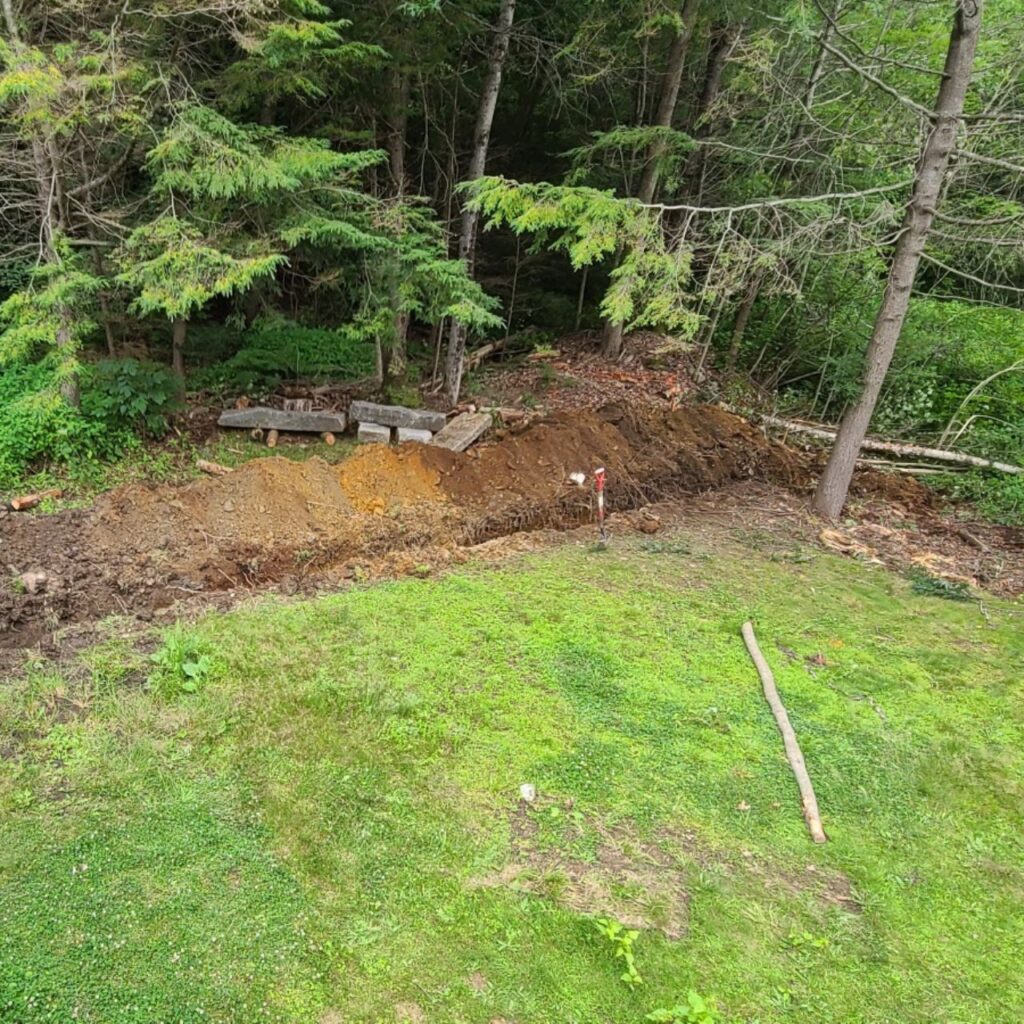
Runoff management is the work of deciding where water goes when it crosses a property, then shaping the ground so it actually goes there. The most common runoff management tool is a swale, a shallow grassed channel that intercepts surface water and carries it around whatever needs protecting. It is the same work we do every week through our drainage and grading service, and it is one of the few fixes that works with gravity instead of fighting it.
What Is Runoff Management, Exactly?
Runoff is simply the rain that does not soak in. When a storm drops more water than the ground can absorb, the excess starts moving downhill across the surface, gathering as it goes. Runoff management is the practice of reading that movement, then giving the water a deliberate route with enough capacity to handle it and a safe place to end up.
That makes runoff management different from most drainage repairs. A basin, a pipe, or a dry well collects water at a point. Runoff management deals with water spread across an area, moving as a sheet or as a shallow stream, often arriving from somewhere you do not own. The answer is usually shaped ground rather than installed product, which is why finished runoff management tends to look like landscape instead of construction.
It also sits inside a bigger picture. Every property has a water budget, and any change to one part of it moves water somewhere else. That is the reason runoff management gets planned across a whole lot rather than section by section. Our full guide to drainage and grading covers how the pieces fit together.
Where the Water on Your Property Actually Comes From
Most homeowners assume the water in the low corner of the yard fell there. Usually it did not. It came off a hill behind the house, off a town road that crowns toward your frontage, off an abutter’s driveway, or off your own roof through downspouts that end six inches from the foundation. The first job in any runoff management plan is separating those sources, because each one gets handled differently.
Central Massachusetts makes this more interesting than flat country does. The terrain rolls, ledge sits close to the surface in a lot of towns, and glacial till packs tight enough that water travels on top of it rather than through it. A yard can look dry all summer and still take on serious volume during a March thaw because the ground below is frozen or simply too dense to accept anything.
Volume also arrives in bursts. A short, hard summer storm can put more water across a lot in twenty minutes than a full day of steady November rain. Sizing runoff management for the average storm is how good intentions end up washed out, so the shaping gets built for the storms that actually cause damage.
How a Swale Works
The swale is the workhorse of runoff management on residential ground: a shallow, wide, gently pitched channel cut into the ground and stabilized with grass. Water enters it along its length rather than at one inlet, then moves slowly down its centerline to an outlet. Because the bottom is broad and the pitch is mild, a swale can carry a surprising amount of water without ever moving it fast enough to cut into the soil.
The practical advantages are hard to beat. There is nothing to clog, nothing to crush, and nothing to freeze shut. It can be mowed with the rest of the lawn. It does not fail quietly the way a buried pipe does, because you can see the whole thing. And when it is built at the right width, most people stop noticing it entirely after the second season of grass.
A swale is not a ditch, and the difference matters. A ditch is narrow, steep sided, and built to move water fast, which is exactly what erodes soil and makes mowing dangerous. A swale trades speed for width. Slow water carries less soil, drops what it is carrying, and gives the ground a chance to absorb some of it along the way.
Reading the Land Before Runoff Management Work Starts
The most useful runoff management site visit happens during or just after a storm, when the evidence is still on the ground. Absent that, the land keeps records. Silt fans at the bottom of a slope, flattened grass all pointing one direction, exposed tree roots, moss on the north face of a lawn, a gully forming beside a driveway edge: each one marks a path water has been using for years.
Then the grades get shot with a laser level so the plan rests on numbers instead of impressions. Ground that looks flat almost never is, and ground that looks like it falls away from the house sometimes falls back toward it for the first several feet. Any honest runoff management plan starts with knowing which way the dirt actually goes.
We look for the outlet first. Elevation is the one thing on a property that cannot be negotiated, so the lowest usable discharge point sets the ceiling for everything upstream of it. If there is no outlet with enough fall, the whole approach changes before a single machine gets unloaded.
The owner supplies the rest. Which storms cause trouble, how long the water sits afterward, whether the wet spot is new, what changed nearby in the last few years. A neighbor who cleared trees or paved a driveway can rewrite a runoff management problem without ever touching your land.
Depth, Pitch, and Width That Make a Swale Work
Pitch is the first runoff management decision. Too little and the water stops moving, sits, and turns the channel into the wet spot it was supposed to cure. Too much and the water accelerates, scours the bottom, and starts carrying soil downstream. The workable range is a gentle, continuous fall with no flat pockets and no sudden drops, held consistent from the top of the run to the outlet.
Width and depth get traded against each other. Wide and shallow is almost always the better answer on a lawn: it carries the same volume, mows safely, drains its own edges, and stays invisible. Narrow and deep only makes sense in a tight side yard where there is no room to spread, and then the sides need real stabilization.
Soil decides the finish. Sandy loam holds a grassed channel with nothing more than seed and straw. Silty ground that moves easily may need an erosion blanket until roots take. Where a run is steep or a bend concentrates flow, a stone-lined center or a series of low check dams slows the water at the exact spot that would otherwise wash first.
Where the Water Goes: Discharge That Holds Up
Every route needs an ending, and the ending is where most runoff management projects fail. A good outlet has three qualities: it is lower than everything feeding it, it can absorb or carry the volume arriving, and it is somewhere the water is entitled to be. A wooded low area on your own land, an existing drainage way, or a stabilized bank all qualify. The middle of an abutter’s lawn does not.
The discharge point itself gets armored. Water leaving a channel or a pipe at speed digs a hole, and that hole grows every storm until it undermines whatever is above it. A stone apron, a spreader that fans the flow back out into sheet movement, or a short run of rip rap turns a concentrated jet back into something the ground can handle.
Where the fall is there but the route crosses ground that has to stay usable, buried pipe finishes the job. Our guide to french drain installation covers that side of it, including how outlets are set so they daylight cleanly instead of backing up.
When Runoff Management Needs Pipe as Well as Shaped Ground
Shaped ground and buried pipe are not competing approaches in runoff management. They solve different halves of the same problem, and most properties need some of each. Surface shaping handles volume and sheet flow across open ground. Pipe handles crossings, tight spaces, and concentrated sources that would carve a channel if you let them run on the surface.
The obvious case is a driveway. Water arriving from uphill has to get to the other side, and it either goes under through a culvert or over the top through a shaped dip. Both work. Which one is right depends on the volume, the grade of the drive, and how much traffic crosses it in a day.
Roof water is the other case. Downspouts concentrate an entire roof plane into one point, which is far too much energy to dump onto a lawn. Piping that water out to a swale, a stabilized outlet, or a dry well takes the concentration out of the system before the runoff management plan has to deal with it.
Where a yard already holds water long after a storm, the correction usually combines both tools. That work is covered in our guide to standing water solutions, which starts from the same grade reading described above.
Berms and Diversions That Intercept Water Uphill
The simplest runoff management correction is almost always the highest one. Water that never reaches the wet part of a property does not have to be moved out of it, so a diversion cut across the slope above a house often does more than anything installed below it. It is a swale placed on contour, catching sheet flow and turning it sideways before it ever picks up speed.
A berm is the same idea built up instead of dug in. Soil is placed and compacted into a low ridge that redirects flow around a target, usually paired with a shallow channel on its uphill side. Berms are useful where digging is limited by ledge, roots, or a septic system, and they read as landscape once they are seeded.
Slope corrections often travel with this work, since a diversion is only as stable as the grade it sits in. That is covered in our guide to regrading and slope correction.
Driveways, Roads, and Water Borrowed From a Neighbor
Roads are runoff machines. A crowned town road sheds everything that lands on it toward the shoulders, and the shoulder is often somebody’s frontage. Add a paved driveway apron, and a property can be receiving water from an acre of pavement it does not own. None of that is unusual, and road water is the most common runoff management problem we get called about along a frontage.
The practical response is interception at the property line, with enough capacity for what the road actually delivers. Where a town drainage system is involved, the highway department has to be part of the conversation before anything is tied into it, because connecting private drainage into a public system without permission tends to get reversed at the owner’s expense.
Abutters deserve the same care. Taking water that used to spread across a wide edge and concentrating it into a single stream aimed at the next lot is how drainage projects turn into legal problems. Good runoff management keeps discharge on your own ground or in an established drainage way, spread out rather than aimed, and starts with a conversation when a shared edge is involved.
Erosion Control While the Ground Is Still Bare
Freshly shaped soil is at its most vulnerable the day the machine leaves. Nothing is rooted, the surface is loose, and the first hard rain can undo a week of careful shaping. Stabilization is part of runoff management, not a follow up: seed and straw on gentle runs, erosion control blanket where the pitch is steeper, stone where water enters or leaves.
Timing matters in New England because seed needs warmth to germinate. Work finished in late fall gets a dormant seeding and a heavier mulch or blanket so the surface is protected through winter and the grass comes in when the ground wakes up. Work finished in the growing season gets watered in and checked after the first storm.
Freeze and thaw are the local complication. Water in the top few inches of soil expands as it freezes, loosens the surface, and leaves it ready to move on the next thaw. Ground with roots in it survives that cycle. Ground left bare through a Central Massachusetts winter usually does not.
Runoff Management Around Foundations and Outbuildings
Buildings are the reason most runoff management work gets called in. A foundation wants positive slope away from it for the first several feet, downspouts carried well past that, and no low pocket beside the wall where water can pond and sit. Get those three right and a wet basement problem often turns out to have been a grading problem all along.
Sheds, garages, and pads need the same thinking at a smaller scale. A gravel pad set into a slope without a channel above it becomes a dam, and the water backs up behind it until it finds a way around. A shallow diversion uphill of the pad solves that before it starts, and it is far easier to build during construction than after.
Older homes in Grafton, Worcester, Shrewsbury, and Northborough often have decades of added mulch, patios, and beds that quietly raised the grade against the foundation. Restoring the pitch away from the wall is unglamorous runoff management, and it fixes more basements than any product sold for the purpose.
In Massachusetts, Watch Out for These
Wetlands rules reach further than most owners expect. Work within 100 feet of a wetland or 200 feet of a perennial stream falls under the state Wetlands Protection Act and is administered locally by your Conservation Commission. The statute itself, Massachusetts General Laws Chapter 131, Section 40, requires written notice and an order of conditions before anyone removes, fills, dredges, or alters protected ground. A swale that ends near a wet area is exactly the kind of runoff management that triggers a filing.
Digging means calling first. Shaping a runoff management channel counts as excavation, so Dig Safe notification through 811 is required at least 72 business hours ahead, and business hours exclude weekends and holidays. The state guidance on Dig Safe spells out what gets marked and what does not. Private lines such as an irrigation main, a propane run, or an invisible fence are not covered by the public markout and have to be located separately.
Frost sets the calendar. Massachusetts foundation work is built to a frost depth of about 48 inches, and while a grassed channel is a surface feature, anything buried alongside it has to respect that same depth to avoid heaving. Late winter through mud season is also when saturated ground rides worst under equipment, which is why some runoff management work gets scheduled rather than rushed.
Local rules are the last layer. Individual towns carry their own stormwater and earth removal bylaws, some require a permit for grading beyond a certain area, and tying anything into a municipal drainage system needs the highway department’s sign off. Those calls take a morning and save a season.
What Runoff Management Looks Like a Year Later
Good runoff management disappears. A year on, the channel is grassed over and mows like the rest of the lawn, the low corner that used to hold water for three days after a storm dries within hours, and there is no silt fan at the bottom of the slope because nothing is moving soil anymore. The property simply stops having a water conversation.
The failure modes are equally visible. A channel that holds standing water means the pitch is wrong or the outlet is blocked. A bare centerline means the water is moving too fast for grass. A new wet spot downstream means the volume got moved without being given a real place to go. All three are correctable, and all three are easier to spot in the first season than the fifth.
It is also worth being honest about limits. Runoff management moves surface water, and no amount of shaping turns naturally wet ground into dry ground. Land with a high water table or a spring under it will always be damp in season. The goal is a property that sheds storms cleanly and stays usable, not one that pretends to be somewhere it is not.
Maintaining a Swale Without Undoing It
Runoff management maintenance is close to nothing, which is the point. Mow it with the lawn, keep the outlet clear of leaves and brush, and walk the length after a heavy storm to see whether anything moved. Sediment that collects in the bottom over several seasons gets skimmed off so the channel keeps its shape rather than slowly filling in.
The real risk is people, not weather. A raised bed built across the low line, a fence with posts set in the channel, a load of loam spread to level out that annoying dip, a shed placed in the one open spot: each of those cancels the work without anyone realizing what the dip was for. Knowing where the route runs keeps it intact.
It helps to tell whoever mows and whoever landscapes. A grassed channel is invisible by design, and runoff management only holds up when the people working on the property month to month know the shape is doing a job.
Frequently Asked Questions
What is the difference between a swale and a ditch?
Width and speed. A ditch is narrow and steep sided, and it is built to move water away fast, which is exactly what scours soil and makes mowing along it awkward or unsafe. A swale is wide, shallow, and gently pitched, so it carries the same volume at a much lower velocity and stays part of the lawn. Slow water also drops the sediment it is carrying instead of delivering it downstream. On residential runoff management we reach for a swale almost every time, and save the harder profile for places where there is genuinely no room to spread the flow out.
Do I need a permit for runoff management work in Massachusetts?
It depends on where the work sits. Ordinary regrading on dry upland ground away from resource areas usually does not require a state permit. Work within 100 feet of a wetland or 200 feet of a perennial stream falls under the Wetlands Protection Act and requires a filing with your local Conservation Commission before anything is altered. Any digging, including cutting a channel, requires Dig Safe notification through 811 at least 72 business hours ahead. Individual towns may also have their own stormwater or earth removal bylaws, and tying into a municipal drainage system always needs the highway department’s approval first.
Will a swale work if my yard is almost flat?
Sometimes, and the answer comes from a laser level rather than the eye. Ground that reads as flat often has several inches of fall across a hundred feet, which is enough to move water in a properly shaped channel. What matters more is whether there is an outlet lower than the wet area, because water will not climb to leave. Where the fall genuinely is not there, the plan changes: interception uphill so less water arrives, buried pipe to a lower point, or a designed area that holds water briefly and releases it slowly instead of trying to drain it.
When is the best time of year for runoff management work in Central Massachusetts?
Late spring through early fall is the strongest window, mainly because seed germinates and the shaped ground stabilizes quickly. Firm summer conditions also carry equipment across a lawn without rutting it. Late fall work is entirely workable with a dormant seeding and a heavier mulch or erosion blanket to hold the surface through winter. The season we avoid where possible is mud season, roughly late winter into early spring, when saturated ground damages easily and nothing seeded will take. We work year round in Grafton, Worcester, Shrewsbury, and Northborough, and simply match the machine and the finish to the conditions.
Can I just pipe the water instead of shaping the ground?
Pipe is the right answer for crossings, tight side yards, and concentrated sources such as roof downspouts, and most projects use some of it. What pipe does not do well is handle large volumes of sheet flow moving across open ground, because every gallon has to find an inlet before the pipe can help. Inlets clog, freeze, and get buried under mulch. Shaped ground accepts water along its entire length with nothing to maintain. The durable runoff management answer on most properties is both: surface shaping for the volume, pipe for the specific places where the water has to go under something.
Runoff management is one of the few improvements that pays off every time it rains and then asks for almost nothing back. If there is a slope sending water at your house, a corner that stays wet three days after a storm, or a driveway that turns into a stream in Grafton, Worcester, Shrewsbury, or Northborough, we are glad to walk the property with you and tell you honestly where the water is coming from and where it can go. When you are ready for numbers, our estimates are always free.