
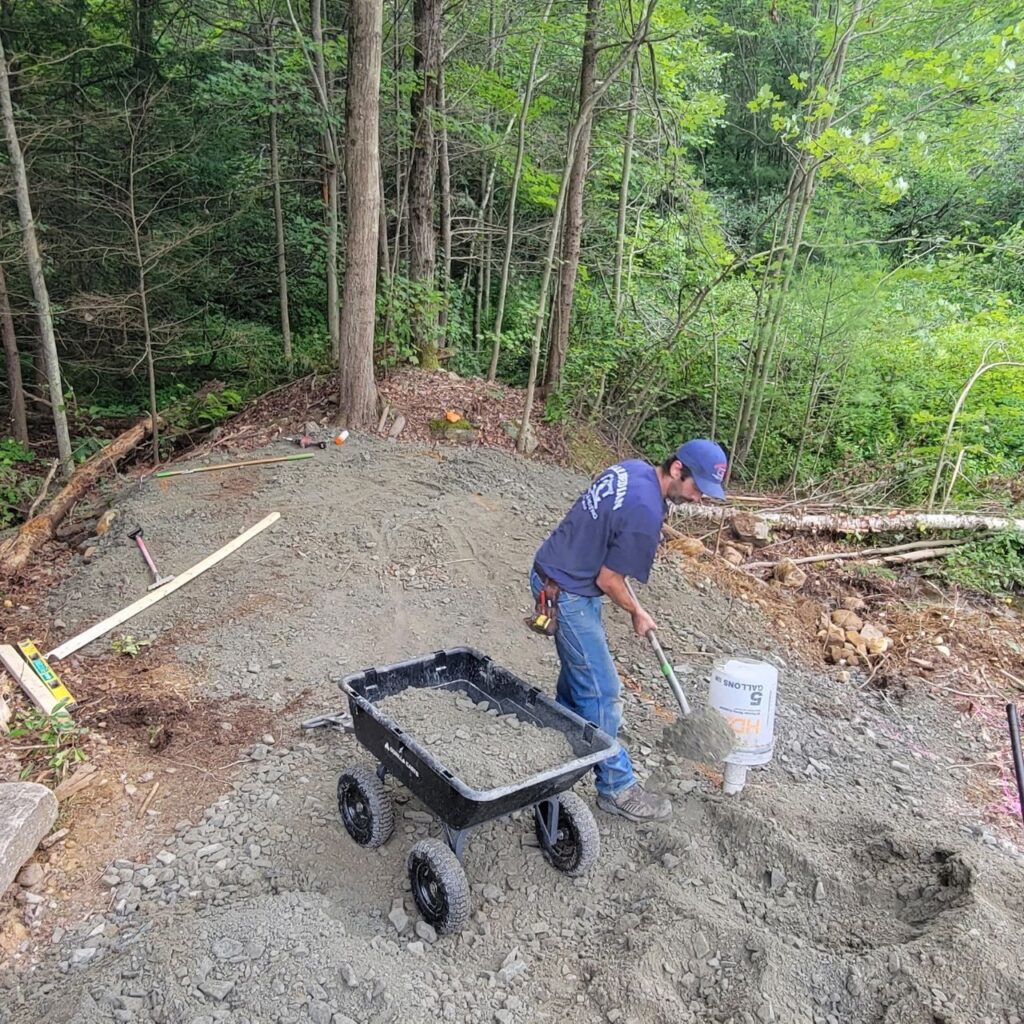
Backfilling and compaction is the work of putting excavated ground back the right way, returning soil or stone around a foundation, over a trench, or behind a wall in thin layers and packing each layer down before the next one goes in. It is the quiet second half of every dig, and it decides whether the ground stays where you put it or slowly sinks for the next ten years. It is the same work we do every week through our excavation and trenching service across Central Massachusetts.
Homeowners watch the digging because digging is dramatic. A machine opens a hole in a morning and the change is obvious. Backfilling and compaction is the opposite: slow, repetitive, and invisible the moment it is finished. That is exactly why it gets rushed by the wrong crews, and why so much of what looks like a foundation problem or a drainage problem started as a fill problem. Backfilling and compaction is a core part of excavation and trenching, not a cleanup step tacked on at the end.
This guide covers what backfilling and compaction actually is, why loose soil behaves the way it does, how lifts and moisture control work, what material belongs against a foundation and what does not, how trenches over pipe are handled, what failure looks like years later, and the frost, Dig Safe, and wetland rules Massachusetts adds on top.
What Is Backfilling and Compaction, Exactly?
Backfilling is the placement of material into an excavated space after the work in that space is done. Compaction is the mechanical densifying of that material as it goes in, pressing the particles closer together and driving out the air trapped between them. The two words describe one continuous operation, which is why the trade almost always says them together.
The material can be the same soil that came out of the hole, imported structural fill, crushed stone, or a combination layered by depth. The choice depends on what sits above it and what has to drain through it. Backfilling and compaction against a basement wall is a different problem from backfilling and compaction over a water line, and both are different from the fill under a slab.
What makes it engineering rather than shoveling is the sequence. Material goes in at a controlled thickness, gets compacted, gets checked, and only then does the next layer go on. Skip the sequence and you have not backfilled anything. You have refilled a hole with loose dirt and left the settling for the property owner to discover.
Why Loose Soil Never Stays Where You Put It
Soil in the ground has been under load for a very long time. It has been squeezed by everything above it, drained and redrained, and worked over by frost cycles until the particles found their tightest arrangement. That is why undisturbed subgrade holds a building, and why fill has to rebuild that condition rather than assume it.
The moment a bucket lifts that soil out, all of it undoes. The material fluffs, air fills the voids, and the same soil now occupies noticeably more volume than the hole it came from. Dump it back loose and it will look full and even proud of grade, which fools people constantly. Then water works through the voids, the particles rearrange, and the surface drops.
That drop is not optional and it is not slow if the fill was loose. A trench refilled without compaction will show a visible trough after the first heavy rain and keep sinking through the first winter. Backfilling and compaction exists to spend that settlement on purpose, with a machine, before anything is built on top of it or planted in it.
The other half of the problem is that settlement is never even. Fill compacts more where it is deeper and less where it feathers out, so the surface does not sink flat. It tilts, cracks, and opens gaps at the edges where it meets ground that never moved.
How Backfilling and Compaction Works in Lifts
Backfilling and compaction is done in lifts, and a lift is simply one layer of material placed and compacted before the next one goes on. Lift thickness is the single most important number in the operation, and it is smaller than people expect. Compaction energy only travels so far down through material, so a plate compactor working the top of a deep pile leaves the bottom of that pile untouched and loose.
The workable lift thickness depends on the material and the machine. Granular stone under a heavy vibratory roller takes a thicker lift than clay soil under a hand tamper. Crews size the lift to the equipment on site rather than to a number in a book, but the principle never changes: thin enough that the compaction reaches the bottom of the layer.
Each lift gets worked over multiple passes in overlapping paths, the same way you would mow a lawn without leaving stripes. The operator listens and watches, because material that has reached density behaves differently under the machine. It stops moving, the sound changes, and the plate begins to bounce rather than sink.
Backfilling and compaction done in lifts takes longer than dumping and looks like almost nothing is happening. That is the correct appearance. A crew that fills a four foot excavation in twenty minutes did not compact it, and no amount of surface tamping afterward will fix what is loose three feet down.
Choosing the Right Backfill Material
The excavated soil is the default choice because it is already on site, but it is not always the right choice. Heavy clay holds water, swells when wet, and shrinks when dry, which is the last behavior you want pressed against a wall. Silty soils turn to soup at the wrong moisture. Topsoil and anything organic is disqualified everywhere below finish grade, because organics decay and leave voids behind years later.
Granular material is the workhorse for backfilling and compaction where performance matters. Sand, gravel, and crushed processed stone compact readily, drain freely, and behave predictably across the moisture range New England throws at them. Where the fill has to both support load and shed water, granular material is usually specified for the lower portion and native soil is used higher up.
Rock and debris are their own trap. Large stones bridging inside a backfill create voids under them that no compactor can reach, and those voids collapse later. Stumps, wood, and construction debris buried in fill are a slow guarantee of a sinkhole in the lawn. Backfilling and compaction only works with clean material in and clean material compacted.
Material choice also has to respect what is above. Fill destined to carry a slab, a walkway, or a driveway is a structural decision. Fill that will only ever grow grass can be more forgiving. Getting that distinction right at the time of backfilling and compaction is far cheaper than discovering it under a cracked walkway.
Foundation Backfill: Why Walls Care How the Dirt Goes Back
A foundation wall is engineered to be braced. In a finished house the floor framing at the top and the slab at the bottom hold the wall against the soil pressure pushing in on it. During construction, before that framing exists, the wall is a tall cantilever and it is at its most vulnerable exactly when the crew wants to start backfilling and compaction.
That is why the order of operations matters so much on new work. Backfilling and compaction against a green or unbraced wall is how walls crack, bow, or push in, and the damage happens in minutes with a machine that has no idea it is doing it. Waiting for concrete strength and for the bracing to be in place is not caution, it is the job.
Equipment position matters just as much as timing. A loaded machine driving right at the edge of an open excavation adds a surcharge load the wall was never designed for. Careful crews work back from the edge, place material by reaching rather than driving, and do the backfilling and compaction closest to the wall with smaller equipment.
The material against the wall should drain. Water that collects in poorly draining backfill puts hydrostatic pressure directly on the foundation and finds every weakness in the waterproofing. Granular backfill next to the wall, tied into a footing drain, is the standard answer and it is a direct extension of foundation excavation done properly in the first place.
Trench Backfill Over Pipe and Conduit
A trench is the hardest backfilling and compaction problem on most residential sites, because there is something fragile at the bottom that the compaction is trying to protect and also trying not to break. Pipe, conduit, and cable all sit in a zone where the backfilling and compaction rules are different.
The bedding under the pipe comes first and it has to be uniform. A pipe supported at two points with a gap between them will eventually crack at the unsupported span. Sand or fine stone shaped to cradle the pipe gives it continuous support along its whole length.
Above the pipe comes the haunching and initial backfill, placed carefully by hand or with light equipment and worked into the space beside the pipe where a machine cannot reach. Heavy compaction directly over a shallow pipe can crush it, so the first lifts over the crown are deliberately gentle and the heavy equipment stays off until there is enough cover.
From there, normal backfilling and compaction discipline resumes in lifts to the surface. This is the stage that gets skipped most often, and it is why so many yards have a long shallow trough tracing exactly where a water or electric line was run. Anyone doing utility trenching properly treats backfilling and compaction as half the job rather than the end of it.
Tracer tape or warning tape belongs in the backfill above buried utilities, set well below finish grade so the next person who digs finds it before finding the line itself. It costs almost nothing and it is the cheapest protection a buried service will ever get.
The Equipment That Does the Compacting
The plate compactor is the machine most people picture: a vibrating steel plate under a walk-behind frame that densifies granular material fast. It works by shaking particles into a tighter arrangement rather than crushing them, which makes it excellent on sand and stone and mediocre on heavy clay.
The rammer, sometimes called a jumping jack, works the opposite way. It delivers a hard impact over a narrow foot, which drives energy deep into cohesive soils and fits into trenches too narrow for anything else. Where a plate glides, a rammer punches.
Ride-on and towed rollers handle open areas and thicker lifts on larger jobs, and hydraulic compaction attachments mount to the excavator arm so the operator can compact inside a trench without anyone standing in it. Doing the backfilling and compaction from the machine is a genuine safety improvement on deeper work, because the safest trench is one nobody is standing in.
The bucket of the machine is not a compactor, even though it gets used as one. Tamping fill with the back of a bucket densifies the top few inches and leaves everything below it loose. Real backfilling and compaction means the right tool matched to the material, the lift, and the space available.
Moisture Content: The Hidden Variable in Backfilling and Compaction
Every soil has a moisture level at which it compacts most easily, and being off that mark in either direction costs density. Too dry and the particles have too much friction to slide into place, so the same machine and the same passes accomplish less. Too wet and the water fills the voids the compaction is trying to close, and the material simply moves around instead of tightening.
That is why crews water dusty fill on a hot week and why they walk away from saturated fill after a long rain. Neither decision is fussiness. Backfilling and compaction at the wrong moisture is work that has to be done twice.
New England makes this harder than it is in drier regions. Spring thaw leaves subgrade and stockpiles carrying more water than they can shed, which is why early spring is the worst window for backfilling and compaction on almost every site in Central Massachusetts. Late summer and early fall are the easy season.
Stockpile management is part of moisture management. Spoil left in a low spot or spread flat soaks up every rain and becomes unusable, while the same material crowned and shed properly stays workable. On a site where the excavated soil is going back in, protecting that pile is protecting the schedule.
What Bad Backfilling and Compaction Looks Like Years Later
The symptoms almost never announce themselves as fill problems, which is why they get misdiagnosed. A walkway that has developed a dip, a patio slab with a crack running across it, or a section of driveway sinking in one wheel path are all classic signs that something underneath gave up rather than something on the surface failing.
Around a house, the tell is the perimeter. Backfill that settles against a foundation creates a trench around the building that collects roof runoff and directs it straight down the wall, which is the exact opposite of what the grade is supposed to do. Homeowners see a wet basement and start pricing waterproofing when the actual problem is a few inches of settled fill.
In lawns, settlement shows as long shallow depressions that follow a buried line, or as isolated soft spots where a stump or a chunk of debris was buried. Both stay wet, scalp under a mower, and refill with topsoil year after year, and both trace directly back to fill that was never compacted.
The repair is almost always more disruptive than doing it right the first time. Fixing settled fill means reopening the area, removing the material, and rebuilding it in proper lifts, often around landscaping, hardscape, or a finished driveway that was not there when the original work was done. Backfilling and compaction is the cheapest insurance on any excavation because the alternative is buying the same excavation twice.
Backfilling and Compaction Around Existing Structures
Working next to a building that is already standing changes the constraints. There is no room to swing a full-size machine, the wall in question is finished rather than freshly poured, and the surrounding lawn, walkways, and plantings all have to survive the operation.
Access is the first limit. Narrow side yards force smaller equipment, and smaller equipment means thinner lifts and more of them. That is a schedule reality, not a shortcut to be negotiated away, and it is one of the reasons excavation around existing structures is a distinct skill rather than a smaller version of open-site work.
Vibration is the second limit. A rammer working hard against an old fieldstone foundation or beside a slab transmits energy into the structure, so crews back off the aggressive equipment near sensitive walls and take the density in more, gentler passes instead. Older homes across Central Massachusetts sit on foundations that deserve that respect.
The third limit is what is already buried. Around an existing house the shallow zone is full of irrigation lines, invisible fence, downspout drains, propane runs, and shed power, and none of it appears on a utility markout. Careful backfilling and compaction near a home starts with knowing what is down there and finishes with leaving it in better shape than it was found.
Backfilling and Compaction Behind Retaining Walls
A retaining wall is a structure that spends its whole life pushing back against fill, so how that fill goes in determines how long the wall stands. Backfilling and compaction behind a wall is not general fill work. The zone directly behind the wall is normally clean crushed stone that drains freely, separated from the native soil by filter fabric so fine particles cannot wash into it and clog it.
Drainage is doing structural work there. Water trapped behind a wall adds enormous pressure to a structure that was designed for soil load alone, and the majority of leaning and failed segmental walls in New England are drainage failures rather than block failures. A pipe at the base of the stone zone carries that water out to daylight.
Compaction behind a wall is deliberately restrained near the face. Heavy equipment working tight to the back of a wall can push the courses out of alignment as it compacts, which shows up as a bulge that never comes back. Crews compact the stone zone with hand equipment close in and bring the heavier machine into the fill further back.
The same logic applies to steep fill slopes without walls. Fill placed on a slope wants to slide, so it gets keyed into the existing ground with benched steps rather than layered over the face, and the finish shaping is handled as part of regrading and slope correction.
Topsoil, Restoration, and the Finish Grade
Structural fill stops below finish grade. The last layer over most residential backfilling and compaction is topsoil, and topsoil is deliberately not compacted hard, because grass roots need the pore space that compaction removes. A lawn established over a hard-packed subgrade struggles for years and never really thickens.
That difference has to be planned. Leaving the compacted fill at the wrong elevation means either a topsoil layer too thin to grow anything or a mound that has to be shaved off later. Crews stop the structural material at a depth that leaves room for real topsoil across the whole area.
Finish grade is where backfilling and compaction meets drainage. The surface over new fill should carry water away from the building, and it should be set slightly high over trenches and deep fill so that the small amount of remaining settlement lands the surface at grade rather than below it. Crowning fresh backfill is planning for physics rather than sloppiness.
Restoration is the part the property owner actually sees. Raking out stone, replacing topsoil, seeding, and cleaning the disturbed edges is what separates a finished job from a completed dig, and it is where a careful crew earns the next call.
When Backfilling and Compaction Has to Be Tested
On residential work, density is usually confirmed by proof: the equipment stops sinking, the material stops moving, and the surface holds up under a loaded machine driven across it. Experienced operators read that behavior accurately, and for most yard-scale backfilling and compaction it is a reasonable standard.
Structural backfilling and compaction is a different matter. Fill that will carry a slab, a footing, or a driveway to a specification is often tested against a laboratory maximum density for that exact material, with a field gauge confirming that the compacted fill reached the required percentage of it. Where a building inspector or an engineer is involved, that documentation is the deliverable.
Which path applies depends on the project, and it is a question worth asking before the fill goes in rather than after. Retrofitting proof onto backfill that is already buried means digging it back up.
Either way, the record matters. Photographs of the lifts, notes on what material went where, and the depth of cover over any buried line are worth keeping, because the next person to open that ground will have no other way to know what is under there.
Why Backfilling and Compaction Is Part of the Dig, Not an Extra
It is common to think of the excavation as the job and the fill as cleanup. On a properly run site the excavation and the backfilling and compaction are planned together from the start, because decisions made on day one determine whether the backfill goes well on day five.
Where the spoil gets stockpiled, whether it stays dry, whether it gets separated from topsoil, whether the access route survives the traffic, and how much material has to be imported are all backfilling and compaction decisions made before a single bucket of fill goes back in the ground.
Sequencing with other trades matters too. The plumber, the electrician, and the waterproofing contractor all need their work inspected and complete before the hole closes, and reopening a compacted excavation to add a missed sleeve costs far more than the sleeve. Coordinating that timing is part of the excavation scope.
That is the honest way to think about it. Backfilling and compaction is not a line to be trimmed when a project gets tight. It is the part of the work that determines whether everything above it holds its shape.
In Massachusetts, Watch Out for These
Call before you dig, and understand that the statute covers the whole operation. MGL Chapter 82 Section 40 defines excavation to include the movement or removal of earth or rock, digging, trenching, grading, augering, and backfilling itself. The law does not treat putting the ground back as a separate lower-risk activity, and neither should anyone running the machine.
The notice is free and it is not optional. Contact Dig Safe by calling 811 and give at least 72 hours of advance notice before digging, not counting weekends or legal holidays, as described in the state guide to Dig Safe. The same statute expects the work area to be premarked in white paint or white stakes so locators know where to work, and it defines a safety zone around each marked facility that heavy equipment is expected to stay out of.
Design for a 48 inch frost depth. That is the standard Massachusetts frost line, and it is why the material in the frost zone matters so much. Fill that holds water in that upper four feet will freeze, expand, and lift whatever sits on it, then set it back down out of level in the spring. Free-draining backfill is a frost strategy as much as a water strategy.
Check wetlands before moving material. The Massachusetts Wetlands Protection Act, MGL Chapter 131 Section 40, requires written notice to the local conservation commission before anyone removes, fills, dredges, or alters a wetland resource area, and jurisdiction generally reaches 100 feet out from a bordering vegetated wetland. Details are on the state page for protecting wetlands in Massachusetts. Placing fill inside that buffer is a filing, not a judgment call, and filling is named in the statute explicitly.
Expect the inspection to be local. Under MGL Chapter 143 Section 3, every city and town employs a building commissioner or inspector of buildings who administers and enforces the state building code locally, so any requirement to inspect or document fill under a structure comes from that office. One call answers it before the hole closes rather than after.
Watch the septic system. Driving loaded equipment over a leach field or reserve area during a fill operation compacts the very soil the system depends on to accept water, and that damage does not undo. The as-built plan is on file with the local board of health.
Frequently Asked Questions About Backfilling and Compaction
How long does new backfill take to settle on its own?
Longer than anyone wants, and unevenly. Uncompacted fill can keep dropping for several years as water works through it and frost cycles rearrange the particles, with the biggest movement in the first winter. That is the entire argument for compacting in lifts: it converts years of unpredictable settlement into a controlled operation that finishes the day the work does.
Can I just use the soil that came out of the hole?
Often yes, as long as it is clean mineral soil with no organics, wood, or debris and it is at a workable moisture content. Heavy clay, saturated silt, and anything with topsoil mixed in are poor candidates against a foundation or under anything structural. In those cases granular fill gets imported for the critical zone and the native soil is used higher up.
Why does my yard have a long dip where a pipe was installed?
That is trench settlement, and it means the backfill went in loose rather than in compacted lifts. Water followed the loose material, the particles rearranged, and the surface dropped along the line of the trench. The permanent fix is reopening the trench and rebuilding the fill properly, though a minor dip in a lawn can sometimes be lived with and topdressed.
Is backfilling and compaction regulated in Central Massachusetts?
The digging that precedes it is, and the statute treats backfilling as part of excavation, so Dig Safe notice applies to the whole operation. Beyond that, fill placed inside a wetland buffer requires a filing with your local conservation commission, and fill under a structure may be inspected by the building department in Grafton, Worcester, Shrewsbury, Northborough, or whichever town you are in.
When is the best time of year for backfilling and compaction in Massachusetts?
Late summer and early fall are the easy window across Central Massachusetts, because soil moisture is close to ideal and compaction goes quickly. Early spring is the hardest, since thawing ground and saturated stockpiles will not reach density no matter how many passes the machine makes. Work stops entirely once frost is in the fill, because frozen material cannot be compacted and will settle as soon as it thaws.
Getting Backfilling and Compaction Done on Your Property
Backfilling and compaction is the least photogenic part of site work and the part that decides the most. Done in lifts with the right material at the right moisture, the ground closes up and nobody thinks about it again. Done fast, it becomes a settled walkway, a wet basement perimeter, or a trench line across the lawn that reappears every spring.
D&M Good Construction handles backfilling and compaction across Grafton, Worcester, Shrewsbury, Northborough, and the surrounding Central Massachusetts towns as part of our excavation and trenching work. We plan the fill before we open the ground, because where the spoil goes and what has to be imported are decisions that get expensive after the digging starts.
If you have ground that has settled, a trench line that keeps sinking, or a project coming up where the fill needs to be right the first time, tell us what you are working with and we will walk the site with you. Our estimates are always free.