
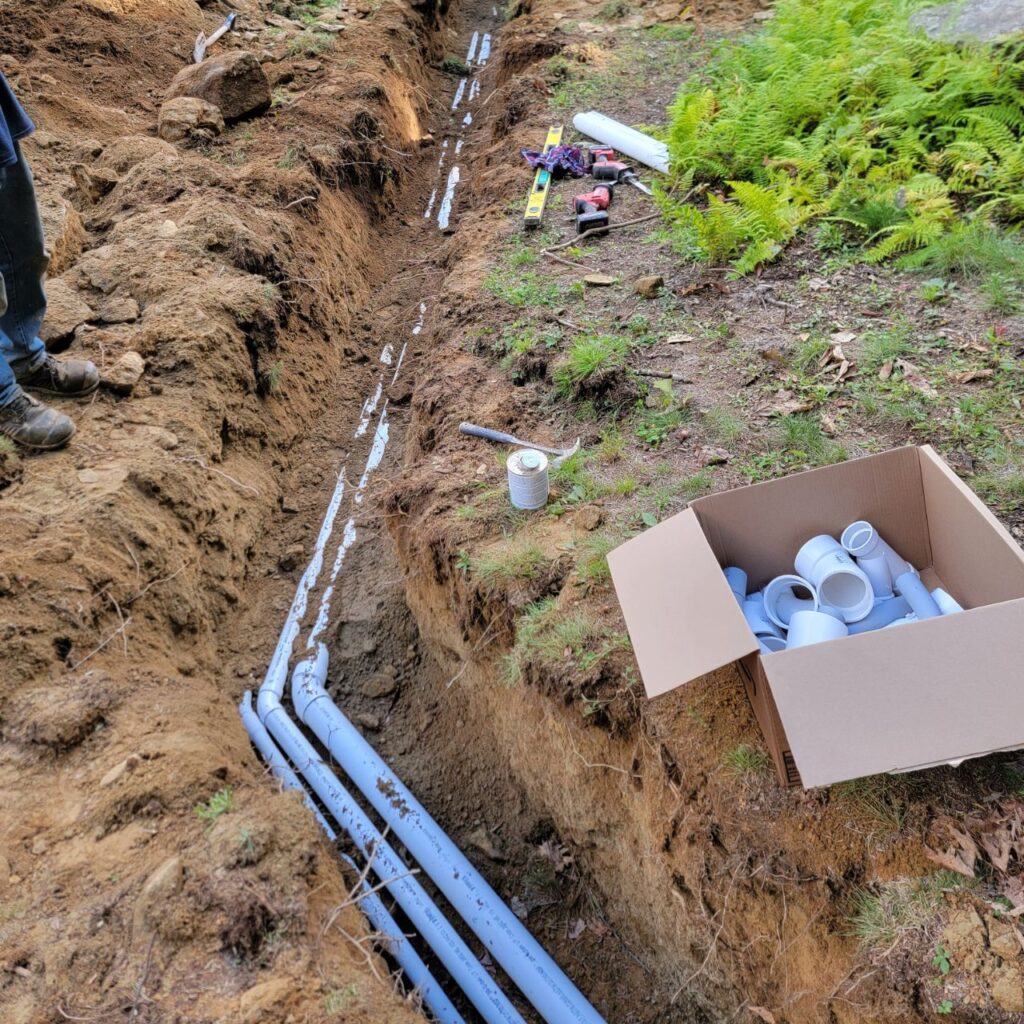
Utility trenching is the excavation of narrow, controlled channels that carry service lines between a source and a building: water, electricity, sewer, gas, irrigation, and drainage. It is the same work we do every week through our Central Massachusetts excavation and trenching service, and it is the part of a project that vanishes completely once it is done. Utility trenching is judged entirely on what happens after the trench closes, which is whether the line works, whether the ground stays put, and whether anyone can still tell where it ran.
What Is Utility Trenching, Exactly?
Utility trenching is defined by precision rather than volume. A foundation dig moves a large amount of earth to an approximate shape, and the concrete that follows corrects the difference. A trench moves a small amount of earth to an exact one, and nothing downstream corrects anything. Every buried line carries its own specification: a required depth, a bedding material it has to sit on, a separation distance from the other lines sharing the corridor, and in most cases an inspection before it can be covered.
Width is set by what has to fit and by what a person needs in order to work safely at the bottom. Depth is set by frost, by code, and by the pitch a gravity line needs to hold across its whole run. The machine work is the straightforward half of utility trenching. Reading the specification, and cutting to it rather than to habit, is the half that decides whether the line lasts. It sits inside the broader trade covered in our guide to excavation and trenching.
Water Service Lines and Frost Depth
Water is the least forgiving line utility trenching handles, because it freezes. A service line has to sit below the frost line for its entire length, which in Massachusetts means below the 48 inch depth the Massachusetts State Building Code uses for frost protection, and it has to stay there across every dip and rise between the source and the house. A trench that hits full depth at the street and then shallows out crossing a high spot in the lawn has a freeze point built into it, and that spot will find the coldest week of the year on its own.
Bedding matters just as much. The pipe is laid on sand or screened material rather than straight onto rock, because one stone bearing against a pressurized line is a slow leak waiting for the ground to move. Tracer wire or marking tape goes in above the pipe so the run can be located later without guesswork, which is worth more than it costs the first time anyone digs in that yard again.
Electric, Conduit, and Low Voltage Runs
Utility trenching for electrical service to a house, a detached garage, a barn, or a well pump is cut to depths the electrical code sets according to the circuit and to whether the conductors are direct buried or pulled through conduit. Three things matter on site regardless of the number: the depth is not a matter of preference, the inspection happens before backfill rather than after, and warning tape belongs above the run so a future shovel gets a warning instead of a surprise.
Conduit is worth the extra material on almost any residential run because it turns the next change into a pull instead of a dig. The same logic applies to everything else that could share the corridor. Irrigation lines, landscape lighting, a conduit for internet or a future generator transfer switch, all of it rides in the same open ground where separation rules allow. Adding a spare conduit while the trench is open is the cheapest utility trenching a property will ever buy.
Sewer, Septic, and the Rules of Pitch
Gravity lines answer to slope rather than depth. A sewer or septic line has no pump behind it, so it works only if it falls consistently from the building to its destination, and both too little fall and too much are real problems. Too little and solids stall in the pipe. Too much and the liquid runs away from the solids it was supposed to carry, which produces the same blockage by a different route.
That changes how utility trenching handles a gravity line. A gravity line is trenched to a grade, not to a depth: the bottom is shaped so the pipe sits fully and evenly supported at its required pitch across the entire run, with no bellies where the ground was over dug and then backfilled soft. Where a gravity line has to cross ground that already holds water, the drainage problem gets solved first, since a trench is a very efficient way to move water somewhere you did not intend. Our guide to standing water solutions covers that side of it.
Gas and Propane Lines
Fuel lines are their own category, mostly because of who is allowed to touch them. In Massachusetts, gas fitting is licensed work, and the connections belong to a licensed gas fitter no matter who opened the ground. The utility trenching side of the job is to cut to the required depth and profile, provide clean bedding, set tracer so the line can be found later, and hold the trench open and safe until the fitter and the inspector have both seen it.
The common residential version is a run from a propane tank to the house, or a service extension from the street to a new heating appliance. Neither is complicated work, and both go wrong the same way, which is a trench backfilled before somebody signed off on what is in it. Coordinating the trades and the inspection into one schedule is most of the value a contractor adds here.
How a Utility Trenching Job Is Actually Cut and Backfilled
The sequence rarely changes. Locate and mark first, always. Strip the topsoil and stage it separately from the subsoil, because putting them back in the wrong order kills the grass and nobody notices until June. Cut the trench with the spoils on one side and the working room on the other. Shape and bed the bottom. Set the line, then stop and let it be inspected.
Backfill is where trenches fail in public. Material goes back in lifts, each one compacted, starting with bedding and haunching around the pipe so it is supported from the sides and not just underneath. Dumped in loose instead, the trench line telegraphs across the lawn as a sunken scar the first wet spring, and then again every spring after that. Compacted properly, the ground stays where it was and the only evidence is a seam of new grass. Good utility trenching is invisible within a season.
Ledge is the New England variable that changes a plan mid trench. Much of Central Massachusetts sits on shallow bedrock, and a run that was going to take an afternoon becomes a different job the moment the bucket stops moving and starts ringing. Rerouting around ledge is usually the cheaper answer than cutting through it, which is why a utility trenching route is worth walking, and probing, before the machine ever arrives.
Utility Trenching Around a Finished Property
Most residential utility trenching happens on properties that people are already living on, which changes the route more than the digging. A trench has to miss the septic field, the leach lines, the well, the mature tree roots that keep a yard worth looking at, and the stone wall nobody wants rebuilt. It often has to cross a driveway or a walkway, which means saw cutting and restoring the surface deliberately rather than digging through and hoping the patch holds.
Access shapes it too. Compact machines reach backyards through side yards that a full size excavator cannot, plating keeps an open trench crossable while the work is in progress, and staging matters when the household still needs the driveway every evening. It is the same tight quarters discipline described in our guide to residential excavation, and it runs alongside the deeper digs covered in foundation excavation whenever a new structure needs both.
In Massachusetts, Watch Out for These
Three rules govern utility trenching in this state, and the first one is not optional. Massachusetts Dig Safe law requires notifying 811 at least 72 business hours before mechanized digging, not counting weekends or holidays, so buried utilities can be marked. The notice is free, it applies to homeowners and contractors alike, and the resulting markings are valid for 30 days. The requirement is explained through the state Dig Safe program, and we file it on every job.
Second is frost. Anything that carries water has to live below the 48 inch frost depth used across the state, and anything that does not carry water still has to tolerate ground that heaves every winter. Third is water itself: work within 100 feet of a wetland, stream, or pond may need review by the local Conservation Commission under the Massachusetts Wetlands Protection Act before it begins. A trench that crosses a resource area is exactly the kind of work that rule exists for, so we confirm where a property sits before any utility trenching is scheduled.
Frequently Asked Questions
Do I need to call Dig Safe for utility trenching on my own property in Central Massachusetts?
Yes. Massachusetts Dig Safe law applies to homeowners as well as contractors, and it covers mechanized digging anywhere on a property, not just near the street. You must notify 811 at least 72 business hours ahead, excluding weekends and holidays, and the markings stay valid for 30 days. We file the notice for every job we run in Grafton, Worcester, and the surrounding towns, so it is one less thing for a homeowner to track.
How deep does a utility trench have to be in Massachusetts?
It depends on what is going in it. Water lines have to sit below the 48 inch frost depth for their entire run, buried electrical depends on the circuit and whether the conductors are in conduit, and gravity sewer lines are cut to a consistent pitch rather than to a fixed depth. That is why a trench is dug to a specification rather than to a habit, and why the inspection happens before anything is covered.
Will utility trenching leave a scar across my lawn?
Not if the backfill is done properly. The trench line shows up later when material is dumped back in loose and then settles over the first wet season. Backfilled in compacted lifts, with the topsoil stripped and replaced separately so the grass has something to grow in, the run usually disappears within a season aside from a seam of newer grass.
Can a utility trench cross a driveway or a walkway?
Yes, and it happens on most residential jobs. The right approach is to saw cut the surface cleanly, trench through, then rebuild the base and restore the surface rather than patching over disturbed ground. A crossing that is rebuilt in compacted layers holds up to traffic and plowing. One that is simply filled and topped will dip within a couple of winters.
How long does utility trenching take on a home in Grafton or Worcester?
A single service run on an open lot is often a one day to two day job once Dig Safe has cleared, with the inspection scheduled between the dig and the backfill. Longer runs, ledge, wet ground, and crossings under driveways all add time. The 72 business hour Dig Safe notice is usually the real constraint on the start date, which is why we file it as soon as a project is scheduled.
Utility trenching is the least visible work on a property and the most permanent, because everything buried in a trench stays there until somebody digs it up again. We run service trenches for homeowners across Grafton, Worcester, Shrewsbury, and Northborough, we file Dig Safe on every job, and we backfill so the lawn forgets the trench was ever there. If a project needs a line brought in, extended, or replaced, reach out and we will walk the route with you. Our estimates are always free.