
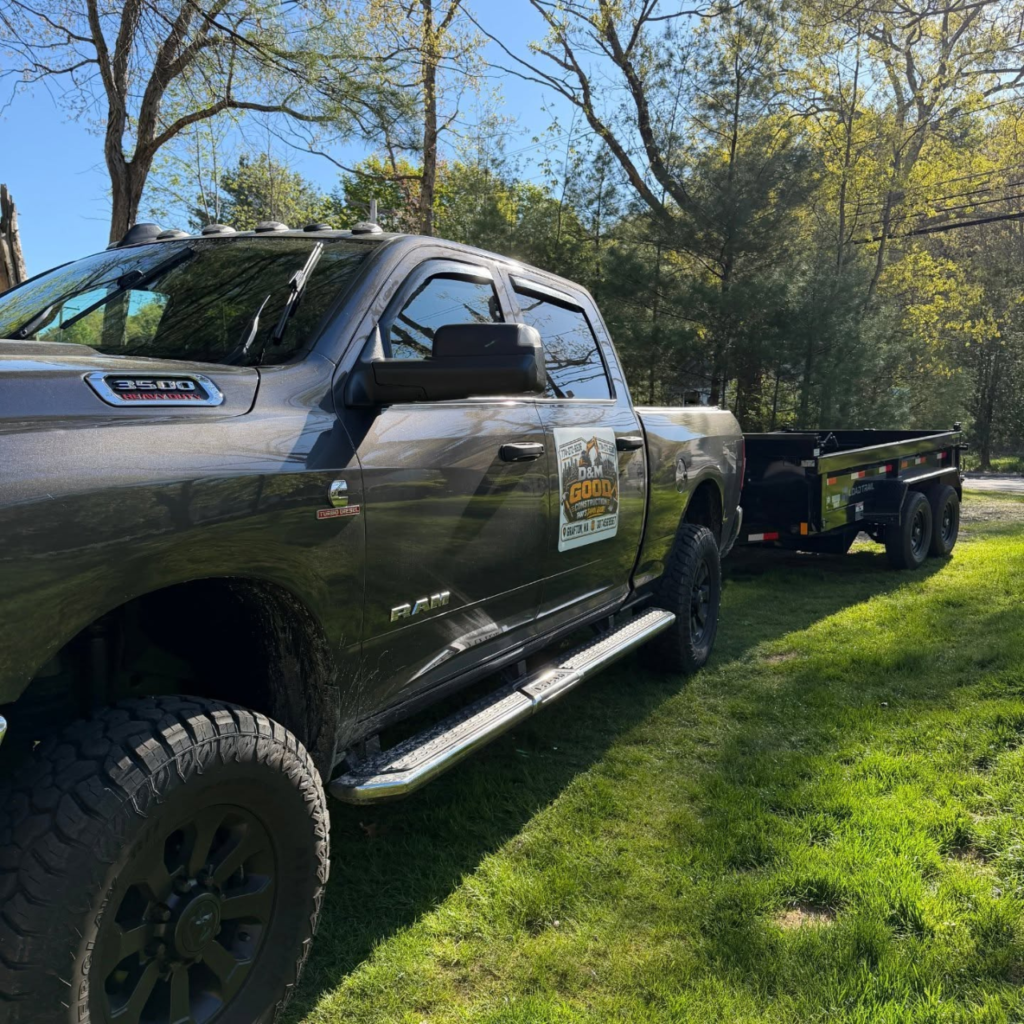
Material hauling and removal is the trucking side of site work: getting soil, stone, stumps, and debris off a property, and getting gravel, structural fill, and loam onto it. Every dig produces material that has to go somewhere, and almost every finished surface needs material brought in. It is the same work we do every week through our excavation and trenching service across Central Massachusetts.
Homeowners rarely think about material hauling and removal until the machine is already running. Then a pile of wet clay appears in the middle of the lawn, the driveway is blocked, and the question becomes where all of that is supposed to end up. The answer was decided at the planning stage, or it was not decided at all.
This guide covers what material hauling and removal actually involves, what leaves a site and what arrives, how loads get sorted and staged, where the material legally goes, and the covering, weight, disposal, and wetland rules Massachusetts adds on top. It is one specific piece of the larger picture described in our guide to excavation and trenching.
What Is Material Hauling and Removal, Exactly?
Material hauling and removal is the planned movement of bulk material between a work site and somewhere else. It covers the excess that comes out of the ground, the waste generated by clearing or tear-out, and the imported material that replaces both. On a small residential job material hauling and removal might be a handful of trailer loads. On a foundation dig it can be a steady rotation of trucks for days.
The word hauling makes it sound like driving, but the driving is the smallest part. The real work is deciding what each pile is, whether it can be reused, whether it can legally leave, where it is allowed to go, and how to load and stage it without wrecking the property on the way out. A crew that gets material hauling and removal right leaves a lawn you can mow. A crew that gets it wrong leaves ruts, a mystery pile behind the shed, and a driveway that never drove the same again.
It is also not an optional extra. Under Massachusetts law the statutory definition of excavation in the Dig Safe chapter expressly includes the movement or removal of earth and rock, along with digging, grading, trenching, and demolition of structures. See MGL c.82 section 40. Moving material is legally part of the dig, not a separate favor at the end.
Why Every Dig Turns Into a Material Hauling and Removal Job
Soil does not compress back into the hole it came from. Excavated ground swells as it is dug, so the material that comes out of a trench or a footing takes up noticeably more room than the void it left. Even when everything gets put back, there is surplus. Add a stump, a few boulders, and the topsoil stripped off a pad, and the surplus becomes a material hauling and removal problem.
The reverse is true too. Structural fill, crushed stone, and screened loam almost never exist on site in the quantity or quality a finished surface needs. So the same project that has to send material away also has to bring material in, which is why hauling shows up on both ends of the schedule. Our post on backfilling and compaction covers what happens to the material once it arrives.
Material hauling and removal is therefore rarely a single trip. It is a sequence: strip and stage, dig and stockpile, sort, remove what cannot stay, import what is needed, place it, and clean up whatever the trucks tracked around. Skipping steps in that sequence is how a two day job becomes a two week job.
What Comes Off a Site: Spoils, Stumps, Stone, and Debris
Spoils are the plain excavated soil, and they are the bulk of most material hauling and removal loads. Their fate depends entirely on what they are. Clean sandy subsoil is a useful commodity somewhere else. Wet clay with organics through it is a liability that nobody wants delivered, and hauling it away costs more effort than the same volume of good fill.
Stumps, root balls, and rock are the awkward category. They do not stack, they do not load evenly, and they cannot go to the same place as clean soil. Root wads hold half their weight in dirt, and a boulder that took ten minutes to dig can take an hour to get onto a trailer. Our post on stump and boulder removal covers what it takes to get them out of the ground in the first place.
Then there is construction and demolition debris: old asphalt, broken concrete, brick, framing lumber, wallboard, and metal. That material is regulated separately from soil and cannot simply be buried on site or thrown in with the spoils. Anything coming out of a demolition and tear-out project needs its own plan before the first wall comes down.
Sorting these four streams at the point of loading, rather than at the point of disposal, is what keeps material hauling and removal efficient. Mixed loads get downgraded to the lowest common denominator, which means clean stone in a debris load stops being clean stone.
What Comes On: Gravel, Structural Fill, and Loam
The inbound half of material hauling and removal is where the finished result actually comes from. Crushed processed gravel goes under driveways and pads. Clean structural fill rebuilds around foundations and under slabs. Washed stone surrounds pipe and builds drainage. Screened loam finishes the surface so grass has something to grow in.
Each of those is a different product with a different price of failure. Putting loam where structural fill belongs guarantees settlement. Putting bank run where washed stone belongs clogs a drain within a few seasons. Part of material hauling and removal is ordering the right material, in the right quantity, delivered at the right point in the schedule. Our post on gravel driveway installation shows how the layers stack up when it is done properly.
Timing matters to material hauling and removal as much as specification does. Material delivered too early sits in the way, gets rained on, and gets contaminated by whatever it is stockpiled against. Material delivered too late leaves an open excavation exposed to weather. On tight residential lots the delivery schedule is often the hardest part of the job to get right.
Sorting Material Before Anything Leaves the Property
The single biggest lever on material hauling and removal is sorting. Massachusetts bans a long list of materials from disposal or transfer for disposal, and construction materials feature heavily on it. Asphalt pavement, brick and concrete, clean gypsum wallboard, ferrous and non-ferrous metals, leaves and yard waste, and treated and untreated wood all appear on the state list. See the MassDEP waste disposal bans.
That list is not aimed at homeowners specifically, but it shapes what any legitimate hauler will accept and where a loaded truck is allowed to tip. Both the party generating the material and the party transporting it carry responsibility for compliance, which is why a contractor who shrugs and says he will find somewhere for it should worry you.
Practically, sorting means separate piles from the first bucketful: clean soil, stone and rubble, wood and brush, metal, and general debris. MassDEP publishes project planning tools and material-specific guidance for exactly this in its construction and demolition materials resources. Sorting during material hauling and removal is not tidiness for its own sake. It is what keeps the material eligible for reuse and recycling instead of turning it into a disposal problem.
Staging Piles Without Making Material Hauling and Removal Harder
Where the piles sit is a material hauling and removal decision, not an accident. A well staged site keeps the driveway open, keeps material off the septic field, keeps spoils out of the drip line of trees you intend to keep, and keeps everything a machine can reach without a second re-handle. Every time material gets moved twice, the job pays for it twice.
Good staging also protects the lawn. Piles sitting on turf for a week kill it, and piles sitting on a slope migrate downhill in the first heavy rain. Plywood, mats, or a sacrificial gravel pad under a stockpile costs almost nothing and saves the restoration.
On small lots there is often nowhere good to stage anything, and that changes the whole plan. Material hauling and removal on a tight site becomes a live operation: dig straight into a trailer, haul, come back, repeat. It is slower per load but it avoids double handling and it keeps the property functional between trips.
The other staging question is the neighbors. A pile at the property line, a truck idling at six in the morning, or mud tracked down a shared road turns a routine job into a complaint. Deciding where the material lives for the week is worth five minutes of conversation before the machine arrives.
Truck Access, Turnarounds, and Damage Nobody Budgets For
The heaviest thing that will ever cross a residential property is a loaded truck, which makes access the riskiest part of material hauling and removal. That is where the damage comes from, and it is almost always avoidable with planning. Loaded trucks need a way in, a place to turn, and firm ground to stand on while they load.
Culverts under driveways, septic tanks and leach fields, buried propane, and shallow utility runs are the usual casualties. Anything that digs or moves earth still requires notification through the state one call system before work begins, and the state publishes the process at Dig Safe and in its guide to Dig Safe. Marking the site protects the trucking route too, not just the excavation.
A soft lawn crossing gets protected with mats or a temporary stone pad. On longer jobs a temporary stone route pays for itself in avoided lawn repair. Our post on foundation excavation covers the same access thinking on a bigger scale, where truck traffic runs for days rather than hours.
Turnaround space is the constraint people forget. If a truck cannot turn, it backs down the driveway, and backing a loaded trailer past a garage corner is where the expensive mistakes live. Sizing the equipment to the access, rather than the volume, is often the smarter call for material hauling and removal on residential lots.
Loading, Trailers, and Trip Counts
Loading is where material hauling and removal efficiency is won or lost. A machine sized to the truck fills it in a few clean passes. A machine too small takes twenty passes and burns the day. A machine too big cannot get to the pile without damaging something.
Trip counts follow from weight, not volume. Wet soil is dramatically heavier than dry soil of the same bulk, and stone is heavier again. A trailer that looks half empty can already be at its legal limit, which is why hauling estimates in cubic yards can be misleading and why an honest contractor talks in loads rather than heaped trailers.
There is also a hard legal ceiling on what can travel a public way. Massachusetts limits vehicle weight on public ways and requires a permit from the authority in charge of the road above the statutory thresholds, with a separate allowance for three axle vehicles. See MGL c.85 section 30. Overloading is not a grey area, and a truck stopped on a town road with an illegal load stops the whole job.
This is why material hauling and removal gets planned around the truck rather than around the pile. The right question is not how much material there is, but how many legal loads that turns into and how many hours of machine time each one costs.
Where Material Hauling and Removal Actually Takes It
Clean soil and stone usually have somewhere useful to go. Fill is wanted constantly for other projects, clean rubble gets processed into recycled aggregate, and brush goes to a chipping or composting operation. A hauler with active outlets for each of those moves material cheaply because the material has value at the other end.
Mixed and contaminated loads are the opposite. They go to a permitted facility, and the cost of that is exactly why sorting matters. MassDEP also publishes specific guidance for soil transport, reuse, and disposal, and for asbestos in older buildings, through its construction and demolition resources.
What cannot happen is the shortcut: a corner of the woods, a low spot in the back field, or a neighbor who says they want fill. Under Massachusetts law no place may be maintained or operated as a site for a solid waste facility, which includes a dumping ground for refuse, unless it has been assigned by the local board of health after a public hearing. See MGL c.111 section 150A. Quietly making a dump on residential land is not a loophole, it is the thing the statute exists to prevent.
Any honest conversation about material hauling and removal includes naming the destination. If a contractor cannot say where the material is going, that is the answer to a different question.
Reusing Material On Site Instead of Hauling It
The cheapest load in any material hauling and removal plan is the one that never leaves. Reuse is the first thing to look at, because hauling costs money in both directions and every yard kept on site is a yard not paid for twice.
Stripped topsoil is the obvious candidate for staying put. Stockpiled properly and kept clean, it goes back over the finished grade and saves buying loam. Clean subsoil can raise a low corner of a yard, build a berm, or bring a wet area up out of the water. Broken rock can become a stone edge or the base of a rough access route.
There are limits. Organic material does not belong under anything structural, and material with debris through it is not fill regardless of how it looks. Raising grade against a house or over a septic system creates new problems, and reshaping ground changes where water goes, which is a drainage decision as much as a hauling decision. On a reclamation project the balance often tips heavily toward reuse, as our post on overgrown lot reclamation describes.
Done well, on site reuse can cut the volume in a material hauling and removal plan substantially. Done carelessly, it just relocates the problem to a spot where it will be more expensive to fix later.
Clean Fill, Suspect Soil, and Why Site History Matters
Not all soil is neutral, and site history can change a material hauling and removal plan completely. Ground around old buildings, former farm sites, filled areas, or anywhere with a history of tanks, ash, or dumping can carry contamination that changes the entire disposal picture. It also changes what can legally be reused on site.
The warning signs usually show up in the excavation itself: staining, odor, buried debris layers, ash, cinders, or fill that clearly is not native. When any of that appears, the correct move is to stop, stage that material separately, and get it characterized before it goes anywhere.
This is also where imported fill deserves scrutiny. Free fill offered by a stranger is a genuine risk, because whatever is in it becomes the property owner problem the moment it is spread. Knowing the source of imported material is part of responsible material hauling and removal, not paperwork for its own sake.
Debris Removal After Clearing and Tear-Out
Clearing work generates material hauling and removal volume out of all proportion to its footprint. Brush, limbs, whole trees, and root balls fill a trailer fast and weigh less than they look, which means many trips. Chipping on site reduces the volume dramatically and produces mulch that can often stay, which is why it is usually the better answer than hauling raw brush.
Structural debris is different. Wallboard, framing, roofing, and old flooring have to be handled as construction and demolition material, and pre-1978 buildings bring lead and asbestos considerations into the picture before anything is loaded. The state maintains asbestos guidance and notification requirements in the same construction and demolition resource set.
A tear-out with no debris plan stalls halfway through, because the pile grows faster than anyone expected and the work stops when there is nowhere to put the next armload. Material hauling and removal capacity is what keeps a demolition moving, and it should be scheduled before the first day, not called for on the third.
Seasonal Timing for Material Hauling and Removal in Central Massachusetts
Season changes everything about material hauling and removal in this part of the state. Spring is the worst window. Thawing ground carries nothing, lawns rut under an empty trailer, and towns post seasonal weight limits on secondary roads precisely because the roadbed is soft.
Summer and early fall are the easy months for material hauling and removal. Ground is firm, material is dry and therefore lighter per load, and lawns recover from the traffic. That is when hauling is most efficient and least damaging, and it is when most of this work should be scheduled if the timing is flexible.
Winter is workable but slow. Frozen ground actually carries trucks well, which helps, but frozen material does not load or place cleanly and it will settle when it thaws. Frost depth in Massachusetts runs to around four feet, so anything requiring a dig below frost gets harder as the season goes on.
The practical takeaway is that material hauling and removal should be planned around the calendar rather than fitted into it. A job pushed into late March often costs more in restoration than it saved by starting early.
In Massachusetts, Watch Out for These
Cover the load. Massachusetts is specific about this, and it applies to every trailer involved in material hauling and removal. Massachusetts law requires that a vehicle be constructed or loaded so nothing can drop, sift, leak, or otherwise escape, and that any load of sand, gravel, loam, dirt, stone, rubbish, or debris that could fall on other vehicles or the highway be fully and adequately covered. See MGL c.85 section 36. An uncovered trailer of loose fill on a public road is a violation, not a shortcut.
Weight limits are enforced. Vehicle weight on public ways is capped by statute above stated thresholds without a permit from the authority in charge of the road, with a separate allowance for three axle vehicles, under MGL c.85 section 30. Many towns also post their own seasonal restrictions during thaw.
Call before you dig. Any excavation, including the movement or removal of earth and rock, requires notification through the state one call system, and the statutory definition covering that work is in MGL c.82 section 40. The process and timing are set out at Dig Safe.
Wetlands change the rules. Work near a wetland, stream, pond, or the land subject to flooding around them falls under the Wetlands Protection Act, which requires written notice and an order of conditions from the local conservation commission before removing, filling, dredging, or altering. See MGL c.131 section 40 and the state overview of protecting wetlands in Massachusetts. Stockpiling soil inside a buffer zone counts as an alteration.
Disposal bans apply to the material itself. Asphalt pavement, brick and concrete, clean gypsum wallboard, metals, wood, and yard waste are all banned from disposal or transfer for disposal in Massachusetts under the MassDEP waste disposal bans. Sorting on site is what keeps a load compliant.
You cannot make your own dump. Operating a place as a refuse facility requires a site assignment from the local board of health after a public hearing under MGL c.111 section 150A. Burying debris in the back of the lot is the specific thing that rule prohibits.
What a Clean Site Looks Like When the Trucks Are Gone
The measure of good material hauling and removal is what you cannot see. No leftover piles behind the garage. No ruts across the lawn. No mud smeared down the road. No stray rubble raked into the grass where the mower will find it in June.
A finished material hauling and removal job also means the imported material is where it belongs and nowhere else, the grade drains the way it was supposed to, and the disturbed ground is either seeded, mulched, or stabilized before the first rain moves it. Stabilization is part of the cleanup, not a separate visit.
That standard is achievable on nearly every residential job. It just has to be planned at the start, because by the time the machine is loaded on the trailer, whatever is still on the ground is staying there.
Frequently Asked Questions About Material Hauling and Removal
What is material hauling and removal in construction?
It is the planned movement of bulk material to and from a work site: excavated soil, stone, stumps, and debris going out, and gravel, structural fill, and loam coming in. On residential projects it usually means truck and trailer loads rather than fleet trucking. The work includes sorting the material, staging it so the property stays usable, and getting it to a place that is legally allowed to take it.
Can I keep excavated soil on my own property in Massachusetts?
Often yes, if it is clean and you are placing it somewhere sensible. Clean subsoil can raise a low area and stripped topsoil can go back over the finished grade. What you cannot do is create a dumping ground, since operating a place as a refuse facility requires a site assignment from the local board of health. Reshaping ground also changes drainage, and work inside a wetland buffer needs conservation commission approval first.
Does a truck hauling dirt or debris have to be covered in Massachusetts?
Yes. State law requires vehicles to be built or loaded so nothing can drop, sift, or leak out, and loads of sand, gravel, loam, dirt, stone, rubbish, or debris that could fall on the road must be fully and adequately covered. It applies on any public way, so it covers a contractor trailer running between a job in Grafton and a facility just as much as a full size dump truck.
How much material comes out of a typical residential excavation?
More than the hole suggests, because soil swells as it is dug and does not compact back into the same space. A footing trench, a pad strip, or a utility run all leave surplus even after backfilling. The honest figure comes from measuring the excavation and knowing the soil, which is why loads, not heaped yards, are the useful unit when planning material hauling and removal.
When is the best time of year for hauling on a Central Massachusetts property?
Summer and early fall are best across Grafton, Worcester, Shrewsbury, and Northborough. The ground is firm, material is dry and lighter per load, and lawns recover from truck traffic. Spring is the worst window, because thawing ground ruts easily and many towns post seasonal weight limits on secondary roads. Winter works when the ground is frozen but frozen material does not place cleanly.
Getting Material Hauling and Removal Handled on Your Property
Hauling is the part of a project that nobody photographs and everybody notices when it goes wrong. Planned properly it is invisible: the piles never block anything, the trucks come when they should, the material that leaves is sorted, and the property looks better at the end than it did before the machine arrived.
D&M Good Construction handles material hauling and removal across Grafton, Worcester, Shrewsbury, Northborough, and the surrounding Central Massachusetts towns as part of our excavation and trenching work. We look at access, soil, volume, and destination before quoting anything, because those four things decide the trucking. Trenching projects carry the same considerations, as our post on utility trenching shows.
If you have a project coming up, a pile that has been sitting since last season, or a lot that needs cleaning out, tell us what you are dealing with and we will walk the site with you. Our estimates are always free.