
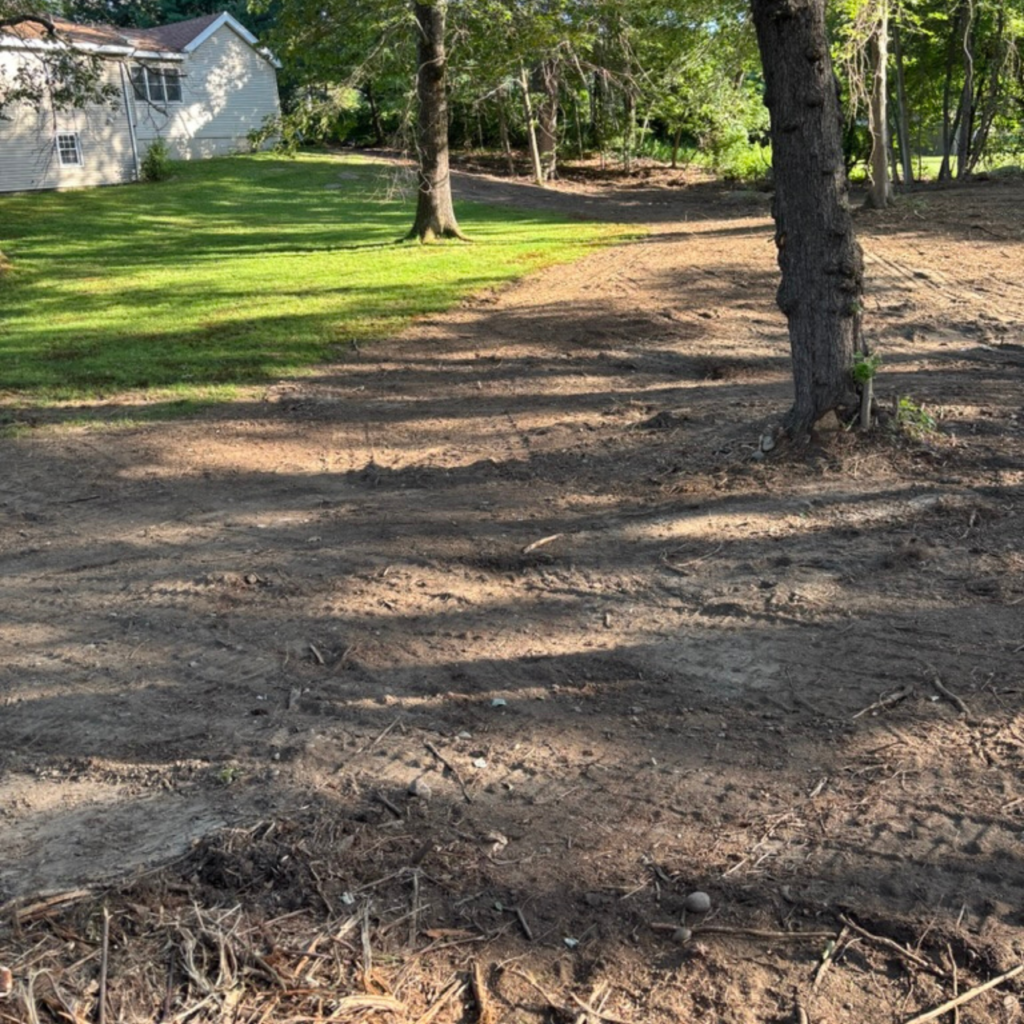
Overgrown lot reclamation is the work of taking land a property owner has quietly written off and making it usable again. It is the same work we do every week through our land clearing and site preparation services in Central Massachusetts, only carried out at full scale on ground that has been left alone long enough to stop functioning as part of the property. The back acre behind the tree line, the pasture that turned into a thicket, the side lot nobody has touched since the previous owner: all of it can come back.
Most people assume reclaiming that land is simply a matter of cutting brush. Cutting is the first hour of the job and almost never the part that decides whether the result lasts. Overgrown lot reclamation is a sequence: clear the growth, remove what sits under the surface, correct the grade, give the water somewhere to go, and finish the surface so it stays open instead of reverting. Skip one of those steps and the lot looks reclaimed for a single season.
What Is Overgrown Lot Reclamation, Exactly?
Overgrown lot reclamation is the full clearing and site preparation of land that has grown well past the point of ordinary maintenance. It is not trimming, and it is not selective clearing around something already in use. It is the process of taking an area that has been surrendered to whatever wanted to grow there and returning it to a defined, usable surface with a deliberate grade, controlled water, and a finish suited to whatever the ground will be used for next.
Scale is what separates overgrown lot reclamation from the smaller jobs in the same family. Tidying a fence line or taking out a handful of saplings is maintenance. Reclamation starts with a piece of land that has no current use at all and ends with one that does. That shift from unusable to usable is the whole point of the work, which is why it gets judged by what the ground can do afterward rather than by how much material came off it.
The broader category of land clearing and site preparation covers everything from a single morning of brush work to preparing a finished building pad. Overgrown lot reclamation sits at the demanding end of that range, because the ground underneath has been out of sight for years. Nobody knows what is in it, how it drains, or what shape it is in until the cover comes off.
How Usable Land Quietly Goes Out of Service
Open land in New England does not stay open on its own. Stop mowing a field and the first summer brings tall grass. By the third year it is a solid mat of raspberry, bittersweet, and multiflora rose. Somewhere around year eight the first gray birch and red maple come up through that mat, and once they do, a lawn tractor is no longer part of the conversation. Nothing dramatic happens in any single season, which is exactly why the change goes unnoticed until overgrown lot reclamation is the only way back.
Ownership changes accelerate it. A property gets sold, the new owners focus on the house, and the far end of the parcel simply falls off the maintenance list. Storm damage does the same thing faster: a few trees come down across the back, the mess is too big for a weekend, and the tangle that grows through the downed wood closes the area off for good. Old stone walls and wet corners help it along by making that ground awkward to mow in the first place.
The result is land you pay taxes on and mow around rather than use. Homeowners in Grafton, Worcester, Shrewsbury, and Northborough regularly discover during a survey or a fence project that a third of their parcel has quietly become woods. Overgrown lot reclamation is usually less involved than they expect, because the underlying ground is still there. It is just buried.
Reading the Lot Before Anything Comes Down
Every overgrown lot reclamation starts on foot. We walk the whole area first and mark what has to be known before a machine touches it: property pins, stone walls, wet spots, seeps and springs, old wells, septic components, buried debris piles, and the trees worth keeping. Neglected land hides all of it well, and finding a wellhead with a mulching head is a bad way to learn it was there.
Boundaries matter more on an overgrown lot reclamation than on almost any other job. Clearing that crosses a property line is not a mistake you can undo, and in a tangle of brush the line is rarely obvious. If the pins cannot be located, that gets resolved before the work is scheduled rather than after. The same goes for any recorded easement running through the area, since a utility right of way carries its own rules about what can be cleared and what cannot.
The walk is also when the plan gets specific. Not everything should come down. Mature oaks, a healthy tree line that screens a neighbor, and anything holding a bank together usually stay. Deciding that in advance, with the owner standing there, prevents the most common regret we hear about overgrown lot reclamation: the lot was opened up further than anyone actually wanted.
What Overgrown Lot Reclamation Actually Involves
Overgrown lot reclamation runs in an order, and the order is not negotiable. Growth comes off first, then stumps and roots, then the grade gets corrected, then drainage is addressed, then the surface is finished. Doing any of it out of sequence means doing part of it twice. There is no way to shape ground you cannot see, and no way to seed a surface that still has stumps in it.
Access comes before all of that. Machines and trucks need a way in and a place to work, and on a neglected back lot that route often has to be opened first. We plan the approach so equipment is not crossing a lawn, a leach field, or a soft area that will rut for years. Where the ground is delicate, mats or a temporary gravel path protect the route in and out.
Machine choice follows the material rather than the other way around. A tracked skid steer with a mulching head handles brush and small stems efficiently. An excavator handles stumps, boulders, and grading. Larger trees are dropped and processed separately. Most overgrown lot reclamation jobs use a combination of all of it over several days, and the equipment moves through in the same order the work does.
Brush, Saplings, and Deciding What Stays
The first visible stage of overgrown lot reclamation is removing the tangle. Brush, briars, vines, and the thin stems that grew up through them get cut and processed, which is the same process covered in our guide to brush clearing in Central Massachusetts. On a reclamation job this stage is larger and less selective than routine brush work, but the judgment is identical: everything that comes down should be something the owner agreed would come down.
Saplings and small trees are the middle layer, and how they are handled depends on what happens next. Where the ground will be lawn, pasture, or a building area, they come out root and all rather than being cut at the base, since cut stumps of most New England hardwoods resprout aggressively. Our guide to small tree and sapling removal covers that distinction in more detail, because it is the single most common reason a reclaimed lot closes back in.
Larger trees are a separate decision every time. A mature oak or maple in the middle of a reclaimed area is often the best thing on the lot once the mess around it is gone. Trees that are dead, leaning toward a structure, or growing out of an old wall usually have to go. The rest is a conversation about shade, screening, and what the space is meant to feel like when the overgrown lot reclamation is finished.
Stumps, Roots, and the Voids They Leave Behind
Stumps are what previous clearing left behind, and on land that has been cut before, there can be a surprising number of them under the growth. Where ground will be built on, driven on, or planted, stumps come out completely, roots included. Buried wood rots into cavities that surface as sinking spots five or ten years later, which is covered in more depth in our guide to stump removal in Central Massachusetts.
Pulling a stump during overgrown lot reclamation leaves a hole considerably larger than the stump was, along with a pile of soil mixed with root material. Both have to be dealt with properly. The cavity gets backfilled in compacted layers with clean material rather than being pushed full and left, because loose backfill settles into a dip that shows up in the first wet spring. The root material is separated out instead of being buried in place.
Grinding is the lighter alternative, and it has a place in overgrown lot reclamation. In lawn areas well away from structures and future construction, grinding the stump below grade and leaving the root system to decay in the ground is often the right call. What matters is that the choice follows from what the ground is for, not from which attachment happened to be on the machine that day.
Rough Grading and Shaping the Ground That Emerges
Once the growth and the stumps are gone, the actual shape of the land is visible for the first time in years, and it is rarely what anyone pictured. Overgrown ground hides mounds, old excavation spoil, wheel ruts, filled holes, and the low areas that made the spot hard to mow long before it grew in. Rough grading is where that gets corrected into a surface that drains and can be maintained.
This stage of overgrown lot reclamation moves material rather than importing it. High spots get cut down, low spots get filled with what came off the high spots, and the whole area is worked into a consistent plane with enough pitch to shed water. Any surface intended for lawn or pasture needs enough slope to drain but gentle enough to mow, and the transitions to the surrounding ground have to be smooth rather than abrupt.
Compaction gets attention here in proportion to what the land will hold. Ground destined for lawn wants a firm but not concrete surface, so topsoil and roots have somewhere to go. Ground that will carry a shed, a driveway, or a building pad needs to be compacted in lifts to a much higher standard. Getting that wrong is expensive to fix later, because the correction happens under whatever was built on top.
Where the Water Goes After the Canopy Is Gone
Overgrown lot reclamation changes how an acre handles water, and this is the part most people never anticipate. A thicket intercepts rain, slows runoff, and moves a remarkable volume of water back into the air through the leaves. Take it away and more water reaches the ground, reaches it faster, and stays longer. A lot that never seemed wet can develop a genuinely soggy corner the first spring after clearing.
That is why grading and water management are part of overgrown lot reclamation rather than a separate project afterward. While the machines are already there and the ground is open, it takes very little extra effort to shape a shallow swale along the low edge, pitch the surface away from a structure, or daylight a pipe that had been buried and forgotten. Coming back to do it after the lawn is established means tearing the lawn up.
Where the water leaves the property matters as much as where it goes on it. Runoff that used to soak in and now sheets across a neighbor property line is a problem you created, and one that is much easier to prevent than to argue about. On sites near a stream, pond, or wetland, this is not merely neighborly. It is a regulatory matter, which the Massachusetts section below covers.
Debris: Chip, Mulch, Haul, or Leave It Behind
Overgrown lot reclamation generates an enormous volume of material, and how it is handled shapes both the schedule and the finished look. Brush and small stems are usually mulched in place with a forestry head, which turns the tangle into a layer of chips that stays on site, suppresses regrowth for a season, and breaks down into the soil. It is the cleanest option when the material is small enough to feed the head.
Larger wood gets sorted. Anything worth firewood can be cut to length and stacked for the owner, which is often the most appreciated part of the job. Stumps, root balls, and soil-laden material generally have to leave, because they will not break down usefully and cannot be buried on site without creating the exact voids the stump removal was meant to prevent. That material goes out by truck.
Burning is legal in Massachusetts only during the open burning season, only with a permit from the local fire department, and only under the conditions the department sets each day. It is worth asking about, but it is never something to plan an overgrown lot reclamation around, since dry weather or a burn ban can close the window without notice. Hauling and chipping are the reliable defaults.
Finishing the Surface So It Stays Open
The last stage of overgrown lot reclamation is what determines whether the lot stays reclaimed. Bare, disturbed soil in New England does not stay bare. It gets colonized within one growing season, and the first colonizers are precisely the species that made the area unusable in the first place. Establishing the intended surface quickly is the only practical defense against that.
For lawn or pasture, that means topsoil where it is needed, a seed mix suited to the light and soil conditions, and mulch or an erosion blanket on any slope. Seeding timing matters in Central Massachusetts, with late summer into early fall generally the most reliable window and spring the second choice. Bare ground going into winter without cover is how a freshly graded lot ends up in gullies by April.
For a driveway, parking area, or building pad, the finish is stone rather than seed, built up in compacted layers over a properly prepared subgrade. Either way, overgrown lot reclamation is not done when the machines leave. It is done when something intentional is growing or holding on the surface, because that is what keeps the brush from reclaiming the ground in the other direction.
Projects That Usually Start With Overgrown Lot Reclamation
A great deal of overgrown lot reclamation is done for its own sake, simply to get the use of land the owner has been paying for and looking at for years. A back acre becomes a yard, a play area, a paddock, or an orchard. Those projects are straightforward, and the finished surface is the deliverable.
The rest is preparation for something specific. A future garage, a shed, a barn, a pool, a septic upgrade, or a house lot all begin with clearing and shaping the ground they will occupy. When that is the goal, the grading standard is higher and the finished elevations have to be planned around the structure rather than around the view, so the intended use needs to be part of the conversation from the first walkthrough.
Selling a property is the third common reason for overgrown lot reclamation. Neglected land photographs poorly, shows poorly, and leaves buyers guessing about what is under it. Open ground with a clean edge reads as usable acreage, and it lets a buyer see the parcel they are actually purchasing. That is a different finish standard again, weighted toward appearance and access rather than toward supporting a foundation.
How Long Overgrown Lot Reclamation Takes
Most residential overgrown lot reclamation runs a matter of days rather than weeks, and the variables are predictable: how large the area is, how heavy the growth is, how many stumps come out, how far material has to travel, and how wet the ground is when the work happens. A quarter acre of light brush is quick. An acre of mature saplings, old stumps, and boulders across soft ground is a genuine project.
Season affects an overgrown lot reclamation as much as size does. Late fall through early spring is the efficient window for clearing, because the growth is dormant, sightlines are open, visibility of the actual ground is better, and frozen or firm soil carries machines without rutting. Mud season is the opposite on every count. Work done in deep spring softness leaves damage that then has to be repaired as part of the same job.
The other schedule factor sits entirely outside our control, and it is worth knowing about early. If the overgrown lot reclamation involves any digging, the Dig Safe notification period has to run before a machine breaks ground, and if any part of the area falls under wetlands jurisdiction, a local filing can add weeks. Both are covered below, and both are far easier to plan for than to discover midway.
In Massachusetts, Watch Out for These
Dig Safe applies to overgrown lot reclamation the moment stumps start coming out or a machine breaks ground. Massachusetts law requires notification at least 72 business hours before excavation, and because business hours exclude weekends and holidays, the practical lead time is most of a week. The Massachusetts Dig Safe program is reached by calling 811, and the resulting ticket is valid for 30 days. How the notification works is set out in the state guide to Dig Safe.
Wetlands are the second consideration on any overgrown lot reclamation, and neglected land is where they hide. Any work within 100 feet of a wetland, or within 200 feet of a perennial stream, falls under the Wetlands Protection Act and is administered by your town Conservation Commission. Clearing vegetation counts as an activity, not only digging. The state overview of protecting wetlands in Massachusetts explains the filing process, which typically begins with a Request for Determination of Applicability or a Notice of Intent.
A wet corner in an overgrown back lot is a genuine possibility rather than a technicality, since the areas that stopped being mowed are frequently the areas that were too wet to mow. If there is any question, it gets checked before the schedule is set. Clearing inside a buffer zone without a filing can result in an enforcement order and a requirement to restore what was removed, which is a far worse outcome than a few weeks of waiting.
Local rules add a third layer. Many Central Massachusetts towns have their own tree, scenic road, or stormwater bylaws, and some require a permit for clearing above a certain area. Open burning is allowed only in season and only with fire department approval. None of this makes overgrown lot reclamation difficult, but all of it belongs in the plan before the first machine arrives rather than after a neighbor makes a phone call.
Frequently Asked Questions
How overgrown is too overgrown to reclaim?
Very little land is genuinely beyond reclaiming. Brush, briars, and saplings up to a few inches across are routine work for a mulching head, and heavier growth simply shifts the job toward an excavator and more days on site. What actually changes the answer is not the density of growth but what is underneath: ledge close to the surface, a wetland, a steep slope, or an old dump area buried in the tangle. That is why we walk the property before scoping an overgrown lot reclamation project rather than judging it from an aerial photo.
Do I need a permit for overgrown lot reclamation in Massachusetts?
It depends on where the land is and what is on it. Straightforward clearing on dry, upland ground well away from water generally does not require a state permit, though your town may have its own tree or stormwater bylaw. Work within 100 feet of a wetland or 200 feet of a perennial stream requires a filing with the local Conservation Commission before anything is cut. Separately, a Dig Safe notification is required before any excavation, including stump removal, anywhere in Massachusetts.
Will the brush just grow back after the lot is cleared?
It will if the job stops at cutting. Most New England brush and hardwood species resprout from cut stumps and root systems, so an overgrown lot reclamation that only removes the visible growth is a temporary result. Lasting reclamation removes root systems where the ground will be used, corrects the grade, and establishes an intended surface such as lawn, pasture, or stone quickly. After that, ordinary mowing or use keeps the ground open with no further intervention.
What is the best time of year for overgrown lot reclamation in Central Massachusetts?
Late fall through early spring is usually the best window for the clearing portion. The growth is dormant, sightlines are open, and firm or frozen ground carries equipment without rutting the property. The exception is the finishing stage, since seeding wants either late summer into early fall or the spring. On many Grafton, Worcester, Shrewsbury, and Northborough projects we clear during the cold months and seed at the next reliable window rather than forcing both into the same week.
Can you reclaim a lot without taking down the mature trees?
Yes, and it is a common request. Removing the understory while keeping the mature canopy produces an open, park-like result that many owners prefer to a fully cleared field, and it keeps the shade and screening a property already has. This version of overgrown lot reclamation requires more selective work and more care around root zones, since machinery compacting soil over a root system can damage a tree that was never touched. We mark the keepers with the owner before starting.
Overgrown lot reclamation is one of the few projects that changes what a property is rather than merely how it looks. If there is a corner, a back acre, or an old field in Grafton, Worcester, Shrewsbury, or Northborough that you have stopped counting as part of your land, we are glad to walk it with you and tell you honestly what is under there and what it would take to bring it back. When you are ready for numbers, our estimates are always free.