
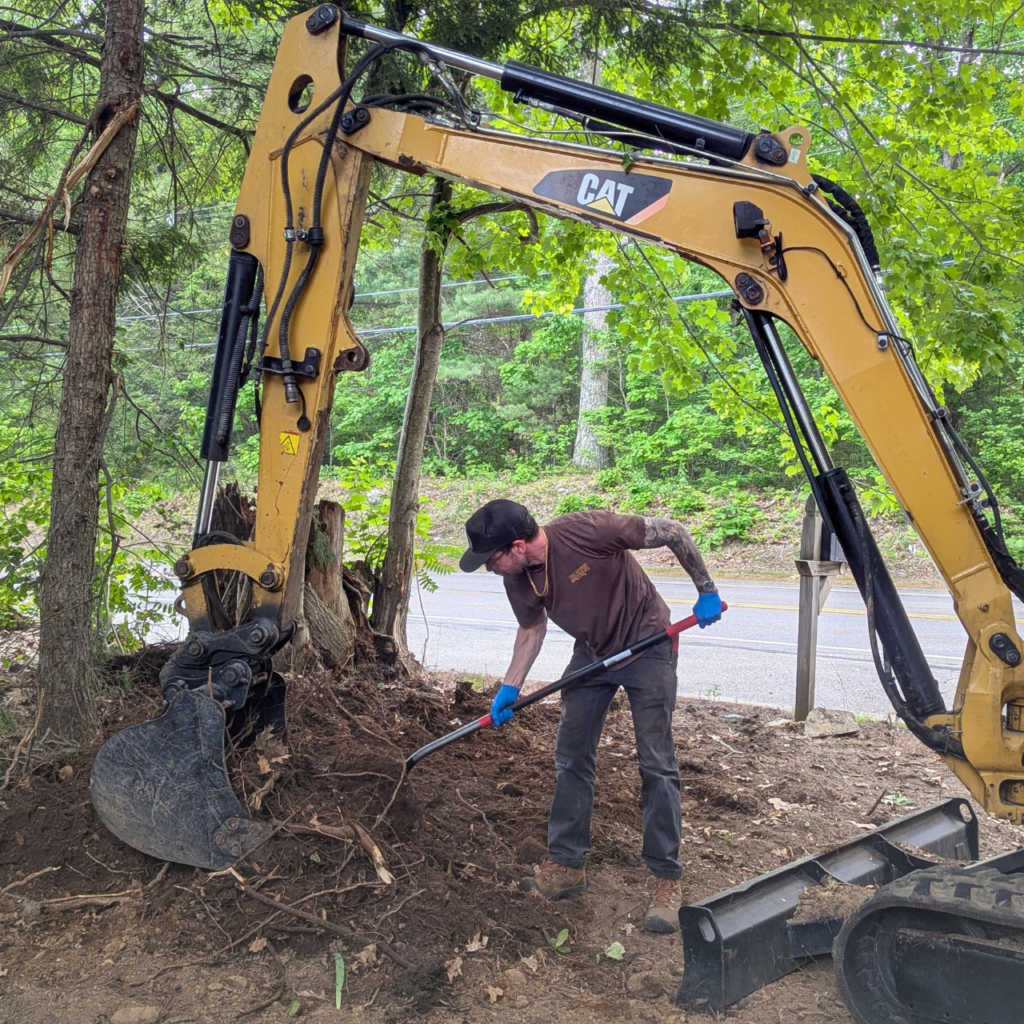
Stump removal is the work of taking a tree stump and its root system out of the ground so the space can be used for something else: lawn, a driveway, a garden bed, a shed pad, or simply flat, open land. It is the same work we handle every week through our Central Massachusetts land clearing and site preparation service, and it usually comes right after a tree comes down. A felled tree leaves a stump behind, and a stump is not finished business. Stump removal is what turns a cleared spot into ground a property owner can build on, mow over, or plant in.
What Is Stump Removal, Exactly?
Stump removal is defined by what happens below the surface, not above it. Cutting a tree down is a chainsaw job that ends at ground level. The stump left behind is a dense, anchored mass of wood, and the roots spreading out from it can reach nearly as wide underground as the branches once reached in the air. Lifting that mass out is a different trade entirely, closer to excavation than to tree work, because it means disturbing and moving ground rather than cutting through open air. It sits inside the broader work covered in our guide to land clearing and site preparation.
There are two honest ways to deal with a stump, and they are not the same job. One grinds the stump down into chips a foot or so below grade and leaves the deeper roots to break down in place. The other pulls the whole stump and its main root ball out of the ground. Which one a property needs depends entirely on what is going to happen on that spot afterward. Choosing the wrong method is how people end up paying for the job twice, once to hide the problem and again to actually solve it.
Grinding Versus Full Stump Removal
Stump grinding uses a machine with a rotating cutting wheel to chew the stump into mulch, working from the top down to somewhere between four and twelve inches below the surface. It is fast, it is contained, and it leaves the surrounding ground mostly undisturbed. What it does not do is take out the root system. The roots stay in the soil and decay slowly over several years, which is fine under a lawn and a problem under anything with a footing.
Full stump removal lifts the stump and the main root ball out whole, usually with an excavator, leaving a hole where the wood used to be. It is more disturbance and more material to deal with, but it clears the ground completely. The rule of thumb is simple enough. If grass is going back over the spot, grinding is usually enough. If a structure, a driveway, or new grade is going over it, the roots have to come out, and that means full stump removal rather than grinding.
Why the Root System Is the Real Job
A stump is only the visible handle on a much larger object. The root system that spreads out beneath it can extend well past the drip line of where the canopy stood, wrapping around rocks, other roots, and sometimes buried utilities. That is why the work is judged by what comes out of the ground rather than by how quickly the stump above grade disappears. A stump that is gone from view but whose roots are still in place has not really been removed. It has been hidden.
Those roots matter because wood in soil does two things as it breaks down. It leaves voids as it rots, and voids under a lawn become soft spots and shallow dips, while voids under a slab or a driveway become cracks and settlement. It also feeds fungi and draws insects, including the carpenter ants and termites that would rather not be that close to a house. Getting the root ball out of the ground is the only way to take both of those futures off the table for good.
What a Left-Behind Stump Costs You Later
A stump that never gets dealt with does not simply sit there quietly. Many hardwoods send up suckers, which are new shoots that sprout from a live stump and the roots around it, and a homeowner who cut a tree down to be rid of it can end up mowing a ring of stubborn regrowth for years. Removing the stump and its root crown ends that cycle, which is one of the most common reasons stump removal follows a tree job at all.
A stump is also a hazard and an obstacle. It is a trip point in a lawn, a hidden blade-breaker for a mower, and a fixed object that dictates where a fence, a shed, a patio, or a garden can go. Around Grafton and Shrewsbury, where a lot of yards were carved out of old woodland, leftover stumps are a common reason a usable-looking corner of a property cannot actually be used. Stump removal is what puts that ground back into service.
Stump Removal After Tree and Brush Clearing
Stump removal rarely happens in isolation. It is usually the last step of a larger clearing project, after the standing trees are down and the smaller growth is gone. When we clear a lot, the sequence runs from the largest material to the smallest: fell the trees, handle the small trees and saplings, cut the brush and undergrowth, and then take out the stumps that anchor the whole thing to the ground. Doing the stumps last means the machine has room to work and a clear path to haul what it pulls.
Grouping the stumps into one pass also keeps the disturbance to a single event rather than tearing the same ground up repeatedly. An excavator that is already on site for clearing can move from stump to stump efficiently, and the open holes can be backfilled and graded together once the last root ball is out. Bundling the stumps into the clearing job is almost always cheaper on effort and easier on the ground than coming back for the stumps as a separate visit weeks later.
What Happens to the Stump and the Grindings
A removed stump is a bulky, awkward piece of debris, and where it goes is part of the job rather than an afterthought. A pulled root ball carries a lot of soil in and around it, which has to be knocked loose and returned to the hole so good dirt does not leave the property with the wood. The stump itself is then hauled off, chipped, or set aside on larger lots where a brush pile has somewhere to live out of the way.
Grinding produces a different byproduct: a pile of wood chips mixed with soil, and there is usually more of it than people expect. Some of that material can be raked back into the grinding void as a first fill, though it will settle as it decomposes and needs topping with clean soil later. The rest gets spread thin as mulch or carted off. Planning where the grindings and the pulled stumps end up keeps the job from trading one eyesore for another.
Regrading and Reclaiming the Ground
Pulling a stump leaves a hole, and a hole is not a finished job. The void where the root ball came out has to be filled in layers and compacted, not simply topped off, because loose fill over an old stump cavity settles into a dish the first wet spring and every spring after. Bringing the spot back to the surrounding grade, with clean soil at the top where grass or plantings will go, is the difference between a repaired yard and a patch that announces itself for years.
On larger projects the reclaimed ground becomes part of a bigger plan. Once the stumps are out and the holes are closed, the same area can be shaped for drainage, leveled for a lawn, or prepared as a pad for something new. That final grading is where a stump removal job connects back to site preparation as a whole, and it is why we treat the fill and the finish grade as part of the work rather than as cleanup left for the homeowner to sort out.
In Massachusetts, Watch Out for These
Stump removal disturbs the ground with machinery, which means the first Massachusetts rule is not optional. State Dig Safe law requires notifying 811 at least 72 business hours before mechanized digging, not counting weekends or holidays, so buried utilities can be marked before a bucket goes in. The notice is free, it applies to homeowners and contractors alike, and the markings stay valid for 30 days. The requirement is explained through the state Dig Safe program, and we file it before any stump removal that involves an excavator.
The second thing to watch is water. Work within 100 feet of a wetland, stream, or pond may need review by the local Conservation Commission under the Massachusetts Wetlands Protection Act before it starts, and pulling root systems near a resource area is exactly the kind of ground disturbance that rule exists to govern. Older stumps can also hide surprises: a stump wrapped around a forgotten well line or an abandoned septic pipe turns a simple removal into a careful one. We confirm where a property sits and what is around each stump before scheduling the work.
Frequently Asked Questions About Stump Removal
Do I need to call Dig Safe before stump removal in Central Massachusetts?
Yes, whenever the work uses a machine. Massachusetts Dig Safe law applies to homeowners as well as contractors, and it covers mechanized digging anywhere on a property, so pulling a stump with an excavator falls squarely under it. You must notify 811 at least 72 business hours ahead, excluding weekends and holidays, and the markings stay valid for 30 days. We file the notice for the stump removal jobs we run in Grafton, Worcester, and the surrounding towns, so it is one less thing for a homeowner to track.
What is the difference between stump grinding and full stump removal?
Grinding chews the stump into chips a few inches to a foot below grade and leaves the roots to decay in the soil, which is fine under a lawn. Full stump removal lifts the stump and its main root ball out of the ground entirely and leaves a hole to backfill. Grinding is faster and less disruptive, but only full removal clears the roots, which is what you need before a structure, a driveway, or new grade goes over the spot.
Will the tree grow back if I only grind the stump?
The tree itself will not, but many hardwoods send up suckers from a live stump and the roots around it, so you can end up mowing stubborn regrowth for a few seasons after grinding. Removing the stump and its root crown ends that cycle completely. If regrowth is the reason you want the stump gone, full stump removal is the more reliable answer than grinding alone.
Does stump removal leave a big hole in my yard?
Full removal does leave a hole where the root ball came out, but a proper job does not stop there. The void is filled in compacted layers and brought back to the surrounding grade with clean soil at the top, so grass or plantings have something to grow in and the spot does not settle into a dip. Grinding leaves a shallower depression of chips and soil that also needs topping with clean fill as it settles.
Can you remove several stumps at once after clearing a lot in Shrewsbury or Northborough?
Yes, and that is usually the most efficient way to do it. When stump removal follows a tree and brush clearing project, an excavator that is already on site can move from stump to stump in one pass, and the open holes get backfilled and graded together at the end. Bundling the stumps into the clearing work keeps the disturbance to a single event rather than tearing up the same ground on a separate visit later.
Stump removal is the quiet last step that decides whether a cleared piece of ground is actually usable or just looks that way from a distance. We take out stumps and their root systems for homeowners across Grafton, Worcester, Shrewsbury, and Northborough, we file Dig Safe on every machine job, and we backfill and grade the ground so the spot is ready for whatever comes next. If a project has a stump or a field of them standing in the way, reach out and we will walk the property with you. Our estimates are always free.