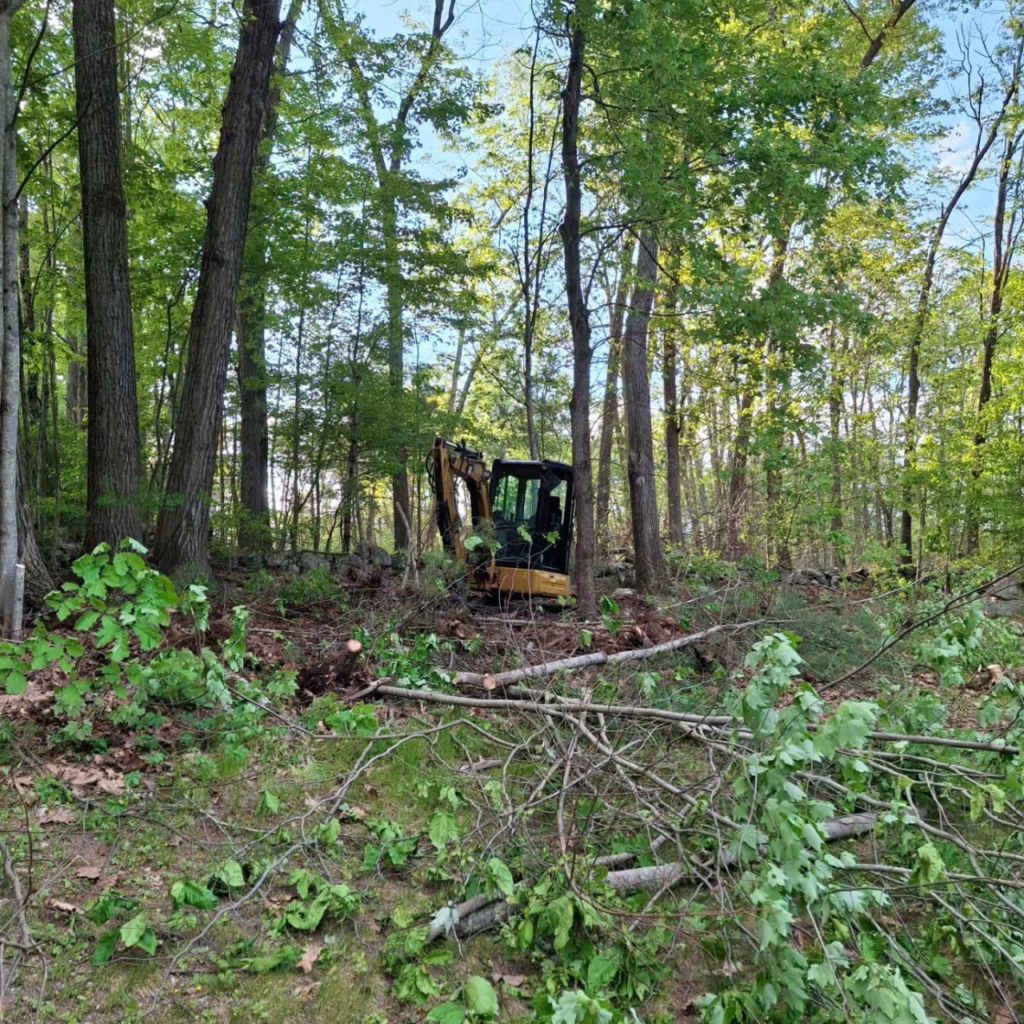
Land clearing is the removal of brush, saplings, stumps, and overgrowth to make ground usable again, and site preparation is what follows: shaping and readying that ground for construction, landscaping, or everyday use. Together they are how an overgrown lot becomes a yard, a field, a building site, or a view.
In wooded Central Massachusetts, land clearing is usually the first physical step of any property project, and the quality of the clearing decides how everything after it goes. This guide covers each kind of clearing and preparation work, what it is and when you need it, drawn from the projects our Central Massachusetts land clearing and site preparation services take on all year.
Brush & Undergrowth Clearing
New England undergrowth never stops advancing. Bittersweet, buckthorn, briars, and brush take back a few feet of ground every year until half the property is a thicket nobody enters. Brush clearing reverses it: cutting the tangle out, grubbing the roots that would regrow by August, and leaving ground ready to mow, plant, or build. The roots are the whole game; land clearing that only cuts what shows above ground is really just scheduling the same job again for next season. Machine clearing also finishes in a day what hand tools take a month of weekends to lose to. For a deeper look at this side of the work, see our full guide to brush clearing.
Small Tree & Sapling Removal
Neglected ground grows a middle crop between brush and forest: saplings and small trees packed too tight to walk through. Removing them is standard land clearing work, taken out root and all where the ground will be used so they cannot stump-sprout back. The real skill is selectivity. A lot cleared to bare dirt is worth less than one cleared with judgment, where the healthy shade trees stay, the junk growth goes, and the finished ground looks intentional. Good contractors flag keeper trees with the owner before the machine ever starts, because that conversation cannot happen after. For a deeper look at this side of the work, see our full guide to small tree and sapling removal in Central Massachusetts.
Stump Removal
Stumps are what the previous clearing left behind, and they hold ground hostage for decades: unmowable, unbuildable, and slowly decaying. Where ground will be built on or planted, stumps come out entirely, roots included, because buried wood rots into voids that surface as sinking spots years later. The cavity left behind gets backfilled in compacted layers so it never reappears as a dip. Grinding is the lighter alternative for lawn areas away from structures, where the root mass can safely stay. Which treatment each stump gets should follow from what the ground is for, not from which machine happened to be on the trailer. For a deeper look at this side of the work, see our full guide to stump removal in Central Massachusetts.
Overgrown Lot Reclamation
Plenty of properties include land the owners have written off: the acre behind the tree line, the field that stopped being a field, the back lot untouched for a decade. Reclamation is land clearing at full scale, followed by the site preparation that makes the ground genuinely usable: grade corrected, holes and mounds leveled, debris gone, and the surface finished for lawn, pasture, or a future building site. Reclaimed ground changes what a property is and consistently appraises for more than the work costs. It is the rare project that pays you back twice, once in use and once at sale. For a deeper look at this side of the work, see our full guide to overgrown lot reclamation.
Fence Line & Property Edge Clearing
Edges grow the worst tangle on any property because nobody mows them. Fences disappear into brush, stone walls sink into growth, and boundary markers vanish. Edge clearing brings the property’s frame back: fence lines opened so fencing can be repaired or replaced, walls uncovered, and corners readable again. It is also the clearing work that demands the most care, since property lines require certainty before cutting, stone walls deserve protection, and the brush leaning over from a neighbor’s tree still belongs to the neighbor. Done right, this clearing improves two properties and zero relationships suffer. For a deeper look at this side of the work, see our full guide to fence line clearing.
View, Trail & Access Clearing
Some of the highest-value land clearing never touches a building project. Opening a view across your own acreage, cutting walking or riding trails through the back woods, or clearing equipment access to a barn or field adds daily use to land that was scenery at best. Selective cutting is the entire craft: remove what blocks the purpose, keep what frames it, and the result looks discovered rather than bulldozed. Trails and access corridors get cleared to the width their use demands and finished so ordinary maintenance keeps them open. For a deeper look at this side of the work, see our full guide to trail and access clearing.
Building Site Preparation
Construction cannot start on raw land. Site preparation converts it: the building envelope cleared, stumps and organic soil removed from under the future structure, equipment access established, and the ground left at the elevations the project needs. Sequence is everything, because preparation done out of order becomes rework billed twice. This is also where clearing hands off to the rest of the site work: excavation and trenching for the foundation, utilities, and drainage all follow onto ground that good preparation made ready. Builders remember the lots that were ready on day one, and they remember the other kind longer. For a deeper look at this side of the work, see our full guide to building site preparation.
Rough Grading & Site Shaping
Cleared ground is honest ground: every rut, mound, and hole that the overgrowth hid is suddenly visible. Rough grading follows land clearing to set the working shape, knocking down high spots, filling stump holes and low spots, softening erosion-prone slopes, and establishing the contours that finish work will build on. Freshly disturbed New England soil has one urgent enemy, the next hard rain, so stabilization and erosion control belong to this step rather than after it. Where a project then needs precise final grades and drainage design, that is drainage and grading, its own discipline, and it picks up exactly where site shaping ends.
Forestry Mulching
Forestry mulching is land clearing’s single-pass method: a rotating drum with carbide teeth grinds standing brush and small trees into chips right where they grew. Nothing gets hauled, nothing gets burned, and the chips stay down as a cover that suppresses regrowth and shields bare soil from erosion. It shines on overgrown fields, understory, trails, views, and property edges, and it is often the gentlest option on the land. Its one limit matters: mulching leaves the roots in the ground, so areas headed for construction or lawn still need traditional clearing and stump removal. The strongest plans use both, matched zone by zone to what the ground is for.
In Massachusetts, Watch Out for These
Massachusetts adds real rules to land clearing. Work within 100 feet of a wetland, pond, or stream falls under the state Wetlands Protection Act and generally needs Conservation Commission review before cutting starts, and rivers extend that reach to 200 feet. Wetlands are not always obvious either; a low spot that holds spring water or a seasonal stream that runs dry by July can still create a regulated buffer. Many towns add their own bylaws for tree removal near roads and shared lot lines. And the calendar matters: firm summer ground, dormant winter growth, and frozen soil all favor clearing, while mud season punishes it. Checking the rules costs a phone call; skipping the check can cost a stop-work order, fines, and replanting. Our land clearing and site preparation team checks all of it during the first walkthrough.
Frequently Asked Questions
What is the difference between land clearing and site preparation?
Land clearing removes what is on the ground: brush, saplings, stumps, and overgrowth. Site preparation readies what is left: shaping, rough grading, and setting up access and elevations for whatever comes next. Most projects need both, in that order.
Do I need permission to clear my own land in Massachusetts?
Often the answer is check first. Clearing within 100 feet of wetlands, ponds, or streams needs Conservation Commission review under the Wetlands Protection Act, and many towns regulate tree removal near roads and lot lines. A walkthrough with someone who knows the local rules settles it quickly.
How much of my lot should I clear?
Less than most people first think. Selective clearing that keeps healthy shade trees and natural buffers looks better, controls erosion, and appraises higher than bare ground. Clear to the purpose: lawn, view, access, or building envelope, and let the rest keep doing what woods do.
What happens to stumps after land clearing?
On ground that will be built on or planted, stumps come out completely, roots and all, and the holes are backfilled in compacted layers. On lawn areas away from structures, grinding can be enough. Buried or ignored stumps decay into soft spots, so the wrong shortcut shows up years later.
When is the best time of year to clear land in New England?
Late summer through winter. The ground is firmer, growth is dormant, and frozen soil actually protects the ground from equipment. Mud season is the worst window, and clearing tied to construction gets scheduled around the builder’s timeline.
If part of your property has been saying no for years, our Central Massachusetts land clearing and site preparation services can turn it into ground that says yes. Request a free estimate and we will walk it with you.