
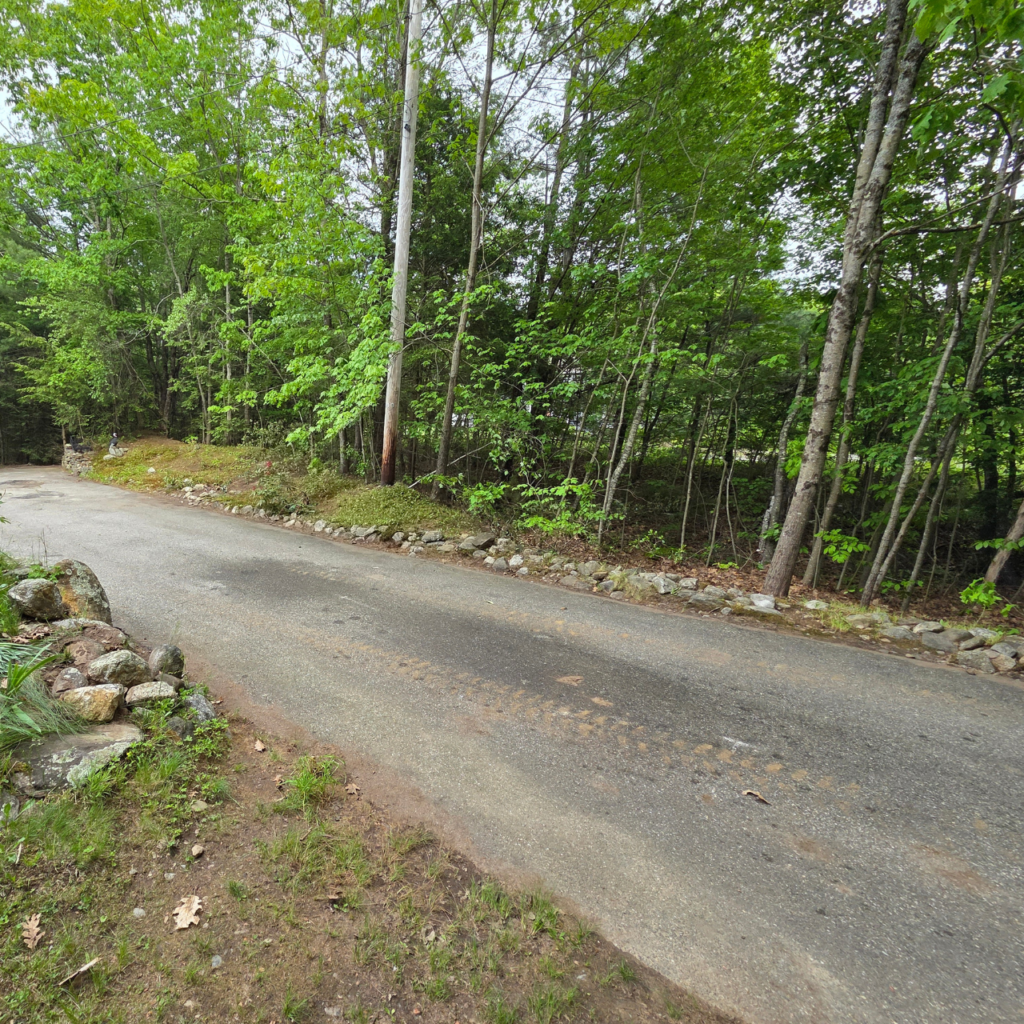
Fence line clearing is the work of opening the strip of ground along a property boundary so a fence can be built, repaired, or simply seen again. It removes the brush, briars, saplings, and low limbs that have taken over the edge of a lot, exposes the existing line of stone wall or old fencing, and leaves a clean working corridor from corner to corner. It is the same work we do every week through our land clearing and site preparation service, and it is one of the few jobs where the value shows up the same afternoon the machine leaves.
What Is Fence Line Clearing, Exactly?
Fence line clearing is selective clearing done in a narrow band rather than across an open area. Instead of taking a whole field or back lot down to soil, the work follows a line: a survey boundary, an existing fence, a stone wall, or the edge where a lawn gives up and the woods begin. Everything inside that band comes out or gets cut back, and everything outside it stays exactly as it was.
The width of the band depends on what the corridor is for. A fence crew needs enough room to swing a post driver, run a string line, and walk a panel into place, which usually means several feet of open ground on at least one side. A homeowner who only wants the boundary visible again may need far less. A cleared corridor for equipment access needs more. Setting that width honestly at the walkthrough is most of what separates a good fence line clearing result from a job that gets redone.
The other defining feature is restraint. Fence line clearing sits at the edge of somebody else’s land, near trees somebody else owns, often within reach of a stone wall that has been there since the property was a farm. The skill is knowing what to leave standing, not how fast the brush can be knocked down.
Why Property Edges Grow the Worst Tangle
Nobody mows a boundary, which is why fence line clearing exists as its own kind of work. The lawn mower turns around a few feet short of it, the brush hog never quite reaches it, and the strip between the maintained yard and the woods becomes the one part of the property that grows without interruption for years at a time. Bittersweet, multiflora rose, greenbrier, poison ivy, and volunteer maples all favor exactly that kind of untouched edge.
Edges also catch far more sun than the woods behind them, so the growth there is denser and thornier than anything in the shaded interior. That is part of why fence line clearing is rarely a quick afternoon of work. The result is a wall of vegetation that hides the boundary completely. Owners in Grafton, Worcester, Shrewsbury, and Northborough regularly tell us they are not sure anymore where their land actually ends, and in most of those cases the answer is buried under fifteen feet of tangle.
That is why fence line clearing tends to be more work per foot than clearing an open area. The growth is older, the stems are heavier, and the ground underneath is full of things that were dropped or piled there decades ago. Old wire, rotted posts, field stone, and fallen limbs all turn up once the brush comes off.
Finding the Property Line Before Anything Gets Cut
This is the single most important step in fence line clearing, and it happens before any equipment comes off the trailer. Cutting a tree that turns out to be on a neighbor’s side of the line is not a small mistake in Massachusetts. Under Massachusetts General Laws Chapter 242, Section 7, a person who willfully cuts down or destroys trees on the land of another is liable to that owner for three times the assessed damages, with single damages only where there was good reason to believe the land was their own.
So we start with evidence. A recorded plot plan, a mortgage survey, iron pins or drill holes at the corners, and the stone wall itself are all useful, though none of them are equal. A stone wall is often near the line rather than on it. An old fence may have been built inside the boundary for convenience. A plot plan is a drawing, not a staked line on the ground.
Where the boundary is genuinely uncertain and the fence line clearing gets close to it, the right answer is a licensed land surveyor before the work, not a guess during it. That is a short delay compared to the alternative. Where the line is well established and the clearing sits comfortably inside it, we flag the corridor with the owner walking beside us so everyone agrees on the limits before the first stem is cut.
We also recommend telling the abutter what is coming. Almost every fence line clearing project touches a shared edge, and a neighbor who hears about it beforehand is a neighbor who watches the machine work instead of calling the town about it.
What Fence Line Clearing Actually Removes
The bulk of the volume is brush and briar. Thorny canes, vines climbing the fence fabric, and dense understory come out first, because nothing else can be assessed until they are gone. This portion overlaps directly with general brush clearing work, and on many properties the fence line is simply the worst concentration of it.
Next come the volunteer saplings. Every boundary in New England grows a row of them, because seeds collect against the barrier and nothing ever mows them off. Left alone, those saplings become the trees that eventually push a fence over, so fence line clearing on a schedule rather than once a generation is what keeps a boundary from becoming a tree line.
Then the low limbs. Mature trees along a boundary usually stay, but the branches hanging into the corridor get taken back so the fence line is clear overhead as well as at ground level. A fence with limbs resting on it fails early, and a corridor with branches at head height is unpleasant to work in and impossible to mow.
Finally the debris nobody expected. Fence line clearing routinely turns up old barbed wire grown into trunks, collapsed page wire, broken posts, scrap metal, and stone piles. All of it comes out with the brush, because leaving wire in a corridor a fence crew is about to work in is how somebody gets hurt.
Stone Walls and Old Fencing Worth Protecting
Central Massachusetts boundaries are full of stone walls, and most of them are older than the houses they run past, which makes fence line clearing here as much a preservation job as a clearing job. They are also fragile in a way that is easy to underestimate: a wall standing untouched for two hundred years can be knocked apart in a minute by a machine reaching over it for a stem on the far side.
So walls get treated as structures during fence line clearing. We clear to them rather than through them, cut back the trees whose roots are actively lifting the stone, and take the growth off the top and faces by hand or with a small machine working from one side only. The result is a wall that reads as a boundary again, which is often the entire reason an owner wanted the edge opened.
Existing fencing gets the same judgment. Some old wire is worth saving and can be repaired once it is visible. Some is a hazard that should come out entirely. We sort that with the owner rather than deciding it from the seat of a machine, because a fence that looks derelict in June may be the only thing keeping livestock in.
Fence Line Clearing Ahead of a New Fence
When a fence contractor is scheduled, fence line clearing has a specific job: hand over a corridor that is straight, level enough to work, and free of anything that will stop a post. That is a different standard from simply making the edge look better.
Straight matters because a fence follows the line it is given. If the corridor wanders around a stump the clearing crew did not want to deal with, the fence wanders too, or the fence crew stops and waits while somebody comes back with a machine. Level matters because most fence styles tolerate a steady grade far better than they tolerate a dip. Where the ground pitches hard along the boundary, mild reshaping during fence line clearing saves a great deal of trouble later.
Free of obstructions matters most of all. Post holes are drilled or driven every six to eight feet, and every buried stump, root mass, and boulder in that corridor is a hole that cannot be finished where the plan says it goes. Pulling those obstructions during the clearing is far easier than pulling them with a fence half built.
Worth knowing: Massachusetts defines what counts as a legal fence in General Laws Chapter 49, Section 2, which treats fences four feet high and in good repair, built of rails, timber, boards, iron, or stone, as legal and sufficient. Towns add their own rules on height and setback, so confirm locally before the posts are ordered.
Reclaiming a Boundary That Has Already Disappeared
The other common version of fence line clearing has no new fence in it at all. The owner simply wants the edge back. Maybe the property was bought with the boundary already lost, maybe a stretch of woods crept twenty feet into what used to be lawn, or maybe an inherited property has not had its edges touched in thirty years.
This version of fence line clearing changes how a lot feels more than almost anything else we do for the effort involved. A yard that seemed to end in a wall of green suddenly ends at a stone wall with woods beyond it, and the usable part of the property grows by a strip that runs the entire length of the line. Where the growth has swallowed far more than the edge, the job shifts into overgrown lot reclamation instead, and we will say so at the walkthrough rather than sell an edge job that cannot deliver what the owner is picturing.
Reclaimed boundaries also solve practical problems. Assessors, abutters, and future buyers can all see where the land ends. Snow gets somewhere to go. Sight lines at a driveway improve. And the strip becomes mowable, which is what keeps it from closing back in.
Brush That Leans In From the Neighbor’s Side
This comes up on nearly every fence line clearing job. A neighbor’s tree overhangs the corridor, or their brush has grown across the line, and the question is what can lawfully be cut.
The general Massachusetts rule is narrow: a property owner may trim branches and roots that cross onto their own land, back to the boundary, at their own expense, and that is the extent of the self-help remedy. What that rule does not allow is reaching over the line to cut at the trunk, or taking a healthy tree down because its canopy is inconvenient. The triple damages provision above is exactly what waits on the other side of that decision.
In practice, the better result almost always comes from a conversation. Many abutters want the edge opened just as much and will agree to work done on both sides at once. When they do, we ask for that agreement in writing before the machine starts, so nothing about the fence line clearing depends on somebody’s memory of a friendly chat in April. When they decline, we clear precisely to the line and leave the rest alone.
Stumps, Roots, and Post Holes
Cutting the growth at ground level is the fast half of fence line clearing. What is under the corridor determines whether the result lasts and whether a fence can actually be installed in it.
Most New England hardwood and brush species resprout from cut stumps and running roots, so a corridor that was only cut will be a thicket again within two or three growing seasons. Where the boundary needs to stay open permanently, the root systems have to come out, which is why fence line clearing so often includes stump removal along the corridor rather than as a separate visit.
Pulling stumps leaves cavities, and cavities left unfilled become a line of soft spots exactly where a fence needs firm bearing. We backfill in compacted layers and bring the corridor back to a consistent grade so post holes start from solid ground. That step is invisible in a photograph and completely obvious two years later when the fence has not moved.
Boulders are the other buried surprise. Field stone along an old wall is rarely limited to the wall itself, and a boulder sitting where a post belongs has to be dug out, broken, or designed around. Finding it during clearing rather than during installation is worth a great deal on a fence that runs hundreds of feet.
Equipment and Access Along a Narrow Edge
Boundaries are, by definition, the least accessible part of a property. They are usually the far side of the lawn, often on a slope, and frequently reachable only by driving across ground the owner cares about. Machine selection for fence line clearing follows from that rather than from what would be fastest in an open field.
Compact equipment does most of this work. A mini excavator with a thumb can pull brush and stumps while sitting in a corridor only a few feet wide, and it reaches over a wall without driving on it. A skid steer with a brush cutter clears volume quickly where the ground allows. Chainsaw work by hand still handles everything within reach of a wall, a fence, or a tree that stays.
Ground conditions matter as much as the machine. Frozen or firm ground carries equipment along a boundary without rutting the lawn between the driveway and the work, which is one reason late fall through early spring is often the best window for fence line clearing in Central Massachusetts. In soft conditions we use mats, lighter machines, or a longer walk with hand tools.
Debris handling is planned before the first cut. Material is chipped, mulched in place where that suits the property, stacked as firewood if the owner wants it, or hauled off. What does not happen is a brush pile left at the end of the line for somebody else to deal with in the spring.
What the Edge Looks Like When We Leave
A finished fence line clearing corridor should read as intentional rather than as a place where something violent happened. Cut stems are taken low enough that nothing catches a mower or a boot. The transition into the remaining woods is feathered rather than sheared, so the edge looks like a property line and not a clearcut.
The ground itself is raked or graded smooth, with holes filled and ruts worked out. Where the corridor will be mowed, we bring it to a surface a mower can cross without damage. Where it will be seeded, we leave a seedbed rather than a compacted track. Where a fence is going in next week, we leave it firm and level and get out of the fence crew’s way.
Good fence line clearing leaves stone walls exposed and intact. Retained trees keep their bark and their root zones. And the line is visible from one end to the other, which for many owners is the first time that has been true since they bought the place.
Keeping the Results of Fence Line Clearing
An open boundary stays open through use, not through effort, and fence line clearing is worth far more when the corridor gets used afterward. Once the corridor is mowable, ordinary mowing two or three times a season holds it indefinitely, and that is the cheapest maintenance plan available for any part of a property.
Where mowing is not practical, the corridor still needs something. A yearly pass with a string trimmer or a walk with loppers in late summer keeps the resprouts from becoming saplings. The gap between a corridor that gets ten minutes a year and one that gets nothing is the difference between an edge that stays clear for a decade and one that closes in three seasons.
Owners who want the least possible upkeep should tell us that at the walkthrough, because it changes the work. Complete root removal, a deeper corridor, and an established grass surface all cost more effort on day one and almost nothing afterward. A quick cut back costs less on day one and asks for attention every year. Both are legitimate choices, and fence line clearing should be scoped to the one the owner actually wants.
How Fence Line Clearing Fits the Rest of the Property Work
Fence line clearing rarely arrives alone. The same visit often includes opening a driveway edge, clearing sight lines at the road, taking out a row of dying trees along the line, or reclaiming a back corner that has been unusable for years. Because the equipment and the crew are already there, combining that work into one mobilization is almost always the sensible order.
It also sits upstream of other projects. Fence line clearing before a survey makes the surveyor’s job faster. Before a fence install, it is a prerequisite. Before a sale, it makes the lot look like what the listing says it is. And before any larger land clearing and site preparation project, an open boundary gives everyone a fixed reference for where the work stops.
What it does not do is fix drainage. A cleared edge sometimes reveals that water has been running along the boundary all along, hidden under the brush. That is a separate conversation about grading and drain piping, and we would rather flag it while the ground is open than let a new fence get set into a wet line.
In Massachusetts, Watch Out for These
Dig Safe before any hole. Fence posts, stump removal, and the grading that follows fence line clearing all count as excavation. Massachusetts law requires notification through Dig Safe by calling 811 at least 72 business hours before digging, not counting weekends or legal holidays, so utilities can mark their underground lines. The state’s guide to Dig Safe explains how the process works. Boundaries are a common place to find a buried service running to a shed, a barn, or a well.
Private utilities are not marked. Dig Safe covers the utility companies’ own lines. The buried feed a previous owner ran out to a garage, an invisible fence wire, a septic line, or an irrigation main is nobody’s responsibility to mark, and property edges are exactly where those tend to run. Tell us what you know about, and we will probe where the history is uncertain.
Wetlands reach further than people expect. Back boundaries are a common place for fence line clearing to run into protected ground. Massachusetts protects a 100 foot buffer zone around wetland resource areas and a 200 foot riverfront area along perennial streams, and work in either generally requires a filing with the local Conservation Commission before it begins. The state’s overview of protecting wetlands in Massachusetts is the place to start. Back boundaries are often exactly where the wet ground is, so this gets checked before scheduling rather than after.
Cutting past the line is expensive. The triple damages rule under Chapter 242, Section 7 applies to trees, timber, wood, and underwood, which covers essentially everything a clearing machine touches. This is the reason we would rather pause a job to confirm a boundary than finish it on an assumption.
Town bylaws still apply. Some Central Massachusetts towns regulate tree removal near a public way, require permits for work in a scenic road right of way, or have stormwater rules that apply once a certain area of ground is disturbed. Scenic road designations in particular affect trees and stone walls within the road layout, which is precisely where a front boundary sits.
Frequently Asked Questions
How wide does a fence line clearing corridor need to be?
It depends entirely on what the corridor is for. If a fence crew is coming, they generally want enough open ground to swing a post driver, pull a string line, and carry panels, which in practice means several feet of working room on at least one side of the line. If the goal is simply to see the boundary and be able to mow it, a narrower band is fine. If the corridor doubles as equipment access to a back field or a barn, it needs to be wider still. We set that width with the owner during the walkthrough rather than picking a default number.
Do I need a permit for fence line clearing in Massachusetts?
Ordinary clearing on dry upland ground usually does not require a state permit, but two things change that answer. Work within 100 feet of a wetland or 200 feet of a perennial stream requires a filing with your local Conservation Commission before anything is cut. And any digging, including stump removal and fence post holes, requires a Dig Safe notification through 811 at least 72 business hours in advance. Individual towns may also have tree or scenic road bylaws that apply along a front boundary, so the local rules are worth a phone call.
Can I cut a neighbor’s branches that hang over my property line?
The general rule in Massachusetts is that you may trim branches and roots back to the boundary line at your own expense, and that is where the self-help remedy stops. You cannot cross the line to cut at the trunk, and you cannot remove a healthy tree because its canopy is inconvenient. Cutting trees on someone else’s land without permission exposes you to triple damages under Massachusetts General Laws Chapter 242, Section 7. On shared edges we ask for a written agreement with the abutter before any fence line clearing extends past the line.
What is the best time of year for fence line clearing in Central Massachusetts?
Late fall through early spring is usually the strongest window. The growth is dormant, poison ivy and briars are far easier to work through, sightlines along the boundary are open, and firm or frozen ground carries equipment without rutting the lawn between the driveway and the work. That said, we clear boundaries year round in Grafton, Worcester, Shrewsbury, and Northborough. Summer work simply calls for lighter machines or ground protection in soft conditions, and any seeding gets scheduled for the next reliable window instead of being forced.
Will the brush grow back along the fence line?
It will if the work stops at cutting. Most New England brush and hardwood species resprout vigorously from cut stumps and running root systems, so a corridor that was only mowed off returns within two or three growing seasons. Lasting results come from fence line clearing that removes the root systems where the ground needs to stay open, backfills and grades the corridor, and then gives it a purpose such as mowed grass or a fence line that gets walked. Ten minutes of trimming a year after that holds the edge indefinitely.
Fence line clearing is one of those projects that costs a property nothing in character and gives back a strip of land the owner had stopped counting. If there is a boundary in Grafton, Worcester, Shrewsbury, or Northborough that you cannot see anymore, or a fence going in that needs a clean corridor first, we are glad to walk the line with you and tell you honestly what is under there. When you are ready for numbers, our estimates are always free.