Stump and boulder removal is the excavation work of getting tree stumps, root balls, and buried rock out of the ground so the land above them can be built on, graded, or simply used again. It is the same work we do every week through our excavation and trenching service, only aimed at what sits under the surface instead of at a trench line or a foundation hole.
A stump is not a surface problem, and neither is a boulder. Both are the visible top of something considerably larger, and both stay exactly where they are until a machine takes them out. Mowing around a stump for ten years does not shrink it. Driving over a rock does not settle it.
What follows is how stump and boulder removal actually works, what makes one job an hour and the next one a full day, and what Massachusetts ground and Massachusetts rules add to it.
What Is Stump and Boulder Removal, Exactly?
Stump and boulder removal is extraction. An excavator works around and under the obstruction, breaks its grip on the surrounding soil, and lifts it out whole. What comes out is not just the part you could see. It is the stump plus its root ball, or the rock plus whatever shape it turned out to have below grade.
That distinction matters more than it sounds. The visible portion of a stump is usually the smallest part of it. The visible portion of a boulder in glacial soil is frequently just a corner.
Once the obstruction is out, the hole it leaves gets filled with clean material and compacted back to the grade around it. Stump and boulder removal is not finished when the stump is on the truck. It is finished when the ground is solid again.
Stump and boulder removal is also different from tree work, and the two are worth separating. A tree crew takes the tree down and deals with everything above the cut. Stump and boulder removal starts after that, at ground level, with a machine and a hole.
Why Stumps Cannot Simply Be Left in the Ground
A buried stump is a slow motion hole. Wood decays. As it decays it loses volume, and the soil above it drops into the space that used to be root.
On a lawn that shows up as a soft depression that appears a few years after the tree came down and keeps deepening. Under a driveway it shows up as a dip that no amount of added gravel permanently fixes, because the settlement underneath is still in progress.
Under anything structural it is worse. Organic material is not fill. It compresses, it rots, and it cannot be compacted to carry load, which is why stump and boulder removal comes first in any area that will support a slab, a footing, a pad, or a driveway base.
Stumps also sprout. Many hardwood species send up shoots from a live stump and its root system for years afterward, and cutting the shoots down does not stop the roots from trying again the following spring.
Grinding a Stump Versus Full Stump and Boulder Removal
Grinding and stump and boulder removal are two different outcomes, and choosing between them comes down to what the ground has to do afterward.
A stump grinder chews the stump into chips, typically to somewhere between six and twelve inches below grade. It is quick, it leaves a small footprint, and it is a reasonable answer when the only goal is being able to mow over the spot.
What grinding leaves behind is the entire root system and a hole full of wood chips. Chips are organic. They decay and settle the same way a whole stump does, only faster and closer to the surface.
Full stump and boulder removal takes the root ball out with the stump and leaves a hole that can be filled with clean mineral soil and compacted properly. That is the version you want under a driveway, a pad, an addition, or a lawn you intend to keep flat.
When someone asks about stump work on a spot that is about to be built on, we recommend extraction, because grinding relocates the settlement problem rather than solving it. If the goal is only to reclaim mowable lawn well away from structures, grinding is often enough. Our guide to stump removal covers that same decision from the land clearing side.
What Sits Under a Stump: The Root Ball and Its Reach
The root ball is the dense mass of structural roots and captured soil directly beneath the trunk. It is what actually held the tree upright, and in stump and boulder removal it is the part that has to move.
Its size scales with the tree. A sapling comes out with a small machine and a chain. A mature oak or maple that stood sixty or eighty feet has structural roots running well past the old drip line and a root ball wide enough that the resulting hole surprises people.
Roots also grow toward what they need, which means they wander. On a tight lot they can run under a walkway, along a foundation wall, beside a septic line, or straight through the spot where a water service was buried decades ago.
That is why stump and boulder removal near a house gets planned rather than simply started. Knowing what is in the ground around the stump decides how much of the root system comes out mechanically and how much gets cut cleanly and left in place. The same caution governs any excavation near structures.
Where Central Massachusetts Boulders Come From
Almost every rock we pull out of a yard in this part of the state was delivered by ice. Central Massachusetts sits on glacial till, the unsorted mix of clay, sand, gravel, cobbles, and rock that the last ice sheet ground up and dropped behind it as it melted back.
Till is not layered the way water deposited soil is. There is no reliable depth at which the rock stops. A boulder can sit two feet down with nothing above it and nothing below it, and its neighbor twenty feet away can be the size of a car.
This is also why the stone walls are everywhere. Generations of farmers pulled rock out of these fields by hand and by ox, and the walls are what they did with it. The supply never ran out, because till keeps producing more as the ground freezes and heaves each winter.
For a property owner the practical consequence is simple. Any excavation in this area, from a fence post to a foundation, is a rock question until the digging proves otherwise.
Telling a Boulder From Ledge Before the Work Starts
A boulder is a loose rock sitting in soil. Ledge is bedrock, still attached to the earth beneath it. The two can look identical from the surface, and only one of them is a stump and boulder removal job.
A boulder can be dug around, tipped, rolled, and lifted out. Once its bottom edge is free it will move. Ledge will not move, because there is no bottom edge to find.
Telling them apart usually means digging. An excavator working the perimeter finds the edges of a boulder within a few minutes, or it does not find them at all, and the not finding is itself the answer.
When the answer turns out to be ledge, the conversation shifts from removal to working around it, raising the design, or bringing in equipment built for rock. It is far easier to learn that before a foundation is laid out than after.
The Machines That Do Stump and Boulder Removal
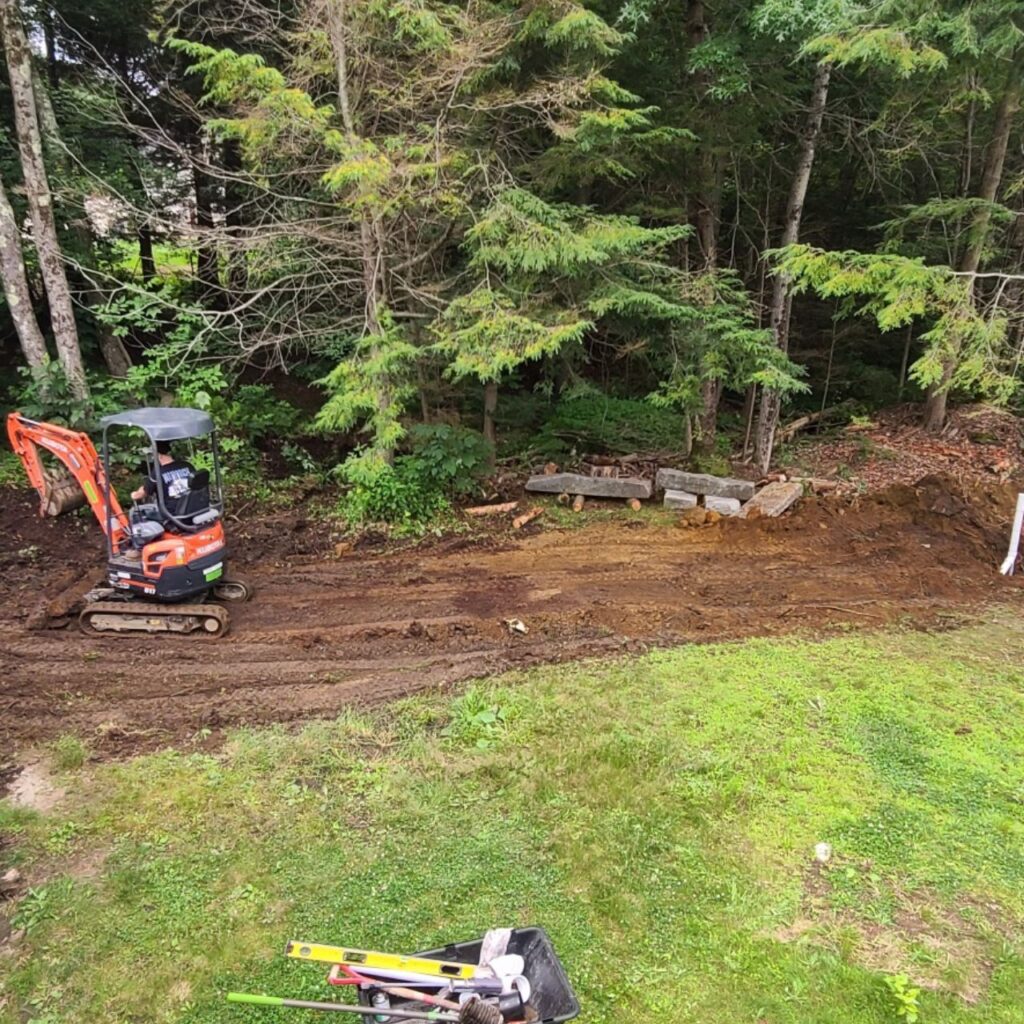
Most residential stump and boulder removal happens with a tracked excavator sized both to the obstruction and to whatever it has to cross in order to reach it.
A compact machine fits through a gate, works between a house and a property line, and does far less damage to an established lawn. It also has real limits on what it can lift.
A larger excavator brings the reach and the breakout force for a mature root ball or a rock that turned out bigger than anyone hoped, but it needs room to work and leaves more track marks on the way in.
Attachments matter as much as size. A thumb on the bucket turns the machine into a hand, and that is what makes real stump and boulder removal possible, letting an operator grab a stump, roll a rock, and set it on a truck instead of shoving it around the yard.
Choosing the machine is a real decision rather than a formality. Too little machine means an afternoon spent scraping at something that will not move. Too much machine means unnecessary damage to ground you then have to repair.
What the Hole Looks Like Afterward
People are consistently surprised by the hole stump and boulder removal leaves. A stump that read as a two foot circle at the surface leaves an opening several times that across, because the machine had to get underneath the root ball to break it loose.
Boulders leave craters shaped like the rock itself, which is to say irregular, with soft loose material at the bottom where the digging happened.
Neither hole is ready for anything as it stands. The sides are disturbed, the bottom is loose, and there is usually a mix of root wood, chips, and rock fragments left sitting in it.
Cleaning the hole out is part of stump and boulder removal. Organic debris comes out, oversized rock comes out, and what remains is a clean void that can be filled with material that will genuinely compact.
Backfilling and Compacting Behind Stump and Boulder Removal
Backfill is where stump and boulder removal either finishes properly or quietly leaves you a problem for later.
Filling a stump hole by pushing the surrounding topsoil into it feels efficient and settles badly. Topsoil is organic, it holds water, and it never reaches the density of the undisturbed ground around it.
The right fill depends on what goes on top. Lawn areas can take clean loam over a compacted mineral base. Anything that will carry weight needs structural fill placed in lifts and compacted as it goes, so the repaired spot behaves like the ground beside it.
Compaction happens in layers for a reason. Dumping four feet of material in one pass and running a machine over the top compacts the top few inches and leaves everything below it loose.
Even done correctly, a filled hole usually settles a little through the first freeze and thaw cycle. Leaving it slightly crowned rather than perfectly flat accounts for that, and it is a small detail that saves a return trip in the spring.
Where the Stumps, Roots, and Rock Actually Go
Nothing that stump and boulder removal pulls out of the ground disappears. It gets hauled away, relocated on site where that is appropriate, or repurposed, and which of those happens is decided before the machine starts.
Stumps and root balls carry a great deal of soil in them, which makes them heavier and bulkier than they look. They generally leave the property, and burying them elsewhere on site is not the shortcut it appears to be, since a buried stump simply creates the same settlement problem in a new location.
Rock is the more interesting half of the equation. Good clean fieldstone has value on the property it came from. It becomes wall stone, a retaining course, erosion armor at a drainage outlet, or a landscape feature that would otherwise have to be trucked in.
We ask about this early, because once a boulder is loaded and gone it is gone. Setting it aside takes nothing more than a decision made at the right moment.
Stump and Boulder Removal Ahead of a Build
When something is going to be built, stump and boulder removal stops being cleanup and becomes part of site preparation.
Footings and slabs have to bear on undisturbed soil or on engineered fill. A stump hole, a root void, or a rock pocket sitting in the middle of a bearing area is a defect that has to be corrected before anything gets poured.
The same is true under a driveway or a gravel pad. Base material spread over a spot that still has a decaying root ball beneath it will telegraph that failure up to the surface within a couple of seasons.
This is why stump and boulder removal normally happens in the same mobilization as the foundation excavation or the pad work, rather than as a separate visit months ahead of it.
On a lot that has gone wild, the same work shows up as one stage of a larger overgrown lot reclamation, where clearing, stump and boulder removal, and rough grading all run together.
When Stump and Boulder Removal Goes Easiest
Ground condition drives stump and boulder removal far more than the calendar does.
Frozen ground fights back. In midwinter the top of the soil profile can be locked hard, and a machine spends its energy breaking frost instead of breaking roots free.
Saturated spring ground is the opposite extreme. The digging is easy, but tracked machines rut soft lawns badly, and the repair afterward can end up larger than the removal was.
Summer and early fall are usually the sweet spot for stump and boulder removal in Central Massachusetts. The ground is firm enough to carry equipment and soft enough to dig, and there is still time for a backfilled area to settle and be seeded before winter arrives.
None of this makes the other seasons impossible. It changes what the work takes and what the ground looks like when we leave.
In Massachusetts, Watch Out for These
Call before anything goes into the ground. Massachusetts routes utility markouts through Dig Safe at 811, and you must give at least 72 business hours notice, not counting weekends or legal holidays, before excavating. A ticket stays valid for 30 days. This applies to stump and boulder removal exactly as it applies to a trench, because a root ball coming out of the ground pulls up whatever is tangled in it.
Understand what those markings cover. As the state’s Dig Safe guidance explains, the program marks public utility facilities. Lines that you or a previous owner installed, such as a well line, an irrigation system, an invisible fence, a propane run out to a fire pit, or power out to a shed, are private and get marked by no one. Around a stump those are frequently the exact lines that get caught.
Watch the wetland setbacks. Under the Wetlands Protection Act, work within 100 feet of a wetland or within 200 feet of most perennial streams falls under the jurisdiction of your local conservation commission, and the state publishes an overview of protecting wetlands in Massachusetts. Pulling stumps and rock disturbs soil and changes how water moves, so a filing can be required even for work that feels minor.
Expect frost to be part of the design. The frost line in this state is taken as 48 inches, so anything structural built where a stump or boulder came out has to be founded below that depth on material that was compacted properly on the way up.
Check the local bylaws before assuming there are none. Some Central Massachusetts towns regulate tree removal, earth removal, or work within a scenic road right of way separately from anything the state requires, and those rules vary from one town to the next.
Frequently Asked Questions
What is the difference between stump grinding and stump and boulder removal?
Grinding reduces the visible stump to chips, usually six to twelve inches below grade, and leaves the entire root system and a hole full of organic chips behind. Stump and boulder removal is extraction: the stump comes out with its root ball, the hole gets cleaned of wood and oversized rock, and it is backfilled with material that can actually be compacted. Grinding is fine for reclaiming lawn well away from structures. Extraction is what you need anywhere the ground will carry weight.
Do I need a permit for stump and boulder removal in Massachusetts?
Sometimes, and it depends mostly on water and on your town. Work within one hundred feet of a wetland or within two hundred feet of most perennial streams falls under the Wetlands Protection Act and needs a filing with your local conservation commission. Some towns also regulate tree removal or earth removal on their own. Permit or not, you must notify Dig Safe at 811 at least 72 business hours before any digging, and private lines on your property are not covered by that markout.
How large is the hole left behind by stump and boulder removal?
Larger than the stump or rock that came out of it, because the machine has to reach underneath the obstruction to free it. A modest stump commonly leaves an opening several times the diameter of the trunk, and a mature tree leaves considerably more. Boulder craters follow the shape of the rock. Every stump and boulder removal hole gets cleaned out and backfilled in compacted lifts, and a slight crown is left over the repair so it finishes flush after the first winter.
Can boulders be removed from a Central Massachusetts yard without wrecking the lawn?
Usually yes, with the right machine and the right timing. A compact tracked excavator can reach most back yards through a gate and works with a much smaller footprint than a full size machine. Timing matters just as much, since saturated spring ground ruts under tracks while firm summer ground does not. Mats and plywood protect travel routes when conditions are marginal, and any disturbed areas get graded and seeded once the work is finished.
What happens to the stumps and rock after they come out of the ground?
Stumps and root balls carry a lot of soil with them and normally leave the property, since burying them elsewhere on the land just moves the settlement problem. Rock is different. Clean fieldstone pulled out of a Central Massachusetts yard is genuinely useful and often stays on site as wall stone, a retaining course, erosion armor at a drainage outlet, or a landscape feature. It is worth deciding that before the boulder gets loaded, because once it leaves it does not come back.
Stump and boulder removal is the step that turns ground you have been working around into ground you can actually use, and the part that decides whether the repair lasts happens after the stump is on the truck. If you have stumps or rock in the way in Grafton, Worcester, Shrewsbury, or Northborough, we would be glad to walk the property with you and talk through what it would take. Our estimates are always free. You can also see where this work fits in the larger picture in our guide to excavation and trenching.