
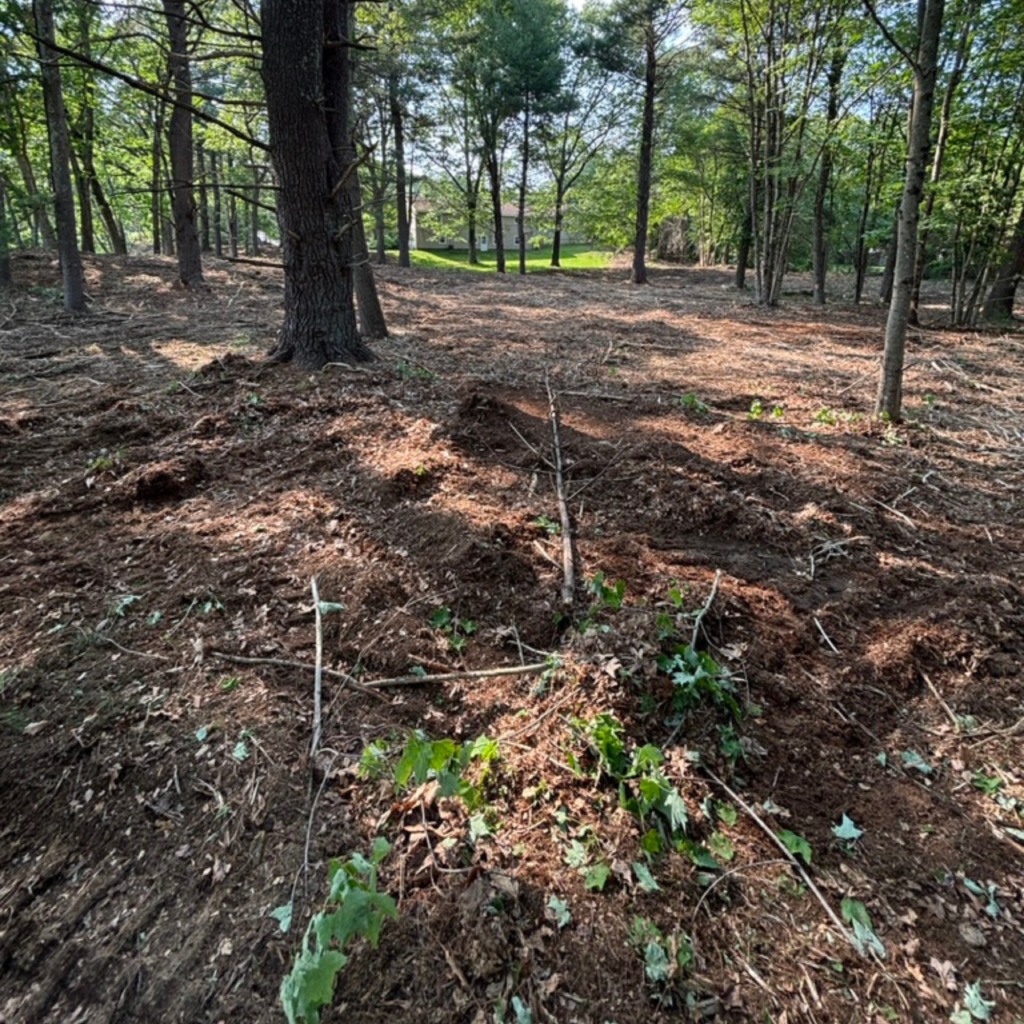
Trail and access clearing is the work of cutting a usable route through wooded or overgrown ground: a walking trail, an opened sight line, or a lane wide enough for a truck or a machine to reach the back of a property. It takes out what blocks the route and leaves standing what you want to keep. It is the same work we do every week through our land clearing and site preparation service across Central Massachusetts.
Most properties in this part of the state have land the owner does not really use. The back acre. The strip behind the tree line. The slope that drops toward the brook. The land is rarely the problem. The problem is that nobody can get into it, so it quietly stops counting as part of the property. Trail and access clearing is the narrow, surgical version of land clearing and site preparation: rather than opening a whole area, it opens a way through.
This guide covers what trail and access clearing actually involves, how a walking trail differs from a view cut and from an equipment lane, what comes out and what stays standing, how width and grade and drainage decide whether a route survives its first winter, the boundary and wetland rules Massachusetts adds on top, and how the work is timed through the New England year.
What Is Trail and Access Clearing, Exactly?
Trail and access clearing is selective removal along a defined route. Somebody walks the line first and decides where it goes. Then the brush, saplings, low limbs, deadfall, and vines along that line come out, along with any full tree that sits squarely in the way. Everything a few feet off the route is left alone. The finished product is a corridor, not a field.
That corridor can be almost anything, depending on what it has to carry. A footpath through the woods needs a few feet of walkable ground and clear headroom. A view cut through a stand of trees needs a wedge of removed understory and a few carefully chosen trees taken down. A lane that has to bring a truck or an excavator to a back building site needs real width, a stable surface, and turning room at the far end.
The distinction that matters most is between clearing a route and clearing an area. Area clearing takes everything in a footprint down to bare ground, which is what happens before a house or a driveway is built. Trail and access clearing keeps the woods and removes only what stands between you and the part of the property you cannot reach today.
Why Land Gets Closed Off in the First Place
Woodland in Central Massachusetts closes in fast. Old stone walls, cart paths, and wood roads that were open for generations disappear inside twenty years once nobody is walking them. Sun reaches the forest floor at the edges, understory fills the gap, and the route vanishes even though the mature trees around it never changed, which is why so much trail and access clearing is really route recovery.
Invasive growth speeds this up. Multiflora rose, bittersweet, honeysuckle, and buckthorn colonize any opening and knit themselves into a wall that is genuinely impassable, not just inconvenient. A homeowner will look at a hundred feet of that and reasonably conclude the land behind it is lost. It usually is not. It is simply behind a barrier that took years to grow and takes a day or two of trail and access clearing to open.
The other closer is deadfall. A few storms drop limbs and whole trees across the old route, and each one becomes a small obstacle course that discourages the next walk. Trail and access clearing usually starts by removing the accumulated wreckage of ten years of weather rather than by cutting anything living at all.
Clearing a Trail You Can Actually Walk
A trail that gets used is a trail that is comfortable. That means a walking surface wide enough for two people or for one person carrying something, headroom well above head height so nobody ducks, and enough width at the shoulders that wet growth is not brushing both arms in June. Trail and access clearing done too narrow produces a tunnel that grows shut in a single season.
Ground matters as much as width. Roots crossing the path, half buried rocks, and stobs left from cut saplings are what actually turn ankles. Cutting brush flush to the ground rather than leaving angled stubs is the single biggest safety difference between amateur work and proper trail and access clearing, and it costs nothing but attention.
Route choice separates a trail that lasts from one that fails. A path that runs straight down a slope becomes a channel the first time it rains hard. A path that traverses across the slope, with gentle grade changes and occasional turns, sheds water sideways and stays walkable. Good trail and access clearing spends more time choosing the line than cutting it.
Opening a View Without Clearing the Woods
The view side of trail and access clearing is its own discipline. The goal is a sight line from a specific place, usually a deck, a window, or a spot in the yard, out to something worth seeing. The mistake is standing in the woods and cutting what looks crowded. The right method is standing where you will actually be looking from and identifying only the trees and growth that block the view from that exact position.
Most views open up with far less cutting than people expect. Removing understory and low limbs while leaving mature trunks in place creates a filtered, layered view through the woods that looks intentional and holds up in every season. Clearing everything to open a wide, blunt window tends to look raw, expose the property to wind, and invite a thicket of new growth into the sunlight you just created.
View work also has to account for what happens next. Every opening in a canopy is an invitation to whatever grows fastest. A view cut with no plan for the understory that follows will close up within a few years, which is why this part of trail and access clearing gets paired with a maintenance conversation from the beginning.
Access Lanes for Equipment and Vehicles
The third kind of route carries weight. If a septic system, a barn, a pool, a shed, or a back building site is going in, something heavy has to reach it. Trail and access clearing for a lane is done wider than for a footpath, cleared higher for equipment cabs and dump bodies, and cleared with a specific machine in mind. A lane sized for a pickup will not pass a loaded triaxle.
Turning and staging matter as much as the run itself. A lane that dead ends with no room to turn around means every trip out is made in reverse, which is slow and hard on the route. Planning a turnaround, a passing spot, or a small staging area at the far end is part of doing trail and access clearing for equipment rather than just for walking.
Surface is the other half of the problem, because a cleared lane through soft ground turns into ruts the first wet week. Where a route has to carry repeated loads, the cleared corridor gets built up into a stone access road with a proper base rather than left as bare soil.
What Comes Out During Trail and Access Clearing
The removal list in trail and access clearing is fairly consistent. Brush and vines along the corridor, saplings and small trees in the route, low limbs that intrude into the walking or driving space, standing deadwood that will drop into the route within a few years, and accumulated deadfall already lying across it. Larger trees come out only when they genuinely sit in the way or are hazardous.
How the material leaves the site is a real decision. Brush can be chipped and spread, mulched in place, piled at the edge of the woods for habitat, or hauled away entirely. Chipping and spreading is often the quiet winner on a trail, because the chips go right back down as a walking surface and there is nothing left to haul. Heavier brush clearing along the corridor is where most of the material volume comes from.
Logs are treated separately. Anything with firewood value is usually cut to length and stacked where the owner can get to it, which is one of the few places where clearing work produces something useful instead of a disposal problem. Anything punky or rotten goes into the brush pile.
What Stays, and Why the Keepers Matter More Than the Cuts
The trees left standing after trail and access clearing define the finished route. Healthy mature trunks along the corridor give a trail its character and hold the soil together. Understory left in patches keeps privacy where the route passes close to a neighbor. Specimen trees, unusual species, and anything with a good form are worth routing around rather than removing.
There is also a structural argument for keeping trees. Woods grow up sheltering each other, and a stand that is suddenly thinned too hard exposes the remaining trunks to wind they never had to handle. Trees that spent forty years in a crowd can come down in the first serious storm after an aggressive cut. Restraint in the middle of trail and access clearing is not laziness, it is wind protection.
Marking is what makes this real on the ground. Keepers get flagged before the saws start, so the decision is made deliberately by daylight and not in the middle of a working day with a machine idling.
Stumps, Roots, and the Ground You Walk On
Every cut sapling leaves a stump, and after trail and access clearing those stumps are the difference between a surface you can walk in the dark and one you cannot. Cutting flush at ground level solves most of it. Where a machine can get in, grinding or pulling the remaining stumps in the route leaves a clean walking surface with nothing to catch a boot or a mower deck.
Bigger stumps in an equipment lane are a different problem, because they interfere with the base rather than just the surface. Those usually get pulled and the hole backfilled and compacted, which is where trail and access clearing quietly crosses into excavation. Full stump removal along a route is planned rather than improvised, because pulling stumps disturbs far more ground than cutting them.
Roots left in place under a footpath are usually fine and often helpful, since they hold the soil on a slope. Roots crossing a lane that will see wheeled traffic are not, because they get broken, they hold water in the ruts they create, and they slowly work loose.
Width, Grade, and Where Water Wants to Go
Water decides which routes survive. A cleared corridor is a low point with an open top, and rain finds it immediately. If the route runs downhill in a straight line, it becomes a stream during every heavy storm and a gully by the second year. This is the most common reason trail and access clearing done without a plan fails.
The fixes are simple and they are all about shedding water sideways rather than carrying it downhill. A slight cross slope moves water off the route instead of along it. Gentle grade reversals, where the trail dips and rises again, break the run into short segments so water leaves before it gains speed. Occasional waterbars do the same job on a steeper pitch.
On flatter ground the problem is the opposite, and the route holds water rather than shedding it. There the answer is usually a modest crown, a shallow ditch line on the uphill side, or moving the route entirely onto slightly higher ground twenty feet away. Any of the three beats walking through a wet trench for the next decade.
Surfacing a Lane That Has to Carry Weight
A footpath usually needs nothing more than what is already there, sometimes topped with chips produced by the trail and access clearing itself. Anything carrying vehicles needs a real surface. Cleared soil under repeated tire loads pumps up water, loses structure, and ruts, and a rutted lane collects the water that ruins the rest of it.
Building a lane properly means stripping the organic layer, shaping the subgrade so it drains, and placing crushed stone in compacted layers. The stripping step is the one people skip, and it is the one that matters, because stone placed on top of soft organic soil sinks into it and disappears.
Not every access route needs that treatment. A lane used twice a year in dry conditions can stay as cleared ground. A lane that has to work in March, or that will carry deliveries during a build, needs stone. Deciding which one you are building is part of scoping trail and access clearing honestly at the start.
Marking the Route Before Anything Gets Cut
Every good trail and access clearing job starts with flagging tape and a walk. The route gets marked, walked again from both directions, and adjusted, because a line that looks right on the way in often looks wrong on the way back. Adjusting flagging is free. Adjusting a cut trail is not.
Marking also catches the things a map does not show: a wet seep that only appears in spring, a stone wall worth routing along instead of through, a ledge outcrop that would take an expensive detour, a septic field that heavy equipment should stay off. These are the details that turn up on foot and nowhere else.
Where the route approaches a property line, marking becomes a legal safeguard rather than a design step. The boundary needs to be established before cutting starts, not estimated from an old fence line or a neighbor.
Trail and Access Clearing Near Boundaries and Abutters
Cutting a tree that turns out to belong to somebody else is the most expensive mistake in this entire category of work, and it is easy to make when trail and access clearing runs near a line. Massachusetts treats it seriously. Under MGL Chapter 242, Section 7, a person who without license willfully cuts down or destroys trees or wood on the land of another is liable to the owner for three times the assessed damages, reduced to single damages only where there was good reason to believe the land was their own.
That is why boundary work comes before saw work whenever the route runs close to a line. Pins, a survey, or a clearly documented boundary is the standard. An assumption is not. The same discipline applies to fence line clearing, where the entire point of the job is working right on the edge of the property.
Talking to abutters early is worth the ten minutes. A neighbor who knows a trail is being cut hears machinery and thinks nothing of it. A neighbor who does not know hears machinery near the line and starts making phone calls.
Trail and Access Clearing Around Wet Ground
Trails have a habit of heading toward water, because the interesting part of a property is often the brook, the pond, or the low wooded ground behind the yard. That is exactly where Massachusetts regulates most tightly. The Wetlands Protection Act, MGL Chapter 131, Section 40, states that no person shall remove, fill, dredge or alter any bank, wetland, marsh, meadow or swamp bordering on waters without filing written notice and receiving an order of conditions.
In practice that means the local conservation commission, not the contractor, decides what is allowed inside the buffer zone. The Commonwealth explains the filing process and the role of local commissions in its guidance on protecting wetlands in Massachusetts. Work in that zone is not automatically prohibited, but it is never automatically permitted either.
The practical answer on most residential trail and access clearing is to route around the wet area. A trail that swings twenty feet upslope of a seep avoids both a permitting question and a permanently muddy stretch of path. When the route genuinely has to reach or cross wet ground, the filing happens first and the clearing waits.
When Trail and Access Clearing Becomes Site Work
There is a line where trail and access clearing turns into moving earth, and it is worth knowing when you cross it. Pulling stumps, cutting into a slope to hold a grade, ditching along a lane, or bringing in stone are all excavation, not clearing. Massachusetts defines the term broadly: under MGL Chapter 82, Section 40, excavation includes the movement or removal of earth or rock, digging, augering, backfilling, grading, and trenching.
That definition matters because it pulls the Dig Safe requirement into work that does not feel like digging. Anyone excavating has to notify Dig Safe by calling 811 before starting, and the Commonwealth explains the process and timing in its Dig Safe information and its guide to Dig Safe. Notice runs at least seventy two business hours ahead, excluding weekends and holidays, so it is a scheduling item and not a morning phone call.
Buried utilities are more common on wooded routes than people assume. Old electric services to barns, well lines, septic lines, and propane runs all cross ground that looks completely undisturbed. Anything crossing a route that will see equipment weight needs to be located before the first pass.
The Forest Cutting Rules Larger Jobs Run Into
Ordinary residential trail and access clearing sits outside the state forest cutting program, but it is worth knowing where the boundary is if you own real acreage. Under MGL Chapter 132, Section 42, an owner proposing to cut forest products on land devoted to forest purposes must give written notice to abutters within two hundred feet at least ten days ahead, notify the state and the local conservation commission with a cutting plan, and wait for a final work order before work begins.
The exemptions in MGL Chapter 132, Section 44 are what keep normal property work clear of it. Cutting for the owner or tenant own noncommercial use is exempt, as is cutting or sale of forest products up to twenty five thousand board feet or fifty cords on a parcel at any one time, along with clearing land for building or cultivation and maintenance cutting in pastures.
The takeaway for most homeowners is simple. A trail, a view cut, and a lane to a back building site are almost always well inside the exemptions. A large view cut on wooded acreage where the logs are being sold is the case worth checking before anyone starts, and it is a question for the state service forester rather than a guess.
Timing Trail and Access Clearing Through the New England Year
Winter is the underrated season for trail and access clearing. Leaves are down, so sight lines and routes are visible in a way they never are in July. Ground is frozen, so machines leave far less damage. Brush is dormant and easier to cut cleanly. On the right property, frozen ground is the difference between a clean job and a rutted mess.
Spring is the hardest window. Mud season leaves soft ground everywhere in Central Massachusetts, and equipment that would float over frozen soil in January sinks in April. Wet ground also compacts around root systems in a way that damages the trees you are keeping.
Summer and early fall are the practical middle. Ground is firm, the work is comfortable, and any seeding on disturbed edges takes hold before winter. The trade off is that full leaf cover hides the route, which is why the walking and flagging often happens in one season and the cutting in another.
In Massachusetts, Watch Out for These
Wetland buffers are the first item on any trail and access clearing job. Under MGL Chapter 131, Section 40, altering a wetland or the ground bordering one requires written notice and an order of conditions, and your local conservation commission administers that. In wooded Central Massachusetts terrain, a wet area can sit well inside a lot with no visible water at all in August, which is exactly when people cut through it by accident.
Boundaries are the second. The triple damages exposure in MGL Chapter 242, Section 7 makes cutting near an unverified line a genuinely bad risk, and old walls and wire fences are frequently not on the line at all.
Dig Safe is the third, and it applies the moment trail and access clearing involves grading, stump pulling, or any earth movement under the definition in MGL Chapter 82, Section 40. Call 811 and build the seventy two business hour notice into the schedule.
Frost is the fourth and it shapes everything structural. Massachusetts design frost depth runs to about forty eight inches, so anything set along a route that has to stay put, from a culvert to a post to a landing, has to account for ground that heaves every winter. Anything placed shallow will move.
Keeping a Trail Open After the First Season
Trail and access clearing is the beginning of a relationship with a route, not the end. Sunlight now reaches ground that has been shaded for years, and everything with a seed in that soil responds. Without a plan, a cleared trail is noticeably tighter after one growing season and half closed after three.
Maintenance is mostly small and regular. One pass a year with a brush cutter along the corridor holds the line indefinitely. Walking the route after big storms and clearing the deadfall keeps it usable. Watching the water and adding a grade break where a wet spot appears prevents the slow erosion that ruins a good path.
Where the surrounding land is genuinely overtaken rather than merely grown in, the honest answer is a larger job first. Cutting a footpath through an acre of bittersweet only buys a season, and overgrown lot reclamation across the whole area is the fix that actually holds.
Trail and Access Clearing Questions We Hear
What is the difference between trail and access clearing and full land clearing?
Full land clearing takes everything within a footprint down to bare ground so something can be built there. Trail and access clearing is selective and follows a route, removing brush, saplings, and obstructions along a corridor while leaving the surrounding woods intact. One creates a building site, the other creates a way through.
How wide should a trail be through Central Massachusetts woods?
It depends entirely on what the route carries. A comfortable walking path needs a few feet of clear tread plus shoulder room and headroom above reach height. A lane for a truck or an excavator needs considerably more width, plus turning room at the far end. Sizing the corridor to the actual use is the first decision.
Do I need a permit for trail and access clearing in Massachusetts?
A simple footpath on your own land away from wet areas usually needs no filing. Anything inside a wetland or its buffer requires written notice and an order of conditions from your local conservation commission, and any earth movement triggers Dig Safe notice through 811 before work begins.
Can a trail be cleared without heavy equipment?
Yes, and on sensitive ground it should be. Hand cutting with saws and brush cutters leaves almost no ground disturbance and works well for footpaths. Equipment becomes necessary when stumps have to come out, when grade has to change, or when the route has to carry vehicle weight.
When is the best time of year for trail and access clearing in Massachusetts?
Winter is often ideal across Central Massachusetts because leaves are down, sight lines are visible, and frozen ground protects the soil from machine damage. Late summer and early fall also work well. Spring mud season is the window to avoid, since soft ground rutted by equipment stays rutted.
Getting Trail and Access Clearing Done on Your Property
Land you cannot walk into is land you do not own in any practical sense. A route changes that in a day or two, and the change is permanent as long as somebody keeps the corridor open. Most owners are surprised at how much property comes back into use from one well chosen line.
D&M Good Construction handles trail and access clearing across Grafton, Worcester, Shrewsbury, Northborough, and the surrounding Central Massachusetts towns as part of our land clearing and site preparation work. We walk the route with you first, because the line is the decision that matters and it is far cheaper to change it with flagging tape than with a saw.
If you have a back lot you cannot get to, a view you would like opened, or a building site that needs a way in before anything else can happen, tell us what you are working with and we will come look at the ground. Our estimates are always free.