
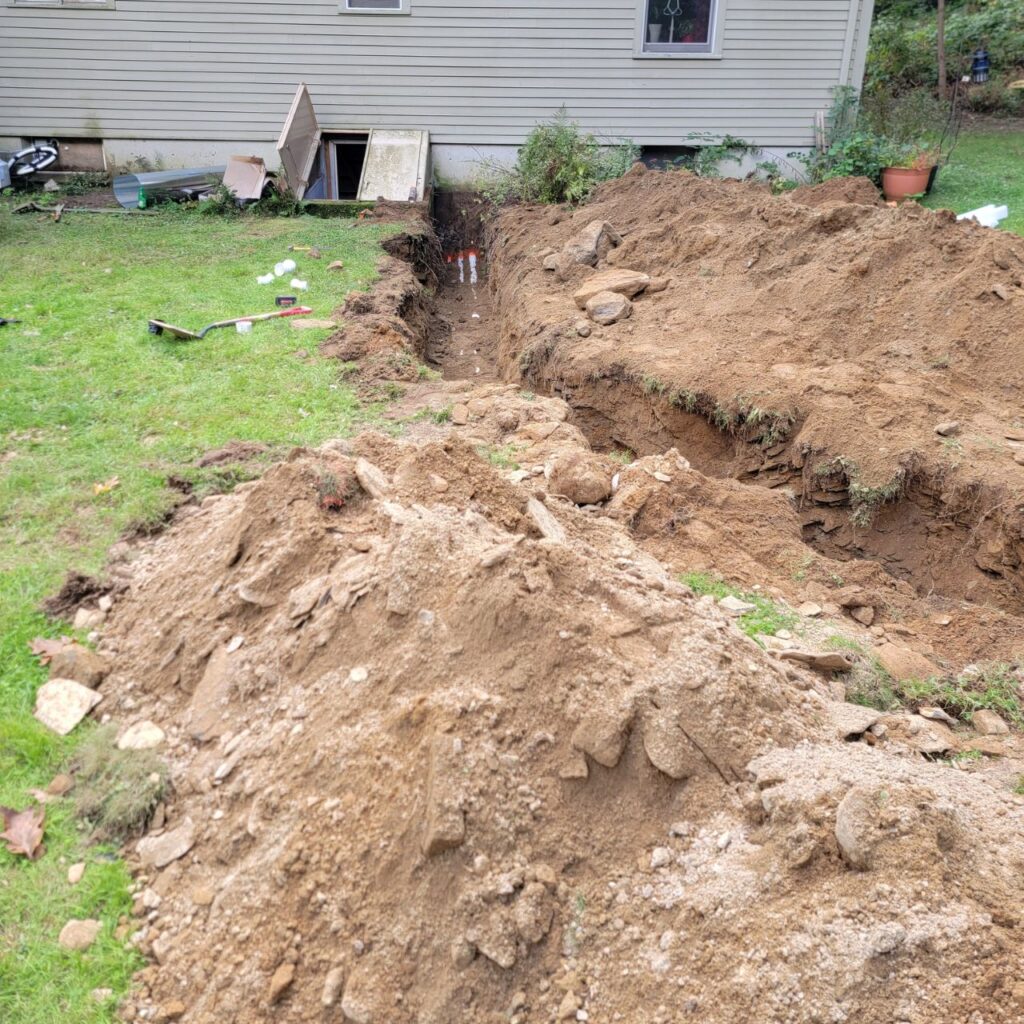
Excavation near structures is the work of digging beside something that already exists and has to survive the process: a house, a garage slab, a foundation wall, a septic tank, a stone wall, or a driveway you would rather not rebuild. It is the same work we do every week through our excavation and trenching services in Central Massachusetts, only with far less room for error. On an open lot, a bank can slump overnight and nobody notices. Beside a building, every bucket of soil that leaves the ground was holding something up.
Most homeowners never think about this distinction until a contractor explains why a short trench along the foundation takes a full day instead of an hour. The answer is almost never the digging itself. It is everything done to make sure the house, the wall, and the buried services beside them are exactly where they started when the work is finished. Excavation near structures carries costs that open-lot digging simply does not.
What Is Excavation Near Structures, Exactly?
Excavation near structures is any soil removal close enough to an existing building or improvement that the digging could change what supports it. There is no single magic distance that turns ordinary digging into this category. What matters is whether the soil being removed is part of the load path holding something up, and that depends on how deep the cut goes, how the ground is built, and what the neighboring structure is founded on.
Soil is a structural material, even though nobody thinks of it that way. A foundation wall is held in place partly by the earth pressing against both sides of it. A retaining wall depends on the mass of soil behind and beneath it. When a machine opens a hole beside either one, it is temporarily removing part of that support. The broader category of excavation and trenching covers all controlled soil removal, and excavation near structures is the branch of it where the consequences of getting it wrong are immediate and visible.
The defining feature is consequence, not size. A shallow trench four feet from an old fieldstone foundation can be far riskier than a deep hole in the middle of an open field. Judging that difference before the machine starts is most of the job, and it is the skill that separates excavation near structures from ordinary site work.
Why Excavation Near Structures Is Different From Open-Lot Digging
On open ground, an operator has room to work. Spoil can be piled wherever it is convenient, the machine can swing a full circle, a bank that sloughs can simply be pushed back, and an over-dig is fixed with a few buckets of fill. Speed is the main constraint and mistakes are cheap, which is the opposite of how excavation near structures has to be approached.
None of that is true beside a building. Excavation near structures is a slower, more deliberate kind of work because three things are happening at once. The bank has to stand up long enough to do the work in it, the structure beside it has to keep its support, and everything buried in that narrow strip of ground has to be found before it is hit.
Spoil placement alone changes the math. A pile of wet soil stacked beside an open cut is a surcharge load, meaning extra weight pressing down right where the ground is least able to carry it. On an open lot that pile is harmless. Beside a foundation it can be the thing that causes the bank to fail. Good crews stage spoil away from the cut or load it directly into a truck, which is slower and is the correct way to work.
Reading the Foundation Before the First Bucket
Central Massachusetts housing stock spans three centuries, and the foundation under a house tells you how carefully the digging beside it has to be handled. Poured concrete walls from recent decades are stiff and predictable. Concrete block is reasonably strong vertically but weaker against sideways pressure. Fieldstone and rubble foundations, common in older homes around Grafton and Worcester, were often laid without mortar and rely heavily on the soil packed against them to stay in place.
So the first step in any excavation near structures is looking, not digging. That means checking the foundation material, estimating where the footing sits, walking the basement to see whether water already comes in, and photographing existing cracks before anything moves. Documenting what was already there protects both the homeowner and the contractor, because settlement cracks in older houses are common and nobody wants an argument later about which ones are new.
It also means asking what the structure is. A detached shed on a floating slab tolerates excavation near structures that would be reckless next to a chimney footing or a bearing wall.
The Zone of Influence and the Angle of Repose
Loose soil will not stand vertically forever. Left alone, it slumps until it reaches its natural resting angle, which engineers call the angle of repose. Sand and gravel settle at a shallower angle than dense clay, and everything gets worse when the material is saturated. This single fact drives most of the decisions in excavation near structures.
Picture a line running down and outward from the bottom edge of a footing at that natural angle. The wedge of soil inside that line is what carries the structure down into the ground. Dig within the wedge and support is being removed, even if the excavation never touches the concrete itself. The deeper the cut goes, the farther out from the building that wedge reaches, which is why depth matters as much as distance in any excavation near structures.
The practical rule that follows is simple. Either stay outside that wedge, or support the ground before entering it. There is no third option that ends well, and the failures we get called to look at are almost always a case of somebody assuming a bank would hold because it held yesterday.
Shoring, Benching, and Temporary Support
When the work has to happen inside that wedge, the ground gets supported on purpose. There are three common approaches, and excavation near structures often uses more than one on the same job.
Sloping lays the sides of the cut back to a stable angle so the bank cannot fail. It is the simplest method and it needs the most room, which is exactly what the tight side yards where excavation near structures happens do not have. Benching cuts the sides into a series of steps instead of one continuous slope, which fits better in a confined space and is common on hillside lots.
Shoring supports the walls of the cut mechanically rather than reshaping them, using a trench box, plates and struts, or timber against the face. It takes up almost no extra room, which is why it is the usual answer along a foundation or a property line. Federal workplace safety rules require a protective system in any trench five feet deep or more, and a competent person has to inspect it, so this is not an optional refinement on deeper work.
When a new footing has to go below an existing one, the job moves past ordinary support into underpinning, which extends the existing foundation downward in controlled sections. That is engineered work, and it belongs in a design rather than in a field decision made partway through an excavation near structures.
Utilities That Hide Beside a House
Every service a house uses converges at the house. Electric, gas, water, sewer, propane, cable, irrigation lines, invisible fencing, well lines, and sump discharge pipes all crowd into the same narrow strip of ground where excavation near structures happens. That congestion is what makes the last ten feet before a building the most dangerous ground on the property.
Dig Safe marks public utility lines up to the meter, and that call is required before digging in Massachusetts. What it does not cover is the private side, meaning everything the homeowner or a previous owner installed past the meter. Those lines are usually unmarked, frequently undocumented, and often shallower than anyone expects. Careful utility trenching beside a house means treating any unexpected pipe or conduit as live until proven otherwise.
Near the marks themselves, the machine stops and hand digging or vacuum excavation takes over to expose the line without touching it. It is tedious and it is far cheaper than a struck gas service.
Water, Backfill, and Compaction Against the Wall
Opening the ground beside a foundation is an opportunity that most projects waste. While the wall is exposed, it can be cleaned, damp proofing or a membrane can be applied, and a proper footing drain can be set in stone and filter fabric to carry groundwater away instead of letting it stand against the wall. Doing that during excavation near structures costs a fraction of what it costs to come back and dig the same trench twice.
What goes back into the hole matters as much as what came out. Free draining material beside the wall lets water move down to the drain rather than collecting in a pocket of clay. Backfill after excavation near structures goes in shallow lifts and gets compacted as it rises, because a trench filled in one dump will settle for years and pull the finished grade back toward the house.
The last few inches decide whether the work holds. The finished grade has to fall away from the building so surface water leaves rather than pools, and that slope has to survive the settlement that follows. A backfilled trench that ends up flat is a trench that will eventually run water into the basement.
Access, Machine Size, and Protecting the Yard
The right machine for excavation near structures is the smallest one that can still do the job. Compact excavators and skid steers fit through gate openings and between a house and a property line where a full size machine has no business being, and rubber tracks spread weight across the ground instead of concentrating it under a wheel.
Access planning is part of the estimate, not an afterthought. It covers where the machine enters, whether a fence section has to come out and go back, how spoil leaves the site, and what the yard needs underneath the traffic. Ground protection mats over lawn and driveway are routine on this kind of work, especially in spring when Central Massachusetts soil is soft.
One buried system deserves its own mention. Septic tanks and leach fields will not carry equipment weight, and driving a loaded machine over a field can crush the distribution lines. Any excavation near structures on a septic property starts with knowing exactly where that system is and staying off it.
Projects That Usually Call for Excavation Near Structures
The most common reason is a new footing. Building an addition, a garage, a porch, or a bulkhead means digging beside the existing house at a depth that reaches below the frost line, which puts it squarely in the wedge of soil supporting the current foundation. That work is close cousin to foundation excavation, with the added constraint that a finished building is standing right there.
Water work is the next most common. Correcting chronic basement moisture, installing a footing drain, routing a sump discharge away from the house, or fixing a grade that slopes the wrong way all require opening the ground tight against the wall.
The rest of the list is repairs and improvements: replacing a failed water or sewer line where it enters the house, running power or gas to a garage, cutting in an egress window, extending a driveway or patio along the side of a building, and removing a stump whose root plate has grown into the foundation. Each is routine work, and each is excavation near structures the moment the cut gets close enough to matter.
In Massachusetts, Watch Out for These
Dig Safe is not optional and it is not fast. Massachusetts requires notification through Dig Safe by calling 811 before excavation begins, and the notice period is 72 business hours, which excludes weekends and holidays. A call placed Thursday afternoon does not clear the job for Monday morning. Once issued, the ticket is valid for 30 days, so a project that stretches past a month needs a fresh one.
Frost governs depth. The design frost line in Massachusetts is 48 inches, and any new footing or bearing element has to sit below it so the freeze and thaw cycle cannot lift it. This is also why a trench backfilled carelessly beside a house causes trouble here that it might not cause in a warmer state.
Wetlands rules reach farther than most homeowners expect. Work within 100 feet of a wetland resource area, or within 200 feet of a perennial stream, falls under the Wetlands Protection Act and requires a filing with the local Conservation Commission before soil is disturbed. The state overview of protecting wetlands in Massachusetts is the place to start, and the Conservation Commission in your town is the office that decides. Excavation near structures on a lot with a brook or a low wet corner often needs that filing even when the digging is right beside the house.
Permits follow the structure, not the hole. Digging by itself usually does not require a building permit, but the thing being built almost always does. The Massachusetts State Building Code, 780 CMR governs footings, foundations, and structural alterations, and your local building department issues and inspects the permit. Anything that underpins or alters an existing foundation is engineered work requiring design and approval.
Frequently Asked Questions
How close to my house can you safely excavate?
There is no single distance that is universally safe, because the answer depends on depth as much as on how far away the cut sits. A shallow trench can often run within a few feet of a wall without issue, while a deeper cut at the same distance may fall inside the wedge of soil supporting the footing. The working rule for excavation near structures is that as a cut gets deeper, it has to move farther out from the building or be shored. We look at the foundation type, the footing depth, and the soil before committing to a distance.
Do I need a permit for excavation near structures in Massachusetts?
The digging itself usually does not require a building permit, but whatever you are building generally does. Footings, foundations, additions, and any alteration of an existing foundation fall under the state building code and require a permit from your local building department, whether or not the job involves excavation near structures. Separately, a Dig Safe notification is required before excavation anywhere in Massachusetts, and work near a wetland or stream may require a filing with your town Conservation Commission first.
Will digging next to my foundation cause cracks?
It should not, when the work is planned and supported correctly. Cracking after excavation near structures appears when soil is removed from within the zone that supports the footing without shoring, when heavy spoil is piled beside an open cut, or when the trench is backfilled loosely and settles for years afterward. Older fieldstone and block foundations need more care than poured concrete. We document existing cracks with photographs before starting so there is a clear record of the condition the house was in.
How far ahead do I have to call Dig Safe in Central Massachusetts?
Massachusetts requires 72 business hours of notice before any excavation near structures or open ground, and business hours exclude weekends and holidays, so the practical lead time is usually most of a week. The ticket is then valid for 30 days. For homeowners in Grafton, Worcester, Shrewsbury, and Northborough this is the single most common reason a start date moves, which is why we place the call as soon as a project is scheduled rather than the day before we dig.
Can you get equipment into a tight side yard?
Usually yes. Compact excavators and skid steers fit through standard gate openings and work in the narrow space between a house and a property line, which is exactly where excavation near structures happens. When access is genuinely too tight for a machine, portions of the digging are done by hand. We walk the access route before quoting so there are no surprises on the first morning, including whether a fence section needs to come out and go back.
Excavation near structures is where careful work pays for itself, because the cost of doing it twice includes repairing whatever moved the first time. If you are planning an addition, chasing water away from a foundation, or running a new line to the house in Grafton, Worcester, Shrewsbury, or Northborough, we are glad to walk the site, look at what is already standing there, and tell you honestly what the ground beside it will allow. When you are ready for numbers, our estimates are always free.