
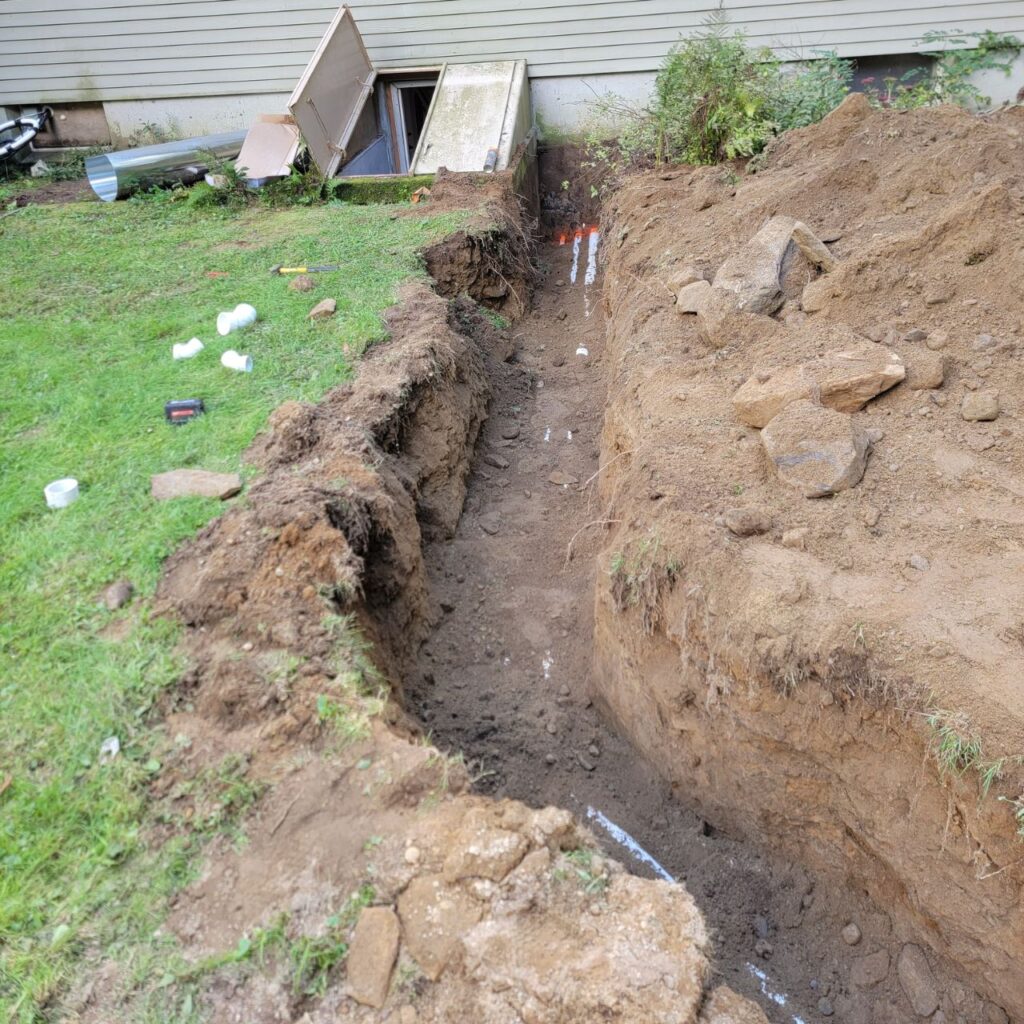
Standing water solutions are the drainage corrections that stop rain from pooling on a lawn, against a foundation, or across a driveway and instead move it somewhere safe. It is the same work we do every week through our Central Massachusetts drainage and grading service: reshaping the ground, collecting water below the surface, and giving it a clear path out. If your yard holds a puddle for days after every storm, the fix is rarely one product. It is a plan.
What Standing Water Solutions Actually Involve
Standing water solutions are less about a single gadget and more about controlling where water goes from the moment it lands. Water only stalls in a yard for two reasons: the ground is too flat or too low to let it run off, or there is nowhere for it to drain once it arrives. Good corrections address both. That can mean regrading the surface, installing buried pipe, adding a collection point like a dry well, or routing roof water away from the house. Most wet yards need a combination, which is why we treat drainage as a system rather than a part off a shelf. Our full guide to drainage and grading walks through how those pieces fit together.
Why Water Pools in a Central Massachusetts Yard
A lot of local drainage trouble comes from the ground itself. Central Massachusetts sits on dense, clay-heavy and rocky glacial soil that drains slowly, so water that would soak away in sandy soil sits on top instead. Add a flat lawn, a downspout dumping at the corner of the house, or a yard that slopes toward the foundation instead of away from it, and you have a puddle that never quite leaves. Frost heave through the winter can also shift the grade over time, turning a yard that once drained fine into one that traps water every spring.
Understanding the cause is the first step, because the wrong fix on the wrong problem just moves the puddle a few feet. Effective standing water solutions always start with that diagnosis.
Regrading the Ground So Water Moves
The most common of all standing water solutions is also the simplest in concept: reshape the ground so water flows away from where you do not want it. Regrading means cutting down the high spots, filling the low spots, and establishing a steady, gentle slope that carries runoff toward a safe outlet. A fall of even a couple of inches over ten feet is usually enough to keep water moving. Done right, regrading fixes the source of the problem rather than treating the symptom, and it is often all a yard needs. When a low area near the house is the culprit, regrading is frequently paired with the same corrections we cover in our guide to yard drainage.
French Drains and Subsurface Collection
When water is already in the ground or the surface cannot be sloped enough, the fix moves underground. A French drain is a trench filled with washed stone and a perforated pipe that collects water below the surface and carries it to a lower outlet. It is the right tool for a chronically soggy strip of lawn, a wet spot at the base of a slope, or water seeping toward a foundation.
The pipe has to be laid at a consistent pitch and wrapped so it does not silt up, which is where installation quality decides whether the drain still works in five years. A buried collection line is one of the most durable standing water solutions when it is built correctly.
Dry Wells, Catch Basins, and Where the Water Goes
Collected water has to end up somewhere. A dry well is a buried chamber, usually filled with stone or a plastic crate, that holds runoff and lets it soak slowly into the ground away from the house. A catch basin is a surface inlet with a grate that captures water at a low point and feeds it into a pipe. Both give a French drain or a graded swale a real destination instead of just relocating the problem to the property line. Choosing the outlet is the part homeowners rarely think about, and it is the part that quietly makes or breaks a set of standing water solutions.
Swales and Surface Shaping
Not every correction needs to be buried. A swale is a shallow, gently shaped channel that guides surface runoff along a deliberate path, often around the edge of a yard or between two structures. Paired with a berm, a low mound of earth, it can steer a sheet of stormwater away from a patio or a garage without a single pipe. Swales are quiet, low-maintenance, and easy to plant over, which makes them a favorite where a homeowner wants the fix to disappear into the landscape. They work best as one piece of a larger set of standing water solutions, not on their own.
Roof Runoff and Downspout Routing
A surprising share of yard flooding starts at the roof. A single downspout can pour hundreds of gallons off a roof in one storm, and if it lets go right at the foundation, no amount of lawn grading will keep up. Extending downspouts, burying them to a pop-up emitter well away from the house, or tying them into a dry well is often the cheapest correction with the biggest payoff. We almost always check roof water first, because fixing it can shrink the size of the other standing water solutions a yard needs.
Matching Standing Water Solutions to Your Yard
The reason there is no single answer is that no two wet yards fail the same way. Matching standing water solutions to a property means reading the grade, the soil, the roofline, and where the water is trying to go before deciding what to build. A flat backyard that ponds might only need regrading. A soggy strip along a fence might need a French drain and a dry well. A basement that floods every spring might come down to two rerouted downspouts. We walk the yard, find the real cause, and design standing water solutions that fit it, rather than selling the same fix to everyone. Getting the diagnosis right is what keeps the water gone for good.
Standing Water Solutions for Driveways and Walkways
Not all of it happens on the lawn. A driveway that holds a sheet of water after every storm, a walkway with a permanent puddle at the low end, or a patio that stays wet for days is the same problem on a hard surface, and it does more damage there. Water that sits on gravel washes the fines out of the surface and starts the potholes that follow. Water that sits against a slab or an apron works into the joints, freezes, and lifts them over a few winters.
On a driveway the cause is almost always pitch: the surface was built flat, it has settled, or runoff from the yard above it has nowhere to cross. Standing water solutions on hard surfaces usually combine regrading the approach, cutting a channel where the water wants to cross, and giving the flow a defined outlet instead of letting it pond at the low corner. Where the surface itself has already broken down, the correction pairs naturally with rebuilding the base, which is covered in our guide to gravel driveway installation. Getting water off the driveway also protects the garage, since a drive that pitches toward the building sends every storm straight at the slab.
Why Standing Water Solutions Are Worth Doing Sooner
Waiting is its own decision, and wet ground charges interest. Turf drowns first: grass roots suffocate in saturated soil, thin out, and give way to moss and the weeds that prefer wet feet, so the lawn keeps shrinking toward the puddle. Then the structures start paying. Water standing against a foundation loads the wall and finds any crack, joint, or failed coating available, which is how a yard problem becomes a basement problem. Posts, deck footings, fence lines, and sill plates that stay damp rot from the ground up on a schedule nobody notices until something moves.
New England weather finishes the job. Ground that stays saturated into November expands every time it freezes, heaving walkways, tipping slabs, and pushing the grade further out of shape, so next spring starts worse than last. That is the practical argument for treating standing water solutions as a repair rather than a renovation. The longer the water sits, the more of the property it touches, and the more the eventual fix has to include. A yard corrected this season is almost always a smaller job than the same yard corrected in three.
In Massachusetts, Watch Out for These
Two rules shape drainage work here, and both are easy to trip over. First, any digging for a French drain, a dry well, or a buried downspout falls under Massachusetts Dig Safe law: you must call 811 and wait 72 business hours, not counting weekends or holidays, before a shovel goes in the ground so buried utilities can be marked. It is free, it is required, and we handle it on every job. You can read the requirement through the state Dig Safe program.
Second, water cannot simply be discharged wherever is convenient. Under the Massachusetts Wetlands Protection Act, work within 100 feet of a wetland or other resource area may need review by the local Conservation Commission before it starts. Standing water solutions that ignore either rule can mean fines or a torn-out install, so we check both before we design anything.
Frequently Asked Questions
Do standing water solutions require a permit in Massachusetts?
Most residential regrading and downspout work does not need a permit, but the answer changes fast near a wetland or resource area. If any part of the water is being moved toward, across, or away from a protected area, the local Conservation Commission may need to review the plan first. We look at where a property sits before we design standing water solutions in Grafton, Worcester, and the rest of Central Massachusetts, so nobody gets a surprise stop-work notice.
How long does a yard drainage correction take?
A straightforward regrade or a single French drain run is often a one-day to two-day job once the weather cooperates. Larger corrections that combine regrading, buried pipe, and a dry well take longer because each part has to be graded and tested in sequence. Wet ground and mud season both stretch the schedule, which is why we would rather set a realistic date than rush the compaction.
Will standing water solutions stop water from getting into my basement?
Surface drainage and a wet basement are usually connected. When water is allowed to pool against the foundation, it finds the path of least resistance through the wall or the footing. Moving that water away from the house with grading and downspout routing removes the source of the pressure, which is often the piece a homeowner in Shrewsbury or Northborough has been missing after years of interior patching.
What is the difference between a French drain and a swale?
A French drain is a buried, gravel-wrapped pipe that collects water below the surface and carries it away. A swale is a shallow, shaped channel on the surface that guides runoff along a planned path. Many yards need both, and a good drainage plan decides which one belongs where instead of forcing a single fix onto every problem.
Can you fix standing water without regrading the whole yard?
Often, yes. Not every lawn needs to be stripped and reshaped. Targeted standing water solutions such as a section of regrading, a French drain along one wet edge, or rerouted downspouts can correct a problem area while leaving the healthy parts of the lawn alone. The right scope depends on why the water is stalling, which is what we figure out on a free site visit.
Standing water solutions are worth getting right the first time, because a yard that drains protects everything built on it. We correct drainage for homeowners across Grafton, Worcester, Shrewsbury, and Northborough, and we start every project by finding out why the water is stalling. If a puddle keeps coming back, reach out for a look. Our estimates are always free, and the sooner standing water is moving again, the less it costs your lawn and your foundation.