
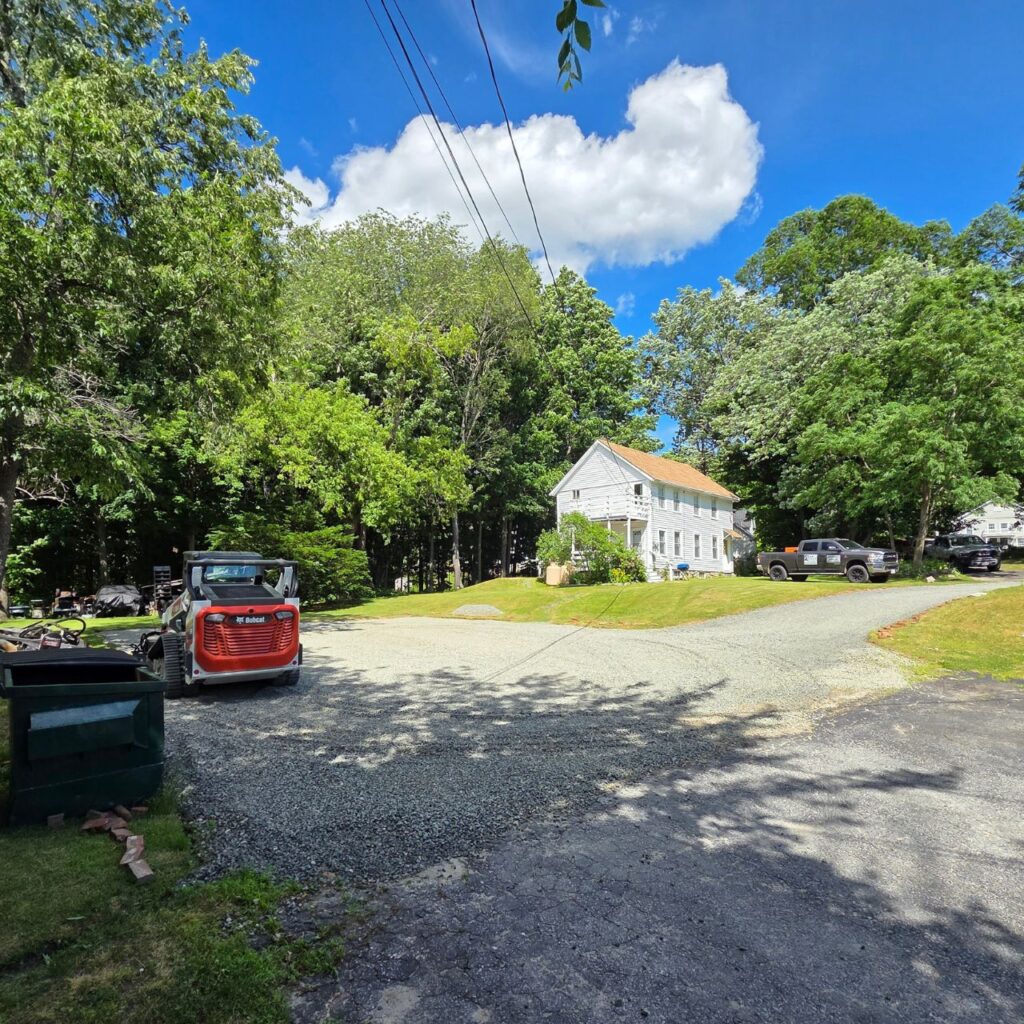
Gravel driveway resurfacing is the work of restoring the wearing surface of a stone driveway before the base underneath it is damaged. New stone is placed over the old surface, graded back to the shape the driveway is supposed to hold, and compacted so it locks in rather than scattering. It is the same work we do every week through our gravel installation and driveway services across Central Massachusetts.
Almost every gravel drive in this part of the state reaches a point where it needs this. Stone does not vanish, but it does migrate. It gets pushed to the shoulders by tires, carried off by runoff, plowed into the lawn in February, and ground into dust in August. Gravel driveway resurfacing is the maintenance cycle that answers all of that, and the property owners who stay ahead of it spend far less time and disruption than the ones who wait.
What Is Gravel Driveway Resurfacing, Exactly?
Gravel driveway resurfacing means adding and reshaping the top layer of stone on a driveway whose foundation is still sound. It is not a rebuild. The compacted base course that carries vehicle weight stays where it is. What gets replaced is the surface layer above it, the part that takes the tire wear, sheds the rain, and gives the driveway its shape.
That distinction is the whole subject. A driveway with a good base and a thin surface is a straightforward job of gravel driveway resurfacing. A driveway whose base has been breached, where tires are riding on subsoil and the stone has been pumped down into mud, is a reconstruction. Those two jobs look similar from the seat of a car and are very different on the ground.
Gravel driveway resurfacing usually happens in one visit. The existing surface is scarified or raked loose where it has hardened, new stone is spread across it, the whole surface is graded to a crown or a consistent pitch, and it is rolled or tracked in. When gravel driveway resurfacing is done at the right moment, a driveway that had been getting worse every spring goes back to shedding water and holding its shape.
Gravel driveway resurfacing follows a maintenance rhythm rather than a fixed interval. A short flat drive over well-drained gravel can go many years. A long sloped drive that carries a delivery truck and a plow every winter needs attention more often. What sets the timing is traffic, slope, and how well water leaves the surface.
Why a Gravel Driveway Wears Down in the First Place
A gravel surface is not a solid sheet. It is a graded blend of stone sizes locked together by the fine material between them. That interlock is what makes it firm. Everything that wears a driveway out is really something removing either the stone or the fines that bind it.
Tires do the mechanical share. Every turn of a wheel pushes stone slightly outward and slightly forward. Over years that is measured in inches of surface migrating to the shoulders and to the bottom of the slope. This is the single largest reason gravel driveway maintenance exists at all.
Water does the rest. Rain running along the surface instead of across it picks up the fines first, because they are the lightest thing there. Once the fines are gone the remaining stone is loose, rattles under tires, and stops shedding water. A driveway that has turned into a layer of round loose stone over a hard pan has lost its binder, not its rock.
Winter adds two more mechanisms. Plow blades scrape surface material into the lawn, and freeze and thaw cycles lift and drop the whole surface repeatedly. Neither is avoidable in Central Massachusetts. Both are the reason gravel driveway resurfacing tends to get scheduled in the spring, once the ground has drained and the damage from the previous winter is visible.
Gravel Driveway Resurfacing Versus Full Reconstruction
The line between gravel driveway resurfacing and a rebuild is the condition of the base. A base course is a compacted layer of larger angular stone, usually placed over a stripped subgrade and sometimes over geotextile fabric, and it is what actually carries the load. The surface above it is a wear layer.
If you dig a test hole in the driveway and find several inches of compacted stone before you reach soil, gravel driveway resurfacing is the right call. If the shovel goes through an inch of stone straight into clay or loam, the base is either gone or was never there, and adding stone to the top is money spent on a surface that will sink into the same soft spot within a season.
This is why we do not quote gravel driveway resurfacing sight unseen. Two driveways with identical symptoms, both rutted and holding water, can need completely different work. One needs a load of stone and a grading pass. The other needs the failed section excavated, a proper base rebuilt, and only then a surface. That deeper job is described in our guide to gravel driveway installation.
Gravel driveway resurfacing also has a middle case that is very common: a driveway that is sound for most of its length with two or three failed sections, usually at the low end, at a turn, or where a vehicle parks. Those sections get rebuilt and the rest gets resurfaced in the same visit. Most jobs in Grafton and the surrounding towns land here rather than at either extreme.
The Signs Gravel Driveway Resurfacing Is Due
Ruts that hold water after a rain are the clearest signal that gravel driveway resurfacing is due. A driveway with a proper crown does not keep puddles. Once you have standing water in wheel tracks, the surface has lost its shape and water is now working on the base rather than running off it.
Loose stone rolling underfoot is the second sign. When you can hear the driveway rather than just drive on it, the fines that bound the surface together have washed out. Adding new material with the right blend of sizes is exactly what gravel driveway resurfacing does about that.
A third sign is stone in the lawn. If you are edging a strip of gravel out of the grass every year, that stone came off the driveway and the driveway is that much thinner. The same goes for a fan of gravel at the bottom of a sloped drive or a build up against the garage apron.
The fourth is potholes that keep coming back in the same place. A pothole filled with a shovel of stone and left uncompacted reopens within weeks. A pothole in a driveway with a sound base disappears permanently once the surface is regraded, which is the difference between patching and gravel driveway resurfacing.
Finally, watch the shoulders. When the driveway sits lower than the lawn on both sides, the surface has been running downhill for years and water now has nowhere to leave. That driveway is a channel, and the next heavy storm will treat it like one.
What the Base Has to Do Before Gravel Driveway Resurfacing Makes Sense
The base is the part nobody looks at and the part that decides whether gravel driveway resurfacing will hold. Its job is to spread wheel loads over enough area that the soil underneath never gets overstressed, and to stay dry enough that it does not soften. A base does that through thickness, angular stone that locks rather than rolls, and compaction.
Before any gravel driveway resurfacing we check whether that base is intact. The quick field tests are honest ones. Drive it after a rain and watch for pumping, where water and fines squeeze up through the surface under a tire. Look for soft spots that flex. Dig two or three holes at the worst places and measure how much stone is there.
Where the base has failed, the fix is to excavate the failed section down to firm ground, place and compact fresh base stone in layers, and only then bring the surface back to grade. Skipping that step is the most common reason a resurfaced driveway disappoints. The new stone is fine. The ground under it was not.
Fabric matters here too. A layer of geotextile between subgrade and base keeps soil fines from migrating up into the stone, which is the slow mechanism that turns a good base into a bad one. On wet or clay soils, which are common through Worcester County, fabric is often the difference between a base that lasts and one that has to be redone.
How Gravel Driveway Resurfacing Actually Gets Done
The sequence for gravel driveway resurfacing is simple and the order matters. First the driveway is assessed and the failed sections are marked. Then the existing surface gets scarified, which means raking or ripping the top inch or two so new stone bonds into it instead of sitting on a hard glazed crust as a separate layer that slides.
Next, material is placed. Stone is dumped and spread with a box blade, a grader attachment, or a skid steer bucket, in a lift thin enough to be compacted properly rather than one deep dump that stays loose. Depth gets adjusted along the way, more where the surface has thinned, less where it is still full.
Then the driveway is shaped. This is the part of gravel driveway resurfacing that separates a lasting job from a temporary one. The surface is cut to a crown down the center or a consistent cross pitch, so that water leaves sideways within a few feet rather than running the length of the drive.
Finally it is compacted. Rolling or tracking the surface pushes the stone sizes into each other and sets the shape. An uncompacted surface looks perfect on the day and reverts to ruts within a month of traffic. Compaction is what makes the shape permanent.
Edges and transitions are the last details. The apron at the road, the pad at the garage, the shoulder where the stone meets lawn, and any culvert ends all get tied in so that the new surface does not simply drop off at the boundaries.
Choosing Stone for Gravel Driveway Resurfacing
Not all gravel is driveway gravel. What holds together is angular crushed stone with a graded range of sizes and enough fine material to bind, often sold locally as a processed or dense graded product. The angular faces lock against each other. Rounded river stone does not lock and never will, which is why a driveway surfaced with pea stone stays loose forever.
For most gravel driveway resurfacing on residential drives, a dense graded crushed stone is the right surface material. It packs to a firm surface, sheds water, and takes a crown. Larger clean stone belongs in the base or in a wet section where drainage matters more than a smooth ride, not on the top of a driveway you want to walk on.
Stone size is a comfort question as well as a performance one. A large sharp surface stone is durable and unpleasant underfoot and hard on bare feet and bicycle tires. A finer blend rides better and dusts more in a dry August. Most driveways end up with a moderate blend that balances the two.
Color and source vary regionally and matter less than gradation. What matters is that the material is a crushed product with fines included, not a washed stone with the fines screened out. Washed stone drains beautifully and will not hold a shape, so it belongs under a surface rather than on it.
Crown, Pitch, and Why Gravel Driveway Resurfacing Is Really a Drainage Job
A gravel driveway fails at the surface almost always because water spent too long on it. Shape is therefore the most important thing gravel driveway resurfacing delivers, more than the depth of stone added.
A crown is a slight ridge down the center that sheds water to both sides. On a driveway that runs across a slope, a single cross pitch to the downhill side does the same job. Either way the target is a small amount of fall, enough that water crosses the driveway in a few feet instead of running along it for a hundred.
The reason gravel driveway resurfacing so often gets treated as a drainage project is that the alternative is erosion. Water that runs the length of a driveway gains speed and carries material with it, so the driveway becomes its own gully. That failure and its fixes are covered in our guide to erosion control.
The shoulders have to let water go somewhere. If the lawn has grown up higher than the driveway over the years, no crown will help, because the water reaches the edge and stops. Part of the work is cutting the shoulders back down so the surface can actually drain to daylight.
On longer or steeper drives, shaped breaks across the surface are sometimes added to intercept water and turn it off the driveway at intervals before it can build up speed. That approach shows up on stone access roads constantly, and it is just as useful on a long residential drive.
Potholes, Washboarding, and Ruts
These three defects have different causes and different answers, and telling them apart tells you what the driveway needs.
Potholes start where water sits. A low spot holds a puddle, tires pump the softened material out, and the hole deepens on its own from there. A pothole over a sound base is a surface problem and gravel driveway resurfacing eliminates it. A pothole that reappears in the same place after every repair is a base problem.
Washboarding is the ripple pattern that shows up on the approach to a stop, at the bottom of a hill, or anywhere vehicles accelerate and brake. It is caused by loose surface stone with too little binder bouncing under tires. Grading the ripples out and adding material with proper fines is the fix, and the ripples return quickly if only the tops are knocked off.
Ruts are wheel tracks that have worn below the surrounding surface. Shallow ruts regrade out. Deep ruts that stay wet mean the base under the wheel path is soft, and the wheel path has to be rebuilt rather than filled. Filling a soft rut with new stone puts good material into a hole that will swallow it.
One habit is worth breaking. Dumping loose stone into holes without grading and compacting the surrounding surface is not gravel driveway maintenance, it is feeding the hole. The stone scatters and the depression returns, usually before the next season.
Edges, Shoulders, and Where the Stone Escapes
Most of the material that leaves a driveway leaves at the sides. Tires push it there, plows throw it there, and runoff carries it there. Any gravel driveway resurfacing that does not deal with the edges is refilling a container with a hole in it.
A defined edge helps enormously. That can be a shallow shoulder cut so the lawn stops encroaching, a stone berm, timber or granite edging on a formal drive, or simply a maintained grass shoulder mowed low and kept below the driveway surface. What matters is that the boundary is deliberate rather than accidental.
Widening is sometimes the honest answer. If vehicles are consistently running off the edge because the driveway is too narrow for the way it is used, no amount of gravel driveway resurfacing will hold. Adding width at the pinch point solves the cause, and that work is described in our guide to driveway extensions.
Parking areas are the other place stone escapes fast, because vehicles turn in place there and turning tires grind and shove more than rolling ones. A drive that also serves as a turnaround needs more surface material and more frequent attention than one that is only driven along, which is why gravel parking areas are built with that in mind.
Culverts, Ditches, and Water Arriving From Somewhere Else
A driveway that keeps failing at the same point is often being fed water from off the property. A ditch that has silted in, a culvert that has crushed or clogged, or a neighboring slope that discharges onto the drive will all defeat a good surface.
The culvert at the road end deserves a look before any gravel driveway resurfacing. If it is blocked, water backs up and crosses the driveway instead of passing under it, which washes the apron out every storm. Clearing or replacing it is a far smaller job than gravel driveway resurfacing on the same apron every year.
Roadside and property ditches do the same job at a smaller scale. A ditch that has filled with leaf litter and sediment stops carrying and starts spilling. Reopening it to a defined line and grade is usually part of the same visit.
Where the water is coming from the yard rather than the road, the answer is not on the driveway at all. Redirecting the source is the durable fix, and the approaches are covered in our guide to yard drainage.
Gravel Driveway Resurfacing and the Central Massachusetts Freeze and Thaw Cycle
This region puts a driveway through dozens of freeze and thaw cycles a year. Water in the surface expands as it freezes, lifting the stone, and drops it back loose on the thaw. Repeat that all winter and a tight surface becomes a soft one by March.
Frost depth here is taken as roughly forty eight inches for foundation and footing purposes, which matters for anything structural at the edge of a driveway. For the driveway surface itself, the relevant number is not depth but drainage. A surface that holds no water in November suffers far less by April.
That is why timing matters for gravel driveway resurfacing. Spring, once the ground has drained and mud season has passed, lets you repair the winter and set the shape for the year. Late summer and early fall are the other strong window, because the surface gets compacted and settled before the first frost.
Mud season itself is the window to avoid. Saturated ground will not compact, machines rut what they drive on, and material placed on soft subgrade gets pushed into it. Waiting a few weeks in April usually produces a better result than starting on the first warm day.
Plowing habits also matter. A plow blade set flat on a gravel drive scrapes surface material into the lawn every pass. Skid shoes or a raised blade preserve the surface, and a driveway that is plowed carefully needs gravel driveway resurfacing much less often than one that is scraped bare every storm.
When Gravel Driveway Resurfacing Turns Into Something Larger
Sometimes the surface is the symptom. If a driveway has failed repeatedly in the same section, the honest scope is larger than gravel driveway resurfacing and it is better to say so before the work starts.
The common escalations are a wet section that needs a drain line or a shaped ditch before it can hold stone, a soft section that needs excavation and a rebuilt base, a steep section that needs regrading to a workable pitch, and a road apron that needs a proper culvert. Each of these is ordinary work, and each of them is invisible if you only look at the top layer.
The general subject of building stone surfaces from the ground up, including base depth, fabric, and compaction, is covered in our pillar guide to gravel installation. Gravel driveway resurfacing is the maintenance end of that same body of work.
Being told the driveway needs more than a top up is not upselling if the evidence is in the holes we dug. Placing new stone over a failing base is the version of this job that wastes material, and we would rather point at the soft section than resurface over it.
Access, Timing, and What Happens to the Driveway During the Work
Most residential gravel driveway resurfacing is a one day or two day operation. Material gets delivered, spread, shaped, and compacted, and the driveway is usable the same evening in most cases.
Access is the practical constraint. Delivery trucks need room to back and dump, and the machine needs room to work along the full width. Vehicles parked on the drive have to move for the day, and anything stored along the edges needs to be clear so the shoulders can be cut.
There is a short settling period after gravel driveway resurfacing. A freshly resurfaced driveway will move slightly under the first weeks of traffic, and it is normal for a light amount of loose stone to sit on top before it works down. Driving it normally helps it set.
Weather sets the schedule more than anything else. Stone places and compacts best with some moisture in it and not in a downpour, so a wet stretch will move the date. That is a scheduling nuisance rather than a real problem, and it produces a better surface than forcing the work into saturated conditions.
Keeping the Surface After Gravel Driveway Resurfacing
A resurfaced driveway lasts far longer with a small amount of attention. The habits that matter are unglamorous and they are the difference between needing gravel driveway resurfacing every few years and needing it twice as often.
Keep the shoulders lower than the driveway. Mow them, cut back the encroaching sod every couple of years, and do not let the lawn build a curb along both sides. Water has to be able to leave.
Keep the ditches and culverts open. A yearly look after the leaves come down catches nearly every blockage before it becomes a washout.
Regrade rather than patch. A grading pass every year or two on a long drive redistributes material that has migrated and restores the crown, and it postpones the next full gravel driveway resurfacing considerably. Shoveling stone into individual holes does not.
Watch how the drive behaves in a heavy rain. Where the water runs, how long a puddle lasts, and which spot always stays wet will tell you more about what the driveway needs than any inspection on a dry day.
In Massachusetts, Watch Out for These
Call 811 before anything digs. Massachusetts law defines excavation broadly under MGL Chapter 82 Section 40, and the definition explicitly includes grading, digging, augering, backfilling, and trenching. Reshaping a driveway shoulder or cutting a ditch is excavation under that definition, so the Dig Safe notice applies. The state guide to Dig Safe sets the requirement at 72 business hours of advance notice, excluding weekends and holidays.
Private utilities are the gap in that system. Dig Safe marks the utility owned lines. A propane line to the house, a well line, a septic line, an irrigation loop, or an underground electric feed to a garage belongs to the property owner and is not marked. On a driveway that has been trenched under before, those are exactly what a grading pass can catch.
Wetlands rules reach further than people expect. Under the Wetlands Protection Act, no person may remove, fill, dredge or alter a protected area without filing written notice and receiving an order of conditions. The buffer zone extends 100 feet from a wetland and 200 feet from most perennial streams, and the state wetlands guidance explains the filing path. A long rural driveway in this region very often has one end inside that buffer.
Stormwater rules apply once the disturbance gets large. The EPA requires a construction stormwater permit for land disturbance of one acre or more, or less than an acre when it is part of a larger common plan of development. Ordinary gravel driveway resurfacing is well under that, but a long driveway rebuilt alongside other site work can add up.
Material deliveries are regulated too. Under MGL Chapter 85 Section 36, a vehicle must be built or loaded so that no part of the load can drop, sift, leak, or escape, and loads of sand, gravel, loam, dirt, or stone that could fall onto the road must be fully and adequately covered. That is the contractor obligation, and it is a reasonable thing to expect of anyone hauling stone to your property.
Check the local rules as well as the state ones. Every city and town employs a building commissioner or inspector of buildings under MGL Chapter 143 Section 3, and many towns also have their own bylaws about driveway aprons, curb cuts, culvert sizing at the road, and work in the town right of way. A resurfacing job that stops at the property line rarely triggers any of it, and one that touches the apron sometimes does.
Frequently Asked Questions
What is the difference between gravel driveway resurfacing and a new driveway?
Resurfacing renews the wearing layer of stone on a driveway whose compacted base is still sound. A new driveway means stripping the subgrade, building a base course from scratch, and then placing a surface. If a shovel goes through an inch of stone straight into soil, the base is gone and resurfacing alone will not hold.
How often is gravel driveway resurfacing needed?
It depends on traffic, slope, and drainage rather than on a fixed schedule. A short flat drive that sheds water well can go many years between resurfacings. A long sloped drive that carries heavy vehicles and gets plowed every winter needs attention far more often. Regular regrading stretches the interval considerably.
When is the best time of year for gravel driveway resurfacing in Central Massachusetts?
Spring after mud season has passed, or late summer into early fall. Both windows give ground dry enough to compact properly. Saturated spring ground will not compact and machines rut it badly. Working before the first frost lets the surface settle and lock in before winter arrives.
Do I need a permit to resurface a gravel driveway in Massachusetts?
Usually not for surface work inside your own property line. It changes if the driveway sits within 100 feet of a wetland or 200 feet of a perennial stream, where an order of conditions from the local conservation commission is required, or if the work touches the apron or culvert in the town right of way. Any grading also triggers Dig Safe notice through 811.
Why do potholes keep coming back in the same spot on my Central Massachusetts driveway?
A pothole that reopens after every repair is telling you the base underneath has failed, not the surface. Water is reaching soft subgrade and tires pump the material out again. Filling it with loose stone feeds the hole. The lasting fix is excavating that section, rebuilding the base in compacted layers, and bringing the surface back to grade.
Gravel driveway resurfacing is one of those jobs where standing on the property answers more than photographs can. We look at how deep the stone actually is, where the water goes during a storm, whether the shoulders let it leave, and whether the base is sound. That inspection is what decides whether the driveway needs a surface or a section rebuilt.
D and M Good Construction handles this work for property owners in Grafton, Worcester, Shrewsbury, Northborough, and the surrounding Central Massachusetts towns as part of our gravel installation and driveway services. If your driveway is rutted, loose underfoot, holding water, or losing stone into the lawn every year, tell us what you are seeing and we will come look at it. Our estimates are always free.