
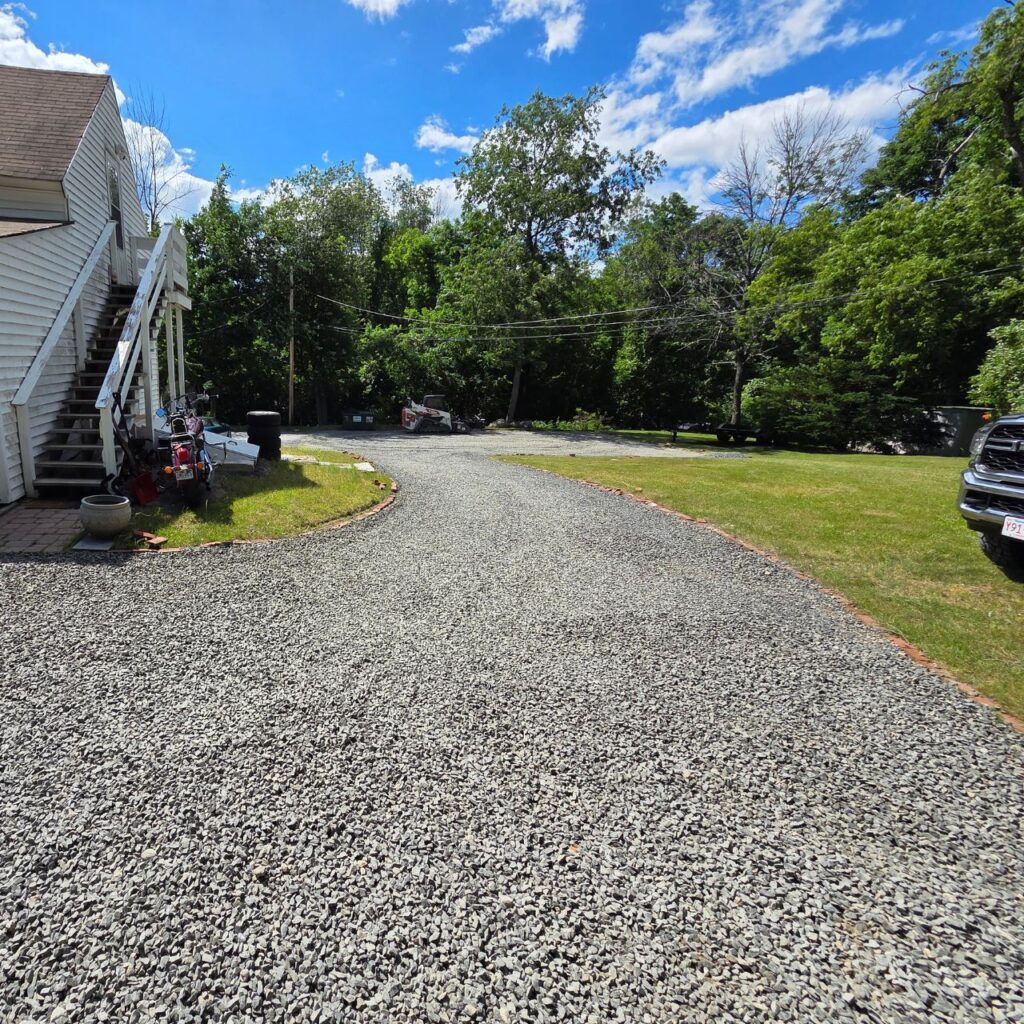
A stone access road is a compacted crushed stone travel surface built to carry vehicles and equipment across ground that was never meant to be driven on. It is the same work we do every week through our gravel installation and driveway service, only stretched across a field, a wood lot, or the back half of a property instead of a front yard.
Where a driveway connects a house to the street, a stone access road connects usable ground to everything behind it. Farm equipment reaches the far field. A camper reaches the back corner. A concrete truck reaches a building site that sits four hundred feet off the road. Without that surface, the same trips either do not happen or they happen once and leave ruts that take a season to heal.
What follows is how a stone access road is planned, built, drained, and kept alive, and what Massachusetts ground and Massachusetts rules add to the job.
What Is a Stone Access Road, Exactly?
A stone access road is a layered structure, not a stripe of gravel raked out over grass. Below the surface you will find prepared subgrade, usually a separation fabric, a coarse base course, and a finer surface course that knits together under traffic.
Each layer has one job. The subgrade carries the load. The fabric keeps stone and soil from mixing. The base spreads weight across a wide footprint so no single tire ever presses directly on soft ground. The surface sheds water and gives tires something to bite.
That layered build is the whole difference between a road and a mess. Stone dumped on topsoil disappears into it within a year, because every load presses angular rock down into soft material and pumps fine soil up into the voids. The stone is still there, technically. It just no longer functions as a surface.
A stone access road also differs from a driveway in what it is asked to do. Driveways carry cars. Access roads carry loaded trucks, tracked machines, trailered equipment, and delivery vehicles that outweigh a pickup several times over. That difference shows up in thickness, in width, and in how the road handles water.
Why Property Owners Build a Stone Access Road
The reasons are almost always practical rather than decorative. A property has ground that is useful and no reliable way to get to it.
Common drivers include reaching a future building site with concrete and lumber deliveries, getting a camper or boat to a back storage spot, running a septic pump truck to a tank on the far side of the house, hauling firewood out of a wood lot, and giving a farm tractor a route that does not chew up the lawn every time it moves.
There is also the simple matter of protecting what is already there. Repeated traffic across turf compacts the root zone, kills grass, and leaves ruts that hold water and breed mosquitoes. One stone access road absorbs all of that traffic and leaves the rest of the property intact.
Value follows use. Land you can actually reach is land you can build on, farm, store on, or sell as buildable. Owners in Grafton and Northborough regularly find that the back acreage they had written off becomes genuinely useful the moment a stone access road reaches it.
Stone Access Roads for Farms and Field Access
A farm road is a stone access road built for equipment that is heavy, wide, and often moving in the worst conditions of the year. Spring planting and fall harvest both land in wet seasons, which is exactly when unimproved ground fails.
Farm routes get designed around turning radius more than anything else. A tractor with an implement behind it needs room to swing at field entrances, and a road that works empty can be useless the moment a spreader or a wagon is hooked on. Entrances get flared, corners get widened, and the surface gets carried a few feet past where you think it needs to end.
Load matters too. A loaded manure spreader or a grain wagon concentrates far more weight per axle than a pickup, so a farm road usually gets a deeper base course and a coarser stone than a residential surface would.
The payoff is season length. A field you can only reach in August is a field you farm around. A stone access road that stays firm in April and November adds working weeks to the year.
Stone Access Roads for Woodlots and Logging
Stone access roads cut into a woodlot follow their own logic. They follow terrain rather than fighting it, they cross water as rarely as possible, and they get built to a standard that matches how often they will be used.
A permanent woods road that a landowner will drive several times a month deserves a full stone access road build. A temporary harvest route that will see one winter of traffic and then grow back may only need spot stone at the wet places and a stable entrance at the public way.
The entrance is the part nobody should improvise. Where a woods road meets a paved road, the town almost always has something to say about sight lines, aprons, and mud tracked onto pavement. That connection is worth building properly even when the rest of the route stays rustic.
Commercial timber harvesting in Massachusetts carries its own state requirements, including forest cutting plan rules administered through the Department of Conservation and Recreation. If a stone access road is going in ahead of a commercial harvest, the harvest paperwork and the road work should be planned together rather than discovered halfway through.
Planning the Route Before Any Stone Arrives
The route decides the budget, the drainage, and whether the stone access road survives. It is the cheapest thing to change and the most expensive thing to get wrong.
Good routes stay on high ground wherever high ground exists. They cross slopes at a gentle angle instead of running straight up them, because a road running directly downhill becomes a stream during a heavy rain. They avoid low spots, seeps, and the soft dark soil that tells you water sits there in spring.
They also avoid the expensive obstacles. A route shifted twenty feet to miss a ledge outcrop, a stone wall, or a wet crossing can save more work than any other decision on the job.
Grade gets checked before the machines arrive. Sustained slopes above roughly ten percent are hard to keep surfaced, because stone migrates downhill under braking and rain runs the length of the road instead of leaving it. Where terrain forces a steep pitch, the road gets shortened, benched into the hill, or given extra water diversions.
Finally, the route gets walked with the actual vehicle in mind. A route that suits a pickup may not suit a thirty foot delivery truck or a lowbed trailer with a machine on it.
Clearing and Grubbing the Corridor
Every access road starts with a corridor. Clearing removes what is above the ground. Grubbing removes what is below it, and grubbing is the step people skip.
Stumps, root balls, and buried organic material all rot. When they rot under a finished surface, they leave voids, and the road settles into those voids in exactly the spots you drive most. A corridor that has been properly grubbed gives up its organics before the stone goes down rather than years afterward.
Topsoil comes off the same way. Topsoil is designed by nature to hold water and grow things, which are the two worst qualities a road base can have. It gets stripped and stockpiled somewhere useful instead of being buried under the road.
The corridor also gets cleared wider than the finished surface. Sunlight and airflow dry a road out, and a lane walled in tight by brush on both sides stays damp for days after everything around it has dried. A few extra feet of daylight on each side is free maintenance for the life of the road.
Subgrade Preparation and Compaction
The subgrade is the native soil the whole stone access road rests on, and no amount of stone rescues a subgrade that was never prepared.
Preparation means shaping the exposed soil to the profile the finished road will have, including its crown and its slope, then compacting it. Shaping it first matters because the layers above follow whatever shape is underneath. A flat subgrade under a crowned surface leaves a bathtub of stone holding water in the middle of the road.
Compaction reveals problems that eyes miss. Soft spots show themselves under a roller or under a loaded truck, pumping and flexing where the soil cannot carry weight. Those spots get dug out and replaced with stone rather than covered up and hoped over.
In Central Massachusetts, the subgrade is frequently glacial till: a dense mix of sand, silt, clay, and stone that drains poorly and holds water like a sponge in spring. It compacts well when dry and turns to soup when wet, which is why timing and drainage matter more here than the stone spec does.
Geotextile Fabric Over Soft Ground
Geotextile separation fabric is the single highest value item on a soft site, and it is what lets a stone access road work on ground that would otherwise swallow it. It is a woven or non woven sheet laid between the subgrade and the base stone, and it does one thing extremely well: it keeps the two from mixing.
Without fabric, every heavy load presses stone down into soft soil and pushes soil up into the stone. Over a few seasons the base becomes a stone and mud composite that behaves like neither. With fabric, the base stays a base.
On genuinely weak ground, a heavier geogrid can be used instead, which adds tensile strength and lets the road bridge across soft areas rather than sink into them. The choice depends on how soft the ground is and what will drive on it.
Fabric is also what makes a thinner build possible. A stone access road on fabric can often carry the same traffic with meaningfully less stone than one without it, because the fabric preserves the structure you paid for.
Base Stone and Surface Stone
A stone access road normally gets built in two courses, and they are not the same material.
The base course is coarse, angular, and open. Angular stone locks together mechanically where round stone rolls, which is why crushed processed material outperforms bank run gravel for structure. The base carries the load and lets water move through rather than pooling.
The surface course is finer, with enough fine material in the mix to knit the top together into something that sheds water instead of swallowing it. That is the layer that gives a road its firm, tight feel, and it is the layer that wears away and gets replaced over time.
Depth follows use. A light duty route for a pickup and an occasional trailer needs less structure than a road that will take concrete trucks and a tracked excavator on a lowbed. We size the build to the heaviest vehicle that will genuinely use it, not the average one, because the heaviest vehicle is what breaks roads.
Each lift gets compacted as it goes. Stone placed in one deep dump and rolled once is compacted on top and loose underneath, which is how a brand new surface develops ruts in its first wet month.
Crown, Pitch, and Roadside Drainage
Water destroys more stone access roads than weight does, and every part of a good build is arranged to get water off the surface quickly.
Crown is the gentle hump built into the center of the road so water runs to both edges instead of down the wheel tracks. On a road cut into a hillside, a single cross slope toward the uphill ditch or the downhill edge often works better than a crown. Either way, the surface is never flat.
Water that reaches the edge has to have somewhere to go. Ditches, shallow swales, or simply a stable shoulder that lets water spread into vegetation all work. Water that reaches the edge and stops soaks back under the road and softens the subgrade from the side.
On sloped routes, broad shallow diversions across the road at intervals turn one long channel into several short ones. They are unglamorous and they are the reason a hillside stone access road still exists after five springs.
The same principles govern every surface we build, which is why the drainage thinking behind a gravel parking area looks so much like the thinking behind a road.
Culverts and Water Crossings
Sooner or later a stone access road meets water. How that gets handled separates a road that lasts from a road that becomes a legal and physical problem.
A defined stream or an intermittent channel needs a properly sized crossing that lets water and, where relevant, wildlife pass through. Undersized pipe is the classic failure: it works for two years, then plugs with leaves during a storm and the water simply takes the road away.
Culverts get set at the natural channel grade, bedded properly, and covered with enough material to keep truck loads from crushing them. Headwalls or riprap at the inlet and outlet keep the ends from eroding out.
Crossings also carry the heaviest regulatory weight of anything on the job in Massachusetts, which the next section covers directly. In practice, the crossing is planned first and the rest of the route is arranged around it.
Width, Turnarounds, and Clearance
The width of a stone access road is chosen by the widest thing that will use it, plus room to be wrong. A single lane residential route commonly runs around twelve feet of finished surface, while farm and equipment routes go wider because implements and dual wheels are wider.
Curves need more width than straightaways, because long vehicles track inside the curve and their rear wheels cut the corner. A curve built to straightaway width is a curve with a rutted inside edge by the end of the first season.
Turnarounds matter more than most owners expect. Any road a delivery truck uses needs somewhere to turn, because a driver who cannot turn will back the whole length of the road, off the edge, and into whatever is beside it. A simple hammerhead or a widened bay at the end solves it.
Overhead clearance counts as width in the vertical direction. Loaded trucks and equipment on trailers need real headroom, so limbs get cut back well above what a pickup needs.
Maintaining a Stone Access Road
A stone access road is a surface with a maintenance cycle, not a permanent installation you forget about. The good news is that the cycle is short and cheap when the build underneath was right.
Routine maintenance is mostly regrading. Dragging or box blading the surface once or twice a year pulls migrated stone back to the center, restores the crown, and erases the ruts before they get deep enough to hold water. Ruts that hold water are how small problems become base problems.
Surface stone gets replenished periodically because it is a wear layer and wear layers wear. Topping up before bare spots appear costs far less than rebuilding after the base gets exposed and starts pumping.
Ditches and culvert ends need to stay clear. Leaves, sediment, and beaver activity all plug drainage, and plugged drainage is the leading cause of road failure in wooded parts of Central Massachusetts.
Vegetation gets cut back on a schedule for the same reason the corridor was cleared wide to begin with. A stone access road that gets sun and wind dries out. A road in a tunnel of brush stays wet.
Owners who already maintain a stone surface at the house tend to find this familiar, since the routine is the same one that keeps a gravel driveway installation looking new for years.
In Massachusetts, Watch Out for These
Wetlands come first on any project like this. The Massachusetts Wetlands Protection Act regulates work within one hundred feet of a wetland or other resource area and within two hundred feet of most perennial streams, and it is administered by your local conservation commission rather than by the state directly. A stone access road that crosses or approaches wet ground very often needs a filing, and the state explains the resource areas and the process in its guidance on protecting wetlands in Massachusetts. Filing first is far cheaper than filing after an enforcement order.
Dig Safe is not optional. Massachusetts law requires you to notify Dig Safe by calling 811 before excavating, and you must give at least seventy two business hours of notice, which excludes weekends and legal holidays. A ticket is valid for thirty days. The state publishes the requirements and exemptions in its Dig Safe materials and its guide to Dig Safe. Clearing, grubbing, ditching, and culvert work all count as excavation.
Local permits vary more than anything else. Many Central Massachusetts towns require a curb cut or driveway opening permit for any new connection to a public way, some regulate earth removal or fill above a threshold volume, and a few have their own stormwater bylaws that reach smaller projects than the state rules do. Worcester, Shrewsbury, Grafton, and Northborough each handle this differently.
Frost is the quiet one. The design frost depth in this part of the state is about forty eight inches, and the freeze and thaw cycle that goes with it is brutal on any surface holding water. A road that drains dries out before it freezes. A road that ponds heaves, softens, and comes apart in March.
Slope and erosion rules apply during construction, not just after. Exposed soil on a sloped corridor needs controls while the work is underway, and a stone access road going in near a wetland or a stream usually needs those controls specified in whatever approval the commission issues.
Frequently Asked Questions
How wide should a stone access road be?
A stone access road is sized by what will use it. A single lane route for a pickup and an occasional trailer commonly finishes around twelve feet wide, while a farm or equipment route runs wider because implements, dual wheels, and loaded trailers are wider than a truck. Curves need extra width beyond the straightaway figure, since long vehicles track inside the turn, and any road a delivery truck uses needs a turnaround at the far end.
Do I need a permit to build a stone access road in Massachusetts?
Often yes, and it depends mostly on water and on your town. Work within one hundred feet of a wetland or within two hundred feet of most perennial streams triggers the Wetlands Protection Act and a filing with your local conservation commission. A new connection to a public way usually needs a town curb cut or driveway permit, and some towns regulate earth removal or stormwater separately. Regardless of permits, you must call Dig Safe at 811 before any excavation.
How long does it take to build a stone access road?
A short, dry, straightforward stone access road can be cleared, prepared, and surfaced in a matter of days. Length, soft ground, ledge, and water crossings are what stretch that out. A culvert or a wetland filing can add weeks of permitting before a machine ever arrives, which is why the route and the crossings get sorted out first rather than last.
Will a stone access road hold up through mud season in Central Massachusetts?
A properly built one will. Mud season failures almost always trace back to a missing step below the surface rather than to the stone itself. Stripped topsoil, a compacted subgrade, separation fabric over soft ground, adequate base depth, and water routed off the surface are what let a road carry weight in April. A stone access road with those elements stays firm through the freeze and thaw cycle, while stone spread on native soil turns soft the first wet spring.
Can a stone access road be paved later?
Yes, and a well built one is most of the work already done. Paving needs a stable, well drained, properly compacted base, which is exactly what a good stone road already has. If paving is a possibility down the road, it is worth saying so at the start so the base depth, the width, and the drainage get built to that standard from day one.
A stone access road is what turns unreachable ground into ground you can use, and the parts that decide whether it lasts are all buried before the first load of surface stone arrives. If you have land in Grafton, Worcester, Shrewsbury, or Northborough that you cannot get to reliably, we would be glad to walk the route with you and talk through what it would take. Our estimates are always free. You can also see where this work sits in the bigger picture in our guide to gravel installation, or read how the same build applies to a driveway extension.