
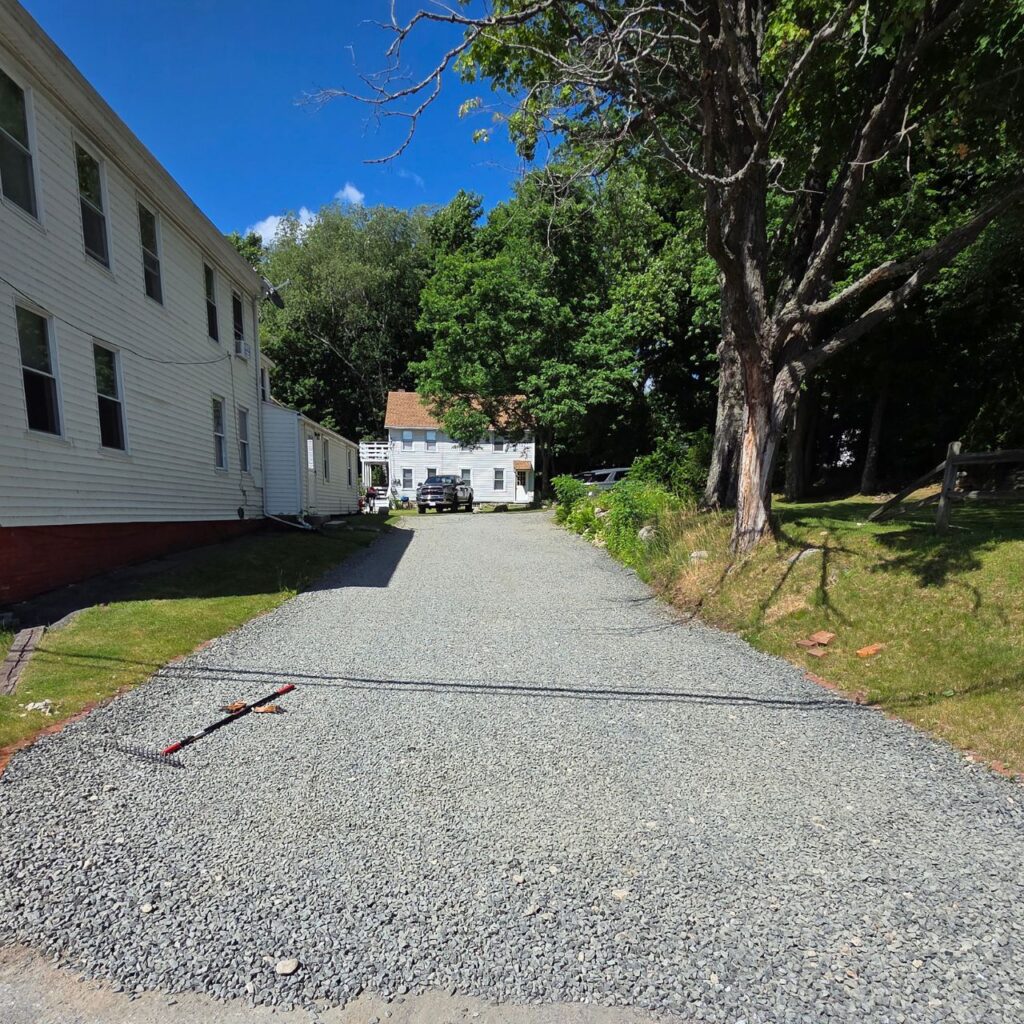
A driveway extension is added gravel surface that makes an existing driveway wider or longer, built on an excavated, compacted stone base so it carries vehicles without rutting, sinking, or pulling away from the original drive. It is the same site work we handle every week through our gravel driveway service in Central Massachusetts, from the first cut in the ground to the final graded surface.
What Is a Driveway Extension, Exactly?
A driveway extension is new driveway surface added onto what you already have. Most of the extensions we build are crushed gravel, because gravel ties cleanly into an existing stone drive and can be shaped to match almost any slope. The work looks simple from the road, yet a lasting result depends on what sits under the stone: excavated subsoil, a compacted base, and a surface pitched to shed water. Skip those steps and the new section ruts, holds puddles, or separates from the original driveway within a season or two.
Whether you are adding a parking spot, a turnaround, or a lane for a second vehicle, the job follows the same core sequence. We strip the topsoil and organic material, dig down to stable ground, lay and compact a process gravel base, then top it with a driving course of crushed stone. To understand how that base is built from the ground up, see our full guide to gravel installation.
Widening Versus Lengthening Your Driveway
Homeowners use the phrase driveway extension for two different jobs, and the distinction changes how we approach the site. Widening adds gravel along the side of the drive, usually to fit two cars abreast, open a door onto solid ground instead of mud, or give delivery and work trucks room to pass. Lengthening pushes the driveway farther back toward a garage, barn, or rear parking area.
Widening is often the trickier of the two, because the new strip has to match the height of the old surface along a long seam while still draining away from it. Lengthening usually follows the existing grade but may run into tree roots, ledge, or a soft low spot that has to be dug out and rebuilt. Either way, the new section is only as good as the ground it sits on, which is why we start with excavation rather than simply dumping stone on the lawn.
Building the Base for a Driveway Extension
The base is where a driveway extension is won or lost. Grass, roots, and topsoil are organic, so they trap water and break down over time. Build over them and the new gravel settles unevenly until the surface fails. Instead we excavate the footprint down to firm subsoil, haul the spoil off site, and start clean.
Into that excavated trench goes a coarse process gravel, spread in lifts and compacted with a plate or roller so it locks together. A well compacted base spreads vehicle weight and gives water somewhere to drain rather than pooling under the surface. The driving course, a finer crushed stone with fines that bind when rolled, goes on top and is graded smooth. Done properly, a driveway extension built this way behaves like the original drive, not like a soft add-on that shifts under the first heavy truck.
On soft or persistently wet ground, we sometimes lay a woven geotextile fabric between the subsoil and the stone. The fabric separates the two layers so the base stone does not migrate down into the mud and disappear, which is a common reason older gravel work seems to swallow load after load of fresh material. Depth matters too. A light footpath needs far less stone than a pad that will hold a loaded dump truck or a camper, so we match base thickness to how the surface will actually be used and to how wet the site tends to get in spring.
Tying New Gravel Into the Existing Surface
The seam between old and new is the part most homeowners never think about, and the part that fails first when the work is rushed. If the addition meets a paved driveway, we cut a clean edge and build the gravel up flush so tires do not drop off a lip. If it meets existing gravel, we scarify the old edge, blend the two bases, and compact across the joint so it reads as one continuous surface.
Matching height matters for drainage as much as for looks. A driveway extension that sits lower than the original collects runoff and ices over in winter; one that sits higher sends water back toward the house or garage. Getting the tie-in flush and correctly pitched is the difference between an addition that disappears into the drive and one that announces itself every time you roll over it.
Grading and Drainage on a Driveway Extension
Every driveway extension needs a plan for where water goes. Adding gravel means adding hard surface, and hard surface sheds water instead of soaking it in. Without a slight, deliberate pitch, that water finds the lowest point, which is often a garage slab, a foundation, or a neighbor’s yard.
We grade the new surface with a gentle crown or cross slope so water runs to the side and away from buildings, then direct it into a swale, a stone-lined channel, or existing drainage. On flatter lots the fix may be as simple as pitching the surface a couple of degrees; on sloped or wet sites it can involve regrading the surrounding ground. When runoff is already a problem, we treat it the same way we do on a dedicated yard drainage project, because an addition that drowns is worse than no addition at all.
Common Reasons Homeowners Add a Driveway Extension
Most calls start with a practical squeeze. A growing family adds a second or third vehicle and the existing driveway can no longer hold them. A boat, camper, or work trailer needs a spot off the street where local rules or an association will not flag it. A tight drive makes backing into traffic nerve-wracking, so a turnaround or wider apron makes leaving safer.
Others are planning ahead. Before pouring a slab or building a garage, homeowners often widen the approach so trucks and equipment can reach the site, which overlaps with the base and access work we cover under gravel driveway installation. Whatever the reason, a gravel driveway extension is usually the quickest way to add usable space without repaving the entire drive.
In Massachusetts, Watch Out for These
A driveway extension involves digging, and in Massachusetts anything that digs starts with Dig Safe. State law requires you to notify the Dig Safe center at 811 at least 72 business hours before excavation, not counting weekends or holidays, so buried gas, electric, and utility lines can be marked. It is free, it is the law, and it protects both the crew and your service lines. The Massachusetts Dig Safe requirement applies to this work exactly as it does to any other dig.
Water is the other consideration. If your property sits near a wetland, stream, pond, or the edge of a flood zone, the work can fall under the Massachusetts Wetlands Protection Act, which regulates activity within 100 feet of a wetland and within 200 feet of many rivers and streams. That often means a filing with your local conservation commission before the first shovel. Finally, extending a driveway toward the street can involve a curb cut or access permit from your town’s highway department. We check these rules in Grafton, Worcester, Shrewsbury, and Northborough while scoping the job, so a driveway extension does not turn into a stop-work order.
Frequently Asked Questions
How long does a driveway extension take in Central Massachusetts?
Most residential gravel additions are excavated, based, and graded in one to three days, depending on size, access, and how much digging the ground needs. Wet or ledge-filled sites in towns like Worcester and Grafton take longer because the base has to be rebuilt properly.
Do I need a permit for a driveway extension?
It depends on where you dig. Dig Safe notification is always required before excavation. A permit may also be needed if the work is near a wetland or ties into the public road. We check the local requirements before starting.
Can you match a new gravel section to my existing driveway in Shrewsbury?
Yes. We scarify and blend the existing edge, match the height along the seam, and compact across the joint so the finished surface reads as one continuous driveway rather than a patch.
Will a gravel addition hold up to plowing and heavy trucks?
A properly based and compacted surface carries the same loads as the original driveway. The key is excavating to firm ground and compacting the process gravel in lifts, not simply spreading stone over grass.
What causes a new gravel section to wash out or rut?
Almost always a skipped or thin base and poor drainage. When gravel is placed over topsoil or the surface is not pitched to shed water, it ruts, puddles, and separates from the old driveway within a season.
If your driveway has run out of room, a gravel driveway extension is one of the simplest upgrades we do. We serve homeowners across Grafton, Worcester, Shrewsbury, Northborough, and the rest of Central Massachusetts, and our estimates are always free. Tell us about your project and we will walk the site with you: request a free estimate.