
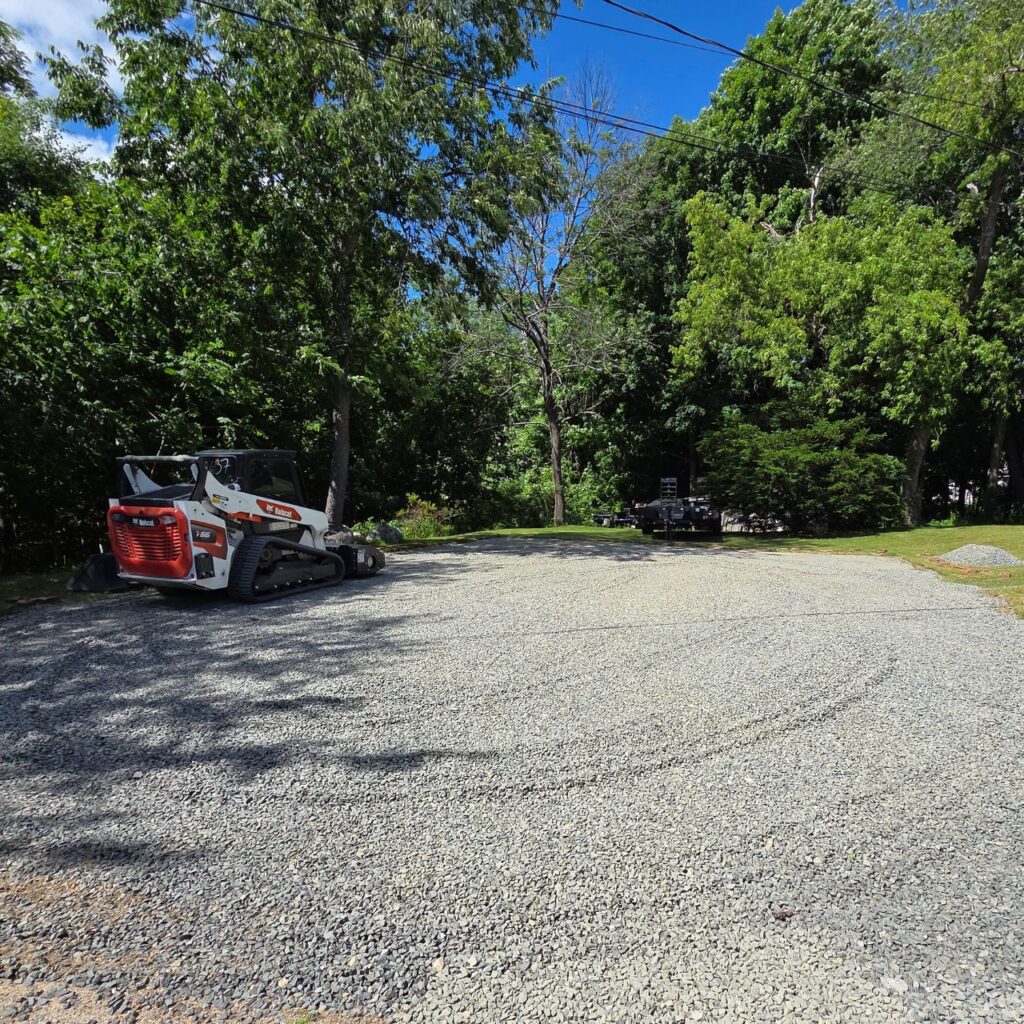
A gravel parking area is a compacted, free-draining surface built from layered crushed stone that gives vehicles a stable, mud-free place to sit without the cost or permitting that pavement demands. It is the same site work we build every season through our gravel installation and driveway service. Done right, a gravel parking area is never a single load of stone dumped on bare dirt. It is a stack of aggregate layers, each doing a specific job, sitting on ground that has been shaped to move water off the surface and away from the property. Get those layers and that shape correct, and the surface stays firm through mud season, frost, and years of vehicle weight.
What Is a Gravel Parking Area, Exactly?
A gravel parking area is a defined, load-bearing surface where vehicles park on compacted stone rather than on pavement or turf. The finished product looks simple, which is exactly why it is so often built wrong. Underneath the top course of stone that you actually see sits a shaped subgrade, a coarse structural base, and often a separation fabric, all working together to spread vehicle loads and shed water. When people say a gravel lot turned to mud or grew potholes within a season, the problem is almost never the surface stone. It is the layers and the grading that no one can see once the job is finished.
A true gravel parking area is engineered for the loads it carries. A pad for two family cars is built differently than an area meant to hold a work trailer, a boat, and a pickup at the same time. The depth of stone, the type of base, and the amount of compaction all scale with the weight and traffic the surface has to handle. That is the difference between real site work and simply spreading gravel across a patch of yard and hoping it holds.
Why a Gravel Parking Area Suits New England Properties
New England ground puts a gravel surface through a hard cycle every year. Water saturates the soil in spring, freezes and lifts it in winter, and bakes it in summer. A properly built surface handles that cycle better than many homeowners expect, because it flexes with the ground instead of cracking the way a rigid slab does. Meltwater drains straight through the stone rather than pooling on top, and small movements from frost settle back out instead of leaving permanent damage.
There is also a practical fit for how properties are used here. Many homes in Central Massachusetts need extra room for a second vehicle, a camper, a landscape trailer, or seasonal equipment, and they need it on ground that was never paved to begin with. A gravel parking area gives that room quickly and shapes to the land, following gentle slopes and odd corners that pavement would fight. For overflow parking, equipment storage, and side-yard pads, it is often the most sensible surface a property can have.
The Base Layers Under a Gravel Parking Area
The strength of any gravel parking area lives in the layers you never see. The work starts by stripping off topsoil, roots, and soft organic material, because that spongy layer holds water and will pump and rut under load no matter how much stone goes on top. Once the subgrade is exposed and shaped, a geotextile separation fabric is often rolled across it. That fabric keeps the underlying soil from migrating up into the stone, which is one of the most common reasons a gravel surface slowly disappears into the mud beneath it.
On top of the fabric goes the structural base, usually a coarse, angular processed gravel that locks together under compaction. This layer carries the weight of the vehicles and distributes it across the subgrade. The angular edges knit into each other, unlike smooth round stone that shifts and spreads. A finer, dense-graded top course is then placed and compacted to create the driving surface. The angular top stone binds tightly, sheds water, and gives tires something firm to grip rather than something loose to scatter.
How deep those layers run depends on the soil and the loads. Firm, sandy ground may need less structural base, while soft or clay-heavy soil needs more depth and sometimes a heavier fabric to stay stable. Skipping the base and laying surface stone straight on dirt is the single fastest way to end up with a rutted, muddy area within a year. The layers below are not an upgrade. They are the parking area.
Grading and Drainage That Keep the Surface Dry
A flat, level parking area sounds ideal, but a truly flat gravel surface is a trap for water. Every gravel parking area needs a deliberate, gentle slope, usually a slight fall across the surface, so that rain and snowmelt run off to a planned edge instead of standing in the low spots. Water that sits will find its way down through the stone, soften the base, and start the slow failure that shows up as ruts and soft patches. Shaping that slope is part of the same drainage and grading work that protects the rest of a property.
Where the water goes once it leaves the surface matters just as much. A well-planned gravel parking area directs runoff toward a swale, a vegetated edge, or a drainage course rather than toward a foundation, a neighbor, or the road. On sloped lots, that may mean cutting into the high side and building up the low side so the finished pad sits level enough to use but still sheds water cleanly. Drainage is not a step that happens after the parking area is built. It is designed into the shape from the first pass of the machine.
Compaction: The Step That Decides Everything
Compaction is where a gravel parking area is either made or quietly ruined. Each layer, from the shaped subgrade to the structural base to the top course, is rolled or plate-compacted before the next goes down. That process drives the air and gaps out of the stone and forces the angular pieces to interlock into a dense mass that behaves almost like a solid slab. Compact properly and the surface barely moves under a loaded truck. Skip it, or try to compact everything in one thick lift at the end, and the stone stays loose, ruts under the first heavy load, and never firms up.
Moisture matters here too. Stone compacts best at the right dampness, which is why good crews watch the weather and sometimes wet the material to help it bind. A gravel parking area built in layers, each one compacted before the next, is the version that stays tight and quiet for years. It is invisible work, and it is the reason two areas that look identical on the surface can behave completely differently under weight.
Edging and Containment
Loose stone wants to travel. Without a defined edge, a gravel parking area slowly spreads outward, thins in the middle, and bleeds into the surrounding lawn and beds until the whole surface loses depth. Containment holds the stone where it belongs. That edge can be a buried timber, a row of set stone, a metal or composite restraint, or a simple graded shoulder that steps down into grass, depending on the look and the budget the property calls for.
Edging also gives the finished area a clean, intentional line rather than a vague gray blur fading into the yard. It keeps the mower off the stone, keeps the stone out of the garden, and makes the parking area read as a built feature instead of an accident. For an area that widens an existing surface, tying the new edge neatly into the old one is the same care we bring to a driveway extension, where the join has to look like it was always there.
Sizing and Layout for Real Vehicles
A parking area only works if the vehicles can actually get in, turn, and get out without a struggle. Sizing starts with what the space needs to hold. A single vehicle wants roughly nine to ten feet of width, and a comfortable two-vehicle pad closer to twenty. Trailers, campers, and work equipment need extra length and, just as importantly, room to swing and back. A pad that fits a truck on paper but leaves no turning room becomes a daily headache the moment it is used.
Layout also accounts for how the parking area connects to the rest of the property. The approach should meet the existing driveway or road at a workable angle, sightlines should stay clear, and the surface should sit where it drains away from buildings. Good layout is the quiet reason a finished pad feels effortless to use, while a poorly planned one has everyone doing three-point turns around the same tight corner every single day.
Maintaining a Gravel Parking Area Over Time
A gravel surface is low maintenance, not no maintenance. Over the years, traffic pushes stone toward the edges, tires carve shallow tracks, and the surface can thin in the paths vehicles use most. The fix is straightforward when it is done on time: a fresh top course raked and compacted back into shape, edges pulled back in, and any low spots that started to hold water regraded before they turn into potholes. Caught early, that upkeep is quick and keeps the base underneath protected.
Left too long, small problems compound. A rut that holds water softens the base beneath it, and once the base fails, the repair is no longer a surface top-up but a rebuild of that section. Keeping runoff moving, refreshing the surface stone every few seasons, and clearing snow with the blade set slightly high so it does not scrape stone away are the habits that let a well-built gravel parking area last for many years with only modest attention.
In Massachusetts, Watch Out for These
Any project that digs, strips, or reshapes ground in Massachusetts starts with a call to Dig Safe. State law requires marking out underground utilities before excavation, and a gravel parking area almost always involves stripping topsoil and cutting grade. You reach the service by dialing 811, and by law the request must be made at least seventy-two business hours in advance, not counting weekends or holidays, so the lines can be located and marked. Skipping that call is both dangerous and illegal. You can read the requirements directly from Dig Safe before any ground is broken.
Wetlands are the other rule that catches people off guard. Adding a compacted, water-shedding parking surface changes how a site drains, and Massachusetts protects the land near wetlands, streams, and other resource areas. Under the Massachusetts Wetlands Protection Act, work within one hundred feet of a wetland typically triggers review by the local conservation commission, and a new gravel parking area inside that buffer usually needs a filing before it begins. On top of that, some towns treat larger new surfaces as impervious area with their own local permitting, so it is always worth a quick check with the town before the machines arrive.
The last thing to watch is the temptation to skip the parts you cannot see. In this climate, an area built without proper base depth, without compaction, or without drainage will look fine for one season and fail in the next. We build every gravel parking area in Grafton, Worcester, Shrewsbury, Northborough, and across Central Massachusetts for the frost and the mud season it actually has to survive, not for the day it is finished. Our estimates are always free, and they start with a look at your soil, your slope, and how you plan to use the space.
Frequently Asked Questions
How long does a gravel parking area last in Central Massachusetts?
A properly built surface can last many years in Central Massachusetts with only occasional top-ups and regrading. The lifespan comes almost entirely from the base and drainage below the surface. An area built with a compacted structural base, separation fabric, and a deliberate slope shrugs off frost and mud season, while one laid straight on topsoil often fails within a single year.
Do I need a permit for a gravel parking area in Massachusetts?
It depends on where and how big. A modest gravel parking area on open ground away from wetlands often needs no state permit, but you must still call Dig Safe at 811 before excavating. If any part of the work falls within one hundred feet of a wetland, stream, or other resource area, the Wetlands Protection Act likely requires a filing with your local conservation commission, and some towns permit larger new surfaces separately.
What is the difference between a gravel parking area and just spreading gravel?
Spreading gravel is a single load of stone dumped on existing ground. It is engineered site work: topsoil is stripped, the subgrade is shaped for drainage, separation fabric and a compacted structural base are installed, and a finish course is compacted on top. The layered, compacted version carries vehicle loads and sheds water; the dumped version turns to ruts and mud.
Will a gravel parking area get muddy or hold water?
A correctly built one will not. Mud and standing water are symptoms of a missing base, missing separation fabric, or a surface graded flat instead of sloped. When topsoil is removed, a compacted stone base is installed, and the surface is pitched to drain to a planned edge, water runs off and through the stone rather than pooling on top or pumping soil up from below.
Can a gravel parking area be built on a slope?
Yes. On sloped lots we cut into the high side and build up the low side so the finished pad sits level enough to park on while still shedding water cleanly. The runoff is directed toward a swale or vegetated edge rather than toward a building or the road. Grading a stable, usable surface out of a slope is routine site work when the drainage is planned from the start.
A gravel parking area is one of the most practical surfaces a Central Massachusetts property can add, and it lives or dies on the work below the stone. If you are weighing a new pad for a second vehicle, a trailer, or overflow parking, we would be glad to walk the site with you. Our estimates are always free, and you can also see how the surface work fits the bigger picture in our guide to gravel installation.